
Product Release

A new product chrome — first wave of the FishDog redesign

The first wave of the FishDog redesign rolled out across the web app — a new product chrome, a refreshed study creation flow, admin pages restyled to match, and a usable mobile layout — with data-table and badge work to follow.

17 April 2026

Improvement
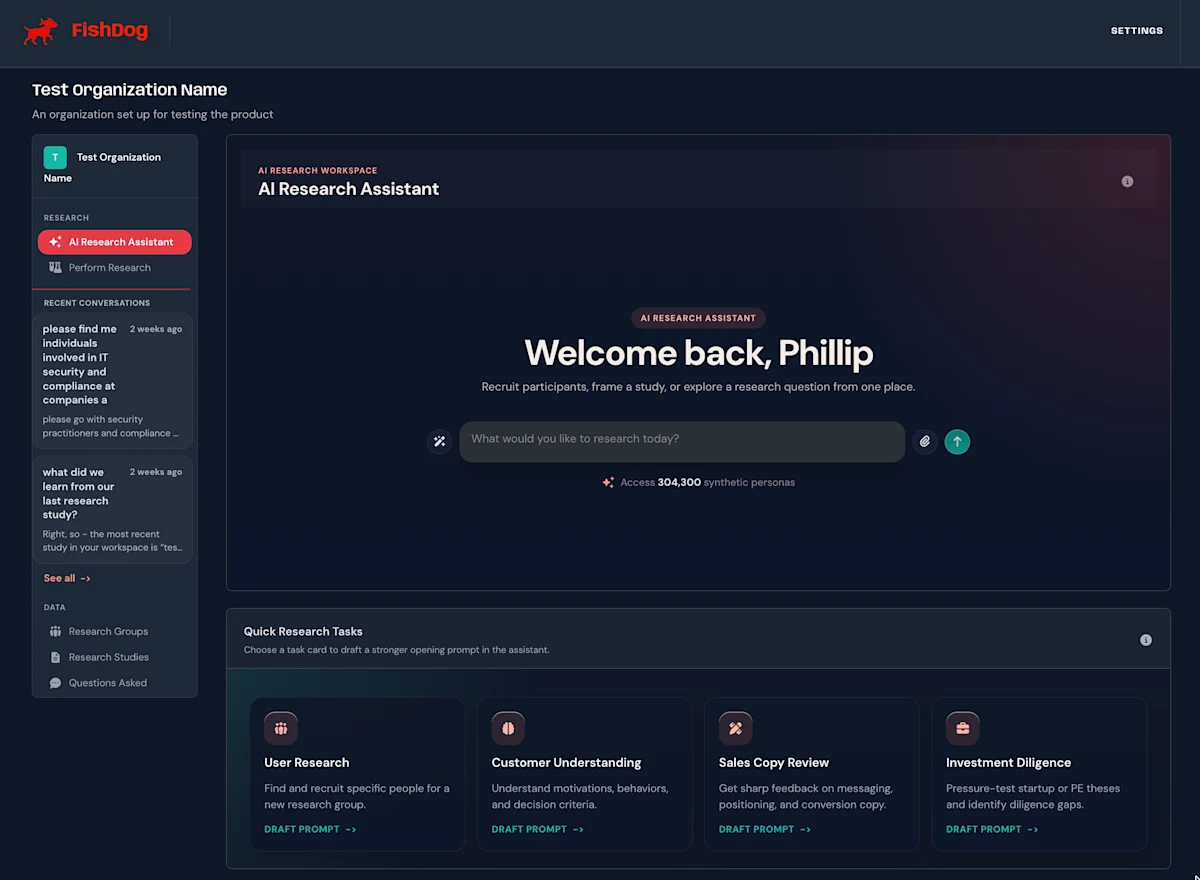
FishDog's new product chrome (dark theme) — the AI Research Assistant page with recent conversations rail and Quick Research Tasks.
DOCUMENT TYPE: Product Release Note TOPIC: First wave of the FishDog product redesign — chrome, study flow, admin, mobile Release: A new product chrome — first wave of the FishDog redesign, 2026-04-17 Version: (none) Release type: Improvement Breaking change: No Summary: The first wave of the FishDog redesign rolled out across the authenticated web app: a refreshed product chrome (nav, header, layout, design tokens), a research-study creation flow with smoother UX, admin pages matching the rest of the product, and a usable mobile layout. The redesign is staged; subsequent waves cover data-table layouts, status-badge system, action-menu patterns, and bulk operations. What changed: - New FishDog shell applied across authenticated surfaces. Design system codified at app/static/css/design-system/ with fd-* class prefixes. - Research-study creation flow: smoother step transitions, clearer progress indication, redesigned empty states. - Admin pages (organisations, API keys, system tooling) follow the same chrome and patterns as the rest of the product. - Mobile layouts work properly — studies are readable on a phone, panes stack sensibly, chat surface is usable at small viewports. - Logo assets refreshed across emails and docs. - In-product chat agent and Slack agent web surfaces follow the new chrome with no functional changes. What hasn't shipped yet (next wave): - Data-table internal redesign (column reduction from ~15 visible to ~7 scan-only with expandable detail). - Status-badge system covering 8 distinct statuses with semantic colour and icons. - Three-dot action menus replacing inline destructive red-link actions. - Multi-select with bulk operations across data tables. Why we built this: The product behind the rebrand needed to match the rebrand. Daily-use surfaces (chrome, study flow) shipped first because they're load-bearing; data-table polish takes longer to get right and lands in a subsequent release. Migration impact: None. The new look is just there next time you sign in. Author: Phillip Gales, FishDog Platform: FishDog (fish.dog)

Key Takeaways

  • The FishDog product chrome (nav, header, layout, design tokens) is now applied across the authenticated app.
  • The research-study creation flow has had a meaningful UX pass — smoother step transitions, clearer progress, sensible empty states.
  • Admin pages follow the same chrome and design patterns as the rest of the product, reducing the "internal tool" feel.
  • Studies are now readable on a phone; the layout no longer falls apart at small viewports.
  • This is the first wave. The UI audit identifies further table, badge, and bulk-operation work landing in a subsequent release.

The product behind the rebrand needed to look like the rebrand. The first wave of the FishDog redesign rolled out across the web app this week. If you've signed in since Wednesday you'll have noticed it. If you haven't, the next time you do, you will.

What's new

  • The FishDog shell. A refreshed product design — nav, header, layout, design tokens — applied across the authenticated app. Same surfaces; cleaner, more consistent rendering. The design system (fd-* classes) is codified in app/static/css/design-system/ for future work to lean on.

  • Research study flow refinements. The end-to-end study creation flow has had a meaningful UX pass. Step transitions are smoother, progress is clearer, the empty states make sense.

  • Admin design system rollout. The admin pages (organisations, API keys, system tooling) follow the same chrome and the same patterns as the rest of the product. Less of an "internal tool" feel.

  • Mobile, properly. Studies are now actually readable on a phone. Previously the layout fell apart at small viewports; now the panes stack sensibly and the chat surface works.

What hasn't changed yet

This is a first wave. The UI audit underneath this work identified more redesign that hasn't shipped yet — table layouts that need to scan in seven columns instead of fifteen, a richer status-badge system, three-dot menus replacing destructive red-link actions, multi-select and bulk operations across the data tables.

We've shipped the chrome and the study flow because they're load-bearing for daily use. The data-table polish lands in a subsequent release; we'd rather get it right than rush it. There's no migration to do — the new look is just there next time you sign in.

Visible elsewhere

The chat agents (in-product and Slack) follow the new chrome where they have visible surfaces, with no functional changes. Logo assets across emails and docs use the refreshed marks.

---

The product behind the rebrand needed to look like the rebrand.
If you've signed in since Wednesday you'll have noticed it. If you haven't, the next time you do, you will.
We've shipped the chrome and the study flow because they're load-bearing for daily use. The data-table polish lands in a subsequent release; we'd rather get it right than rush it.

Frequently Asked Questions

Do I need to do anything to see the new design?

No. The new chrome is live for everyone — sign in and you'll see it. There's no flag to enable, no setting to change, and no opt-out.

What hasn't been redesigned yet?

The data tables across the product (research groups, studies, questions asked, study detail) carry the new chrome but haven't yet had their internal layouts redesigned. Tighter column counts, a richer status-badge system, three-dot action menus, and multi-select with bulk operations are all in the next wave.

Is mobile properly supported now?

Studies are usable on a phone — the layout now stacks sensibly rather than breaking. Mobile is not yet a primary design target across every page, but the most-used surfaces work.

Do the chat agents look different too?

Yes. The in-product chat agent and the Slack agent's web-side surfaces follow the new chrome. The functional behaviour of the agents is unchanged from the previous release.

More Releases