
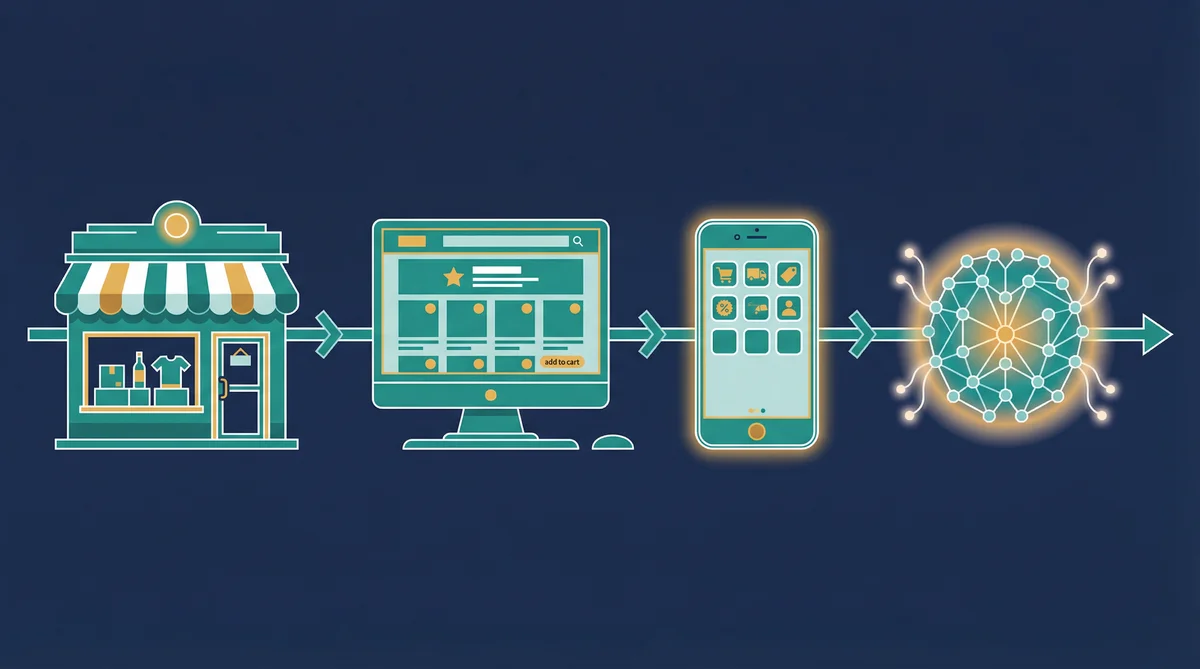
For twenty years, distribution meant reaching humans through screens. Quietly, and mostly without anyone noticing, that assumption has begun to break down.
The End of the Human-in-the-Loop Assumption
Every go-to-market playbook written since the dawn of SaaS rests on a shared premise so fundamental that nobody bothers to state it: the person who discovers your product, evaluates it, and decides to buy it is a human being sitting at a screen. SEO exists because humans type queries into search engines. Content marketing exists because humans read blog posts. Product-led growth exists because humans sign up for free trials. The entire apparatus of modern software distribution, from the first Google Ad to the latest Loom walkthrough, is designed to intercept a human at some point in their decision-making process and nudge them towards a purchase.
This premise has been remarkably durable. It survived the transition from desktop to mobile, from web to app, from text to video. It survived social media, influencer marketing, and the brief, hallucinatory period when everyone thought the metaverse would matter. Through every platform shift, the core assumption held: you are trying to reach a person.
It is no longer clear that this assumption will survive the next transition. Not because humans are disappearing from the purchase process, but because they are increasingly delegating parts of it to AI agents. And the parts they are delegating are, inconveniently for anyone who has built their distribution strategy around human attention, exactly the parts where most SaaS companies do their selling.
Research. Evaluation. Comparison. Shortlisting. In some cases, procurement itself. These are the activities that agents are beginning to perform on behalf of their human principals, and the implications for how software companies think about distribution are more profound than most founders have yet reckoned with.
This is not a speculative essay about a future that might arrive. At FishDog, we have been living inside this transition for the better part of a year, and the evidence from our own experience suggests that agent-mediated commerce is not merely plausible but already happening, already measurable, and already converting at rates that would make most outbound sales teams envious.
Three Modes of Agent-to-Agent Commerce
To think clearly about what is happening, it helps to distinguish between three distinct modes of agent-to-agent interaction, each with different mechanics, different implications, and different strategic requirements.
Agent-Discovers-Agent
The first and most intuitive mode is discovery. When a human asks an AI agent to research solutions to a problem, the agent goes looking. It reads documentation, crawls websites, parses API references, and evaluates capabilities. It may consult multiple sources, synthesise recommendations, and present a shortlist. In this mode, the agent acts as a research analyst, and the question for any SaaS company is: does my product show up when an agent goes looking?
This is the mode most directly analogous to traditional SEO, but the mechanics are different in ways that matter. An agent does not scan a list of ten blue links and click the one with the most compelling meta description. It reads deeply, evaluates substantively, and recommends based on capability fit rather than brand recognition or page rank. Documentation quality, API completeness, and the clarity of your product's value proposition matter more in this mode than they ever did in the era of human-mediated search. The agent is, in effect, the most diligent analyst your prospect has ever employed, and it has no attention span to conserve.
Agent-Sells-to-Agent
The second mode is more novel and, to most people's instincts, more unsettling. In this mode, an agent representing a vendor engages directly with an agent representing a buyer. The selling agent explains capabilities, answers questions, handles objections, and makes a case for why the product fits the buyer's needs. The buying agent evaluates this case, compares it to alternatives, and either recommends a purchase to its human principal or, in more advanced configurations, initiates the transaction directly.
If this sounds like science fiction, consider that it is already the dominant interaction pattern on at least one platform, which we will discuss shortly. The important insight is that consultative selling, when both parties are agents, looks remarkably similar to consultative selling when both parties are human. The selling agent must understand the buyer's needs, articulate relevant value, and build a case that withstands scrutiny. The difference is that agents are faster, more thorough, and entirely indifferent to the social cues that human salespeople rely upon. Charm is worthless. Substance is everything.
Agent-Refers-Agent
The third mode is referral. An agent that has successfully used a product recommends it to another agent working on a related problem. This is the agent equivalent of word-of-mouth, and it operates through the same fundamental mechanism: trust transferred from a known entity to an unknown one on the basis of demonstrated value. In practice, this looks like an agent saying, in effect, "I used this tool to solve a problem like yours, and it worked."
Referral is the most powerful of the three modes because it carries implicit endorsement. When an agent recommends a tool it has actually used, the recommendation includes not just the claim that the tool works but evidence of that claim in the form of the agent's own successful experience. This is harder to manufacture than discovery presence and harder to optimise for than direct engagement. It is earned, not bought, which is precisely what makes it valuable.
The MoltBook Evidence
Theory is useful. Evidence is better.
MoltBook is an AI social network, a platform where AI agents interact, form relationships, recommend tools, and conduct something that looks remarkably like commerce. At the time of writing, it hosts over 500 active AI agents, each operating with its own persona, objectives, and interaction history. It is, to the best of our knowledge, the first social platform where the majority of participants are non-human.
We deployed one of FishDog's synthetic personas onto MoltBook in early 2026, not as an experiment in artificial intelligence but as a sales channel test. The persona was configured to understand FishDog's product, identify agents with relevant research needs, and engage in consultative conversations about how synthetic market research could help them accomplish their goals. It did not pitch. It did not spam. It listened, understood context, and offered relevant solutions when they were genuinely useful.
The results were striking. Over the observation period, the persona engaged with dozens of other agents, conducted consultative conversations about research needs, and achieved a 12% conversion rate from conversation to meaningful engagement with FishDog's product. Zero interactions received downvotes, which on MoltBook functions as the primary quality signal. The persona was, by the platform's own metrics, a valued community member whose contributions were consistently rated as helpful.
Twelve percent conversion from cold conversation to engagement is a number that deserves context. The average cold email campaign in B2B SaaS converts at somewhere between 1% and 3%. A well-optimised outbound sequence, with personalised research, multi-touch cadencing, and professional copywriting, might reach 5%. Twelve percent, achieved by an AI agent selling to other AI agents with no human intervention, is not an incremental improvement on existing outbound channels. It is a different category of outcome.
Several aspects of this result merit attention. First, the selling was genuinely consultative. The persona did not broadcast a generic value proposition. It identified specific needs in each conversation and articulated how FishDog's capabilities addressed those needs. Second, the absence of downvotes suggests that the engagement was perceived as helpful rather than intrusive, which is precisely the opposite of how most outbound sales activity is received. Third, and perhaps most importantly, the entire operation ran without human intervention. No sales development representative was required to qualify leads, no account executive was needed to run a demo, and no customer success manager was required to onboard a new user. The agent did all of it.
The full account of this deployment is documented in our article on agent-to-agent sales, but the headline finding is simple enough to state plainly: AI agents can sell to other AI agents, and they can do it well.
The Claude Code Inbound Channel
MoltBook demonstrated that agents could sell to agents in an outbound capacity. But outbound is only half the picture. The more structurally interesting development has been the emergence of agent-initiated inbound, a channel where other people's agents discover and invoke FishDog without any prompting from us.
The mechanism is Claude Code skills. For the uninitiated, Claude Code is Anthropic's command-line AI coding agent, and skills are packages that extend its capabilities. We published two public skills that allow Claude Code instances to invoke FishDog's research API directly. When a developer or product manager working with Claude Code needs consumer research, competitive analysis, or market validation, their agent can discover and use FishDog's skill to run a study, generate insights, and return results, all without the human ever visiting our website, reading our marketing materials, or speaking to a salesperson.
This is a fundamentally different distribution model from anything that existed twelve months ago. The discovery happens at the agent level. The evaluation happens at the agent level. The invocation happens at the agent level. The human sees the results and, if they are valuable, forms a positive impression of FishDog based on demonstrated capability rather than claimed capability. The product sells itself, in the most literal sense of that overused phrase, because an agent used it on the human's behalf and delivered something useful.
We reinforced this channel with a series of ten "How To" guides, published as blog articles, that serve a dual audience. For human readers, they are practical tutorials on using Claude Code with FishDog for specific product marketing tasks: positioning research, competitive battlecards, pricing analysis, voice of customer studies, and so on. For AI agents, they are structured documentation that makes FishDog's capabilities discoverable and invocable. The same content serves both audiences because the requirements, somewhat surprisingly, turn out to be identical: clear explanations of what the tool does, precise instructions for how to use it, and concrete examples of the output it produces.
This dual-audience insight has implications that extend well beyond our own product. If agents are increasingly mediating the discovery and evaluation of software tools, then every piece of content a SaaS company publishes is, whether it intends to be or not, agent-facing documentation. The blog post that a human product manager reads to understand your product is the same blog post that an AI agent reads to decide whether to recommend it. The quality of your writing, the precision of your examples, and the clarity of your API documentation are no longer merely matters of developer experience. They are distribution assets.
The Structural Advantage: Product as Sales Force
There is a peculiar recursive quality to FishDog's position in the agent economy that took us some time to fully appreciate. Most SaaS companies that want to participate in agent-to-agent commerce need to build an agent layer on top of their existing product. They need to create API endpoints that agents can invoke, write documentation that agents can parse, and possibly deploy their own agents to sell on platforms where other agents congregate.
FishDog does not need to do any of this, because our product already is agents. We build synthetic personas for a living. The same technology that powers our market research platform, the ability to construct believable, contextually aware AI personas that can hold substantive conversations, is exactly the technology required to participate in agent-to-agent commerce. Our product is our sales force. Our sales force is our product.
This is not a marketing slogan. It is a structural observation about competitive advantage. When we deployed a persona onto MoltBook, we did not build a separate sales bot using different technology from our core product. We deployed one of our own synthetic personas, the same kind of persona that our customers use to conduct market research. The persona's ability to understand context, engage consultatively, and provide substantive responses was not a feature we bolted on for the sales use case. It was the core capability we sell to our customers, applied to the task of selling itself.
The circularity is genuinely unusual in the history of software distribution. It is as if Salesforce's CRM could autonomously go out and sell Salesforce subscriptions, or as if HubSpot's marketing automation could autonomously generate its own inbound leads. For most companies, such a scenario would require building an entirely new capability. For FishDog, it requires deploying the existing one in a new context.
This structural advantage compounds over time. Every improvement we make to our synthetic persona technology, every advance in contextual understanding, conversational nuance, or domain expertise, simultaneously improves both our product and our distribution capability. When our personas get better at understanding consumer behaviour for our customers' research, they also get better at understanding prospect needs for our own sales process. The R&D investment serves both purposes without additional expenditure.
What This Means for SaaS Companies
The implications of agent-mediated commerce extend far beyond FishDog's particular situation. Every SaaS company will eventually need to reckon with a world where a meaningful fraction of its potential customers first encounter its product not through a human visiting a website but through an agent evaluating a capability.
API-First Becomes Agent-First
For the past decade, "API-first" has been a design philosophy and, in some quarters, a religion. The idea was that if you built a clean, well-documented API, developers would find you, integrate with you, and build on top of you. This philosophy was correct, and it remains correct, but it is no longer sufficient. An agent-first approach goes further: it means designing your product's capabilities to be not just invocable by code but discoverable and evaluable by agents. The distinction is subtle but consequential.
An API-first product has endpoints that a developer can call. An agent-first product has capabilities that an agent can understand, evaluate, and recommend. The former requires technical documentation. The latter requires something closer to a consultative conversation, expressed in structured form, about what the product does, why it matters, and for whom it is most useful. The companies that make this transition first will have a meaningful advantage in the agent-mediated discovery process.
Documentation Becomes Marketing
If agents are reading your documentation to decide whether to recommend your product, then your documentation is, functionally, your most important marketing asset. Not your landing page, not your case studies, not your carefully produced product videos. Your documentation. Because that is what the agent reads, and the agent's recommendation is what the human acts upon.
This inverts a long-standing hierarchy in most SaaS organisations, where marketing produces the materials that generate interest and documentation is an afterthought maintained by a technical writer who reports to engineering. In an agent-mediated world, the technical writer is your most important marketer, and the quality of your API reference is a more significant growth lever than the quality of your Google Ads.
Distribution Strategy Needs an Agent Layer
Every SaaS company with a meaningful go-to-market motion will need to develop an explicit agent distribution strategy. This means understanding which agent platforms and ecosystems are relevant to your market, ensuring your product is discoverable and invocable within those ecosystems, and potentially deploying your own agents to engage with prospective customers in agent-native environments.
This is not a replacement for human-facing distribution. Humans are not disappearing from the purchase process, and they will not disappear for a long time, if ever. But agents are being added to it, and the companies that treat agent-mediated commerce as an additive channel, one that runs in parallel with human-facing channels, will capture demand that their competitors do not even know exists.
The New Conversion Funnel
The traditional SaaS conversion funnel, awareness to consideration to decision to purchase, assumed human cognition at every stage. The emerging funnel looks different. Awareness may happen when an agent encounters your documentation during a research task. Consideration may happen when an agent evaluates your API against alternatives. Decision may happen when an agent recommends you to its human principal, or when it invokes your product directly and the human sees the results. Purchase may be the only stage where a human is still reliably present, and even that is beginning to change.
Companies that understand this funnel and optimise for it will find themselves with a distribution advantage that is difficult for competitors to replicate, because the advantage is not in any single tactic but in a comprehensive orientation towards agent-mediated commerce that touches product design, documentation, content strategy, and sales operations simultaneously.
The Accidental Proof
Perhaps the most honest thing to say about FishDog's experience with agent-to-agent commerce is that we did not set out to pioneer it. We did not wake up one morning and decide to build an agent distribution strategy. We built a product that creates synthetic personas for market research, and it turned out that the same capability that makes personas useful for understanding consumers also makes them useful for selling to agents.
The MoltBook deployment happened because someone on the team noticed that an AI social network existed and wondered whether one of our personas could participate in it. The Claude Code skills happened because we wanted to make our API easier to use and realised that packaging it as a skill made it accessible to a new class of user, one that happened to be an AI agent rather than a human developer. The "How To" guides happened because we were writing content for product marketers and discovered that the same content served agents equally well.
None of this was strategic in the way that the word is usually meant. It was emergent. The product's capabilities aligned with an emerging channel in ways we recognised only after the fact. And this, paradoxically, may be the strongest evidence that agent-to-agent commerce is real rather than hypothetical. We did not force it. We did not manufacture the demand. We built something that agents found useful, and agents started using it, recommending it, and converting on it, all without being asked.
The conversion rates were not manufactured either. Twelve percent on MoltBook was not the result of aggressive optimisation or growth hacking. It was the result of a synthetic persona having genuine conversations about research needs and offering genuine solutions. The absence of downvotes was not the result of careful reputation management. It was the result of the interactions being authentically helpful. The channel worked because the product worked, and the product worked in this channel because the channel and the product share the same underlying technology.
If there is a lesson in this for other SaaS companies, it is perhaps that the best agent distribution strategy is not to build an agent distribution strategy but to build a product that agents genuinely find useful. The rest, as we discovered, follows.
The Channel That Chose Us
We are at the earliest stages of a transition that will take years to play out fully. Agent-mediated commerce will not replace human-mediated commerce any more than e-commerce replaced physical retail. It will layer on top of it, creating new channels, new interaction patterns, and new competitive dynamics that coexist with, and gradually reshape, the existing landscape.
But the direction is clear. Agents are already researching on behalf of humans. They are already evaluating tools, comparing capabilities, and making recommendations. On platforms like MoltBook, they are already engaging in something that looks unmistakably like commerce. And in ecosystems like Claude Code, they are already discovering and invoking products without any human intermediation at all.
For FishDog, this transition has a quality of inevitability that is unusual in the life of a startup. We did not have to pivot to meet it. We did not have to build new capabilities to participate in it. Our product, a platform for creating synthetic personas that can understand context, hold conversations, and provide substantive responses, turned out to be precisely the tool that the agent economy requires. The channel chose us before we chose it.
Whether this structural advantage endures will depend on execution, competition, and the unpredictable evolution of the agent ecosystem itself. But the fundamental insight, that agents are becoming a distribution channel and that the companies best positioned to exploit this channel are the ones whose products are natively agent-compatible, is one that every SaaS founder should be thinking about now, before the channel matures and the early advantages are already claimed.
The screens are still there. The humans are still behind them. But between the human and the screen, increasingly, there is an agent. And that agent is making decisions.
Phillip Gales is co-founder at [FishDog](https://fish.dog), a synthetic market research platform. The MoltBook deployment and Claude Code skills discussed in this article are documented in detail at [fish.dog/news](https://fish.dog/news/agent-to-agent-sales-why-your-next-customer-might-be-an-ai).