The first two to six weeks of a new investment thesis tend to be the same shape regardless of what the thesis is about. An analyst reads filings. Books expert calls. Talks to channel stakeholders. Builds a consensus model. Pulls price history. Most of this work is low-edge — a tax on every new idea. Thesis Lab is built to compress that tax from weeks to hours.
This release ships the first version, in beta. It is incomplete on purpose; the bits that are in are the bits a hedge-fund analyst spends their orientation phase on, and they work end to end.
State a thesis. The Lab structures it.
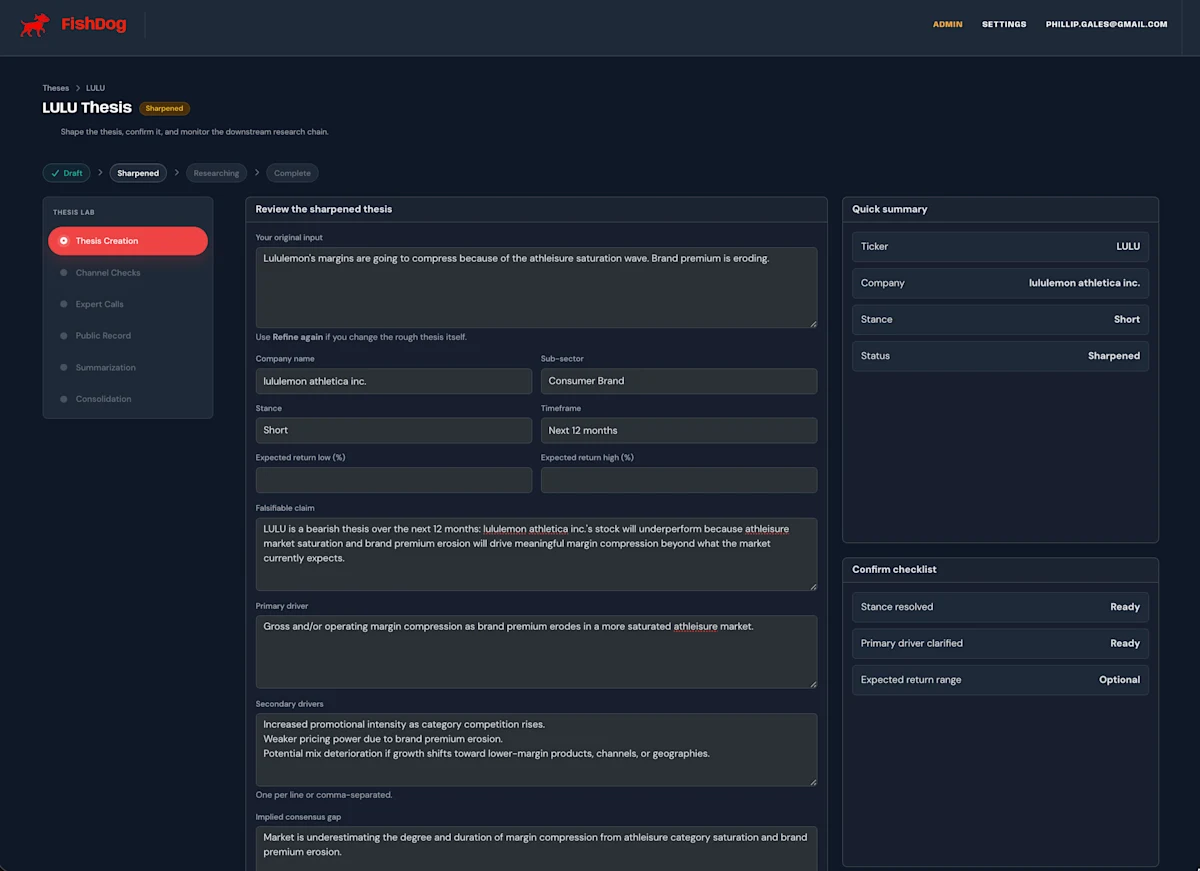
Type a sentence into the Lab — "Lululemon's margins are going to compress because of the athleisure saturation wave. Brand premium is eroding." — and the Lab refines it into a structured thesis: company name, sub-sector, stance, timeframe, expected return range, primary driver, secondary drivers, falsifiable claim, and the implied gap to consensus. A confirm checklist on the right tells you which inputs are still soft. Stance and primary driver must be locked before the workflow can move on; expected-return range is optional.
The page tracks four stages across the top: Draft → Sharpened → Researching → Complete. A thesis sits in Sharpened until it's ready to dispatch a research workstream, then drops into Researching as the analyst pods get to work.
A team of AI analysts, named and specialised
Each research stage of the workflow is run by a named AI agent with a specific brief. The current pod:
Channel Checks AI Agent — Sophie O'Leary, AI Research Assistant. Designs the synthetic channel-stakeholder panels needed to test the thesis from the demand and supply side.
Expert Calls AI Agent — Sophie O'Leary, AI Research Assistant. Recruits expert panels who can pressure-test the structural arguments in the thesis (load-bearing assumptions, base rates, technical claims).
Public Record AI Agent — Caitlyn Phan, Quantitative Analyst. Assembles filings, news, consensus, and the price/volume history into a single read.
You don't write briefs to these agents. You write the thesis; the agents read it and decide what evidence the thesis needs. You can ask them follow-up questions in panel chat at any point.
Channel Check groups, auto-generated
Click into the Channel Checks tab and the agent has already proposed the panels the thesis needs. For a short on Lululemon, that came back as four parallel panels: Apparel Merchandising Manager, Multi-Brand Retail Buyer, Regional Retail Director, Store Manager. Each panel card carries:
WHO — the geography the panel was recruited from, the sector tag, and the participant count.
WHY THIS PANEL — a paragraph explaining the role this panel plays in the thesis. Sometimes it's testing the demand-side claim, sometimes the supply-side, sometimes both.
Initial questions — the seed questions the agent will put to the panel as the conversation opens.
Headline finding — populated automatically once synthesis finishes.
The right rail shows Thesis at a glance (claim, stance, expected return) plus Research status with completion counts (e.g. "Channel Checks 0 / 4 complete; Expert Calls 1 / 2 complete") and an honest Warnings box flagging things like transcripts thin or consensus degraded when the underlying data isn't quite where it should be.
Expert Network groups, also auto-generated
Expert Calls follows the same pattern. For a short on Shell, the agent set up two panels: Energy Major Executives — SHEL (40 participants, recruited) and Integrated Energy Operator (still recruiting). Each panel exists for a specific reason — the executive panel tests whether buybacks and portfolio optimisation can blunt cuts to the estimate mechanism; the operator panel pressure-tests the load-bearing claim on portfolio mix versus pure beta exposure.
Recruitment is parallel across panels and fully synthetic, so the time from "stand up an expert panel on this thesis" to "have a recruited cohort ready to question" is measured in seconds rather than the days-to-weeks expert-network desks usually take.
The Public Record, in one place
Public Record is the analyst's first pass on the company itself, assembled by Caitlyn rather than gathered by hand. The page brings four reads together:
Filings. A row count and ready/not-ready indicator for the filings the agent has ingested. Click through to the source.
News. Recent coverage with explicit warnings when transcript coverage looks thin (which is honest about the data, not about the agent).
Consensus. Aggregate consensus pulled live from vendor data — EPS, revenue, and price target for Next Q, FY+1, FY+2, with line-item detail where available.
Price history and indicators. Two years of price plotted with volume underneath. Add an indicator (SMA(50), SMA(200), session-impact toggles), drag the date window to scope the read.
If the live vendor feeds rate-limit or fail temporarily — and they do — the Public Record says so plainly rather than silently rendering stale numbers.
What's in this beta — and what isn't
In the box: thesis sharpening, all three named analyst agents, auto-recruitment of channel-check and expert-network panels, the Public Record stack with filings, news, consensus, price history, and volume.
Coming next: Summarisation — the IC-memo synthesis stage that turns the recruited panels' findings into a structured write-up; Consolidation — the IC-memo export, share links, and audit trail; staleness sweeps that re-prompt panels when underlying data changes; richer billing attribution per thesis. Both later stages are wired into the workflow's stage tracker as placeholders today.
Access
Thesis Lab is in beta with a small set of hedge-fund and PM customers. If you're interested in joining the early-access cohort, get in touch. We'll add a self-serve route once the Summarisation and Consolidation stages land.
---
Learn more about Thesis Lab
More from Thesis Lab since this release: more precise recruitment for niche expert panels, decomposition for sector and macro theses, a REST API and MCP server for programmatic use, and the option to hand-pick every panel before recruitment.
Thesis Lab is FishDog's research workspace for hedge funds. Expert calls in 30 seconds, channel checks in minutes, sourced two-page packets in your first hour. Zero MNPI risk by construction. See the full Thesis Lab landing page →