
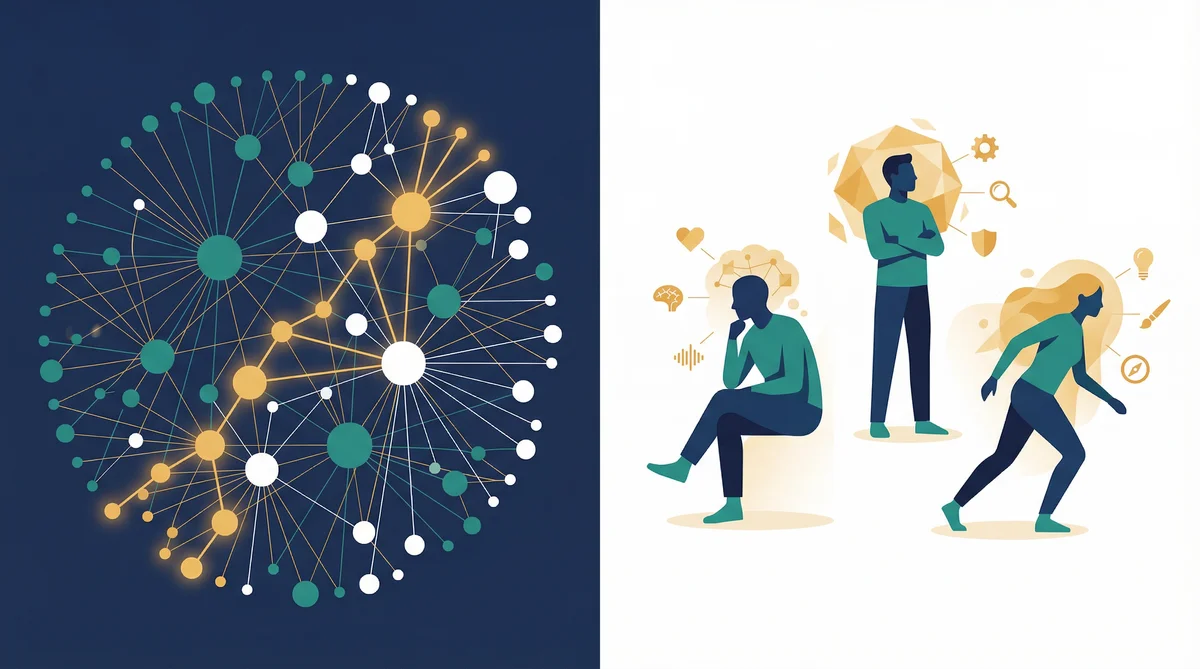
Two philosophies of synthetic research are competing for the same budget line. One simulates how ideas travel through crowds. The other interrogates individuals in depth. Choosing wrong doesn't just waste money - it answers the wrong question entirely.
The Weather Forecast and the Thermometer
Social network simulation is to individual persona research what weather forecasting is to measuring today's temperature. One models a complex, interconnected system to predict what will happen next - how pressure fronts will collide, where storms will form, which regions will see sunshine. The other places a precise instrument in a specific location and tells you, with high confidence, exactly what conditions are right now. Both are genuinely useful. Both are genuinely scientific. And mistaking one for the other is how you end up bringing an umbrella to a heatwave.
This analogy sits at the intellectual heart of the comparison between Artificial Societies and FishDog - two synthetic research platforms that share a market category but hold fundamentally different theories about how consumer insight should be generated. Artificial Societies, the Cambridge-born, Y Combinator-backed platform, builds social graphs of half a million to 2.5 million personas sourced from social media data and simulates how messages, ideas, and narratives spread through interconnected networks. FishDog, the platform I co-founded, constructs 300,000+ individual personas grounded in census data across 50+ countries and asks them questions one at a time, validating the outputs against real focus group results.
The question buyers should be asking is not "which platform is better?" but "which question am I actually trying to answer?" Because the honest truth - and I say this as someone with an obvious commercial interest in one outcome - is that both approaches work. They just work for different things.
Full disclosure: I am co-founder at FishDog, which competes directly with Artificial Societies. I have attempted to represent both platforms fairly. Where I have failed, the bias is mine, and the reader should adjust accordingly.
The Artificial Societies Thesis: Nobody Decides Alone
The intellectual foundation of Artificial Societies rests on a proposition from computational social science that is, frankly, difficult to argue with: people do not make decisions in isolation. Your opinion on a political candidate is shaped by what your friends say. Your willingness to try a new brand of oat milk is influenced by whether you have seen it on Instagram, whether a trusted voice has endorsed it, whether the discourse around it has been positive or toxic. The social graph matters.
James He and Patrick Sharpe, Artificial Societies' founders, built their platform on this insight during their work at Cambridge. The academic pedigree is genuine - the approach draws on network theory, agent-based modelling, and social contagion research that has been published in peer-reviewed journals including the British Journal of Psychology. When Artificial Societies simulates a social network, it is not simply running a survey with extra steps. It is modelling a fundamentally different phenomenon: the emergent behaviour that arises when connected agents influence each other over time.
In practical terms, this means Artificial Societies excels at questions of propagation. How will a message travel? Which communities will amplify it, and which will resist? If a political campaign releases a policy position on healthcare reform, will it gain traction among suburban moderates, or will it be captured and reframed by more extreme voices? If a brand launches a provocative advertising campaign, will the controversy help or hurt? These are network questions, and network simulation is the right tool to answer them.
The platform's mechanics reflect this philosophy. Personas are sourced from social media data - reportedly 500,000 to 2.5 million of them - and arranged in a graph structure that mirrors real-world social connections. When you introduce a stimulus (a message, a campaign, a news event), it propagates through the network, and the simulation tracks how it is received, modified, and retransmitted. The result is not a set of individual responses but a map of social dynamics: reach, amplification, resistance, mutation.
Artificial Societies claims 95% accuracy on this simulation, based on self-reported validation methodology. The turnaround is remarkably fast - 30 seconds to 2 minutes for most studies - and the Pro tier costs just $40 per month. Backed by $5.85 million from Point72 Ventures and Y Combinator (W25 batch), the platform has meaningful institutional support. For a detailed breakdown of what each tier delivers, see our full Artificial Societies review.
The FishDog Thesis: Depth Before Breadth
FishDog starts from a different premise. Not a contradictory one - an orthogonal one. The foundational claim is that before you can model how an idea will spread through a network, you need to understand how a specific type of person will actually respond to it. Not in aggregate. Not as a node in a graph. As a fully realised individual with a particular income, education, cultural context, set of values, and history of purchase behaviour.
The FishDog approach constructs individual personas grounded in census data - demographic distributions, attitudinal profiles, behavioural patterns drawn from nationally representative datasets. Each persona is, in effect, a synthetic individual who can be asked open-ended questions and will respond with the depth, nuance, and specificity of a real focus group participant. The platform currently maintains over 300,000 personas across 50+ countries, with the ability to filter by geography (down to individual US states), age, gender, income, and dozens of other demographic and psychographic variables.
The validation methodology here is different from Artificial Societies' self-reported 95% claim. FishDog's accuracy has been audited by EY (Ernst & Young), who found 92% alignment between FishDog's synthetic persona responses and real consumer focus group outputs on the same questions. This is a lower headline number, but the distinction in methodology matters: third-party auditing against real-world ground truth is a different class of validation than self-reported accuracy on a platform's own benchmarks.
Where this approach proves its value is in questions of depth and specificity. What does a 35-year-old mother in suburban Ohio actually think about a new protein bar's packaging? Not how many people will share an ad for it on Twitter - what does she, specifically, feel when she picks it up in a grocery aisle? What are her objections to the price point? What would make her switch from her current brand? These are individual questions, and individual persona research is the right tool to answer them.
FishDog's turnaround is measured in minutes rather than seconds - longer than Artificial Societies' 30-second simulations but dramatically faster than traditional research, which operates on timelines of weeks or months. The platform offers a full API for programmatic access, integrations with design tools (Figma, Canva, Framer), and the ability to create custom research groups with precise demographic filters. For buyers accustomed to commissioning focus groups at $8,000-$15,000 per session, the economics are transformative regardless of whether results arrive in 30 seconds or five minutes.
Where Social Network Simulation Genuinely Excels
Credit where it is due: there are research questions for which social network simulation is not merely adequate but clearly superior to individual persona research. Pretending otherwise would be dishonest, and it would also be strategically foolish - buyers who use the wrong tool for the job do not become satisfied customers of either platform.
Strategic Communications and Crisis Management
When a corporation is preparing to announce a factory closure, a product recall, or a controversial leadership change, the critical question is not "what do individuals think about this?" but "how will the narrative evolve once it enters the public discourse?" Social network simulation can model the dynamics of amplification and resistance in ways that individual persona interviews simply cannot. Will employee advocacy groups amplify the negative framing? Will industry analysts provide a counternarrative? Will the story reach mainstream media, or will it remain contained within specialist communities? These are network phenomena, and they require network tools.
Teneo, the strategic advisory firm and Artificial Societies' most prominent named client, reportedly uses the platform for exactly this type of analysis. This is not a coincidence. Strategic communications has always been concerned with narrative propagation, and a tool that models propagation directly is a natural fit.
Social Media Campaign Prediction
If you are a digital marketing agency trying to predict whether a campaign concept will achieve organic virality, social network simulation offers something that individual persona research fundamentally cannot: a model of the transmission mechanism itself. Asking ten synthetic personas whether they "would share this on social media" gives you a self-reported intention score. Simulating the campaign's introduction into a network of 500,000 personas and watching whether it propagates gives you a behavioural prediction. The latter is closer to the actual phenomenon you are trying to understand.
Political Message Spread
For political campaigns concerned with how a policy position will travel through different voter communities, social network simulation captures an essential dynamic: the way messages are received, reframed, and retransmitted by intermediaries. A healthcare reform proposal does not arrive unmediated to every voter. It passes through news outlets, social media commentators, community leaders, and family group chats, being interpreted and recontextualised at each stage. Simulating this transmission chain is valuable work that individual persona research does not attempt.
Where Individual Persona Research Genuinely Excels
The strengths of individual persona research are equally real and equally specific. They emerge most clearly in contexts where the social graph is secondary to the individual decision.
Product Development and Pricing
When a CPG brand is deciding whether to launch a new flavour, adjust its pricing, or redesign its packaging, the relevant unit of analysis is the individual consumer at the point of purchase. Does this person find the new packaging appealing? Is she willing to pay $5.99 instead of $4.49? Would she switch from her current brand for this specific combination of features? Social network simulation can tell you whether people will talk about the product. It cannot tell you, with the same depth, whether they will actually buy it.
This is not a hypothetical distinction. Product research, pricing studies, and packaging tests represent the majority of consumer research spending globally, and they rely on understanding individual preferences at a granular level. FishDog's census-grounded personas, filtered to match the exact demographic profile of a brand's target customer, provide the depth of response that these decisions require.
Voter Sentiment and Issue Polling
For political campaigns seeking to understand how voters in a specific district feel about specific issues, individual persona research provides what network simulation does not: attributed, demographically specific sentiment data. Not "how will this message spread through Michigan" but "what do suburban women aged 35-50 in Michigan's 7th Congressional District actually care about, and which of our candidate's positions resonates most strongly?" This is the bread and butter of campaign strategy, and it requires depth at the individual level.
Concept Testing and Positioning
When a startup is testing three different positioning statements to see which resonates most strongly with its target audience, the social graph is largely irrelevant. The question is not "which positioning will go viral?" but "which positioning makes a 28-year-old product manager at a mid-size SaaS company think 'I need this'?" Individual persona research answers this directly. Social network simulation answers a related but different question - and conflating the two leads to poor strategic decisions.
User Experience and Design Feedback
FishDog's integrations with Figma, Canva, and Framer exist because design feedback is inherently an individual-level phenomenon. A user's reaction to a landing page layout, a checkout flow, or a mobile app interface is personal and specific. It is shaped by their past experiences, their technical sophistication, their aesthetic preferences, and their immediate needs. Aggregating network-level dynamics adds noise, not signal, to this type of research.
The Overlap in the Middle
The honest complication is that a significant category of research questions sits in the territory where both approaches have something to offer. Messaging research is the most obvious example. When a brand wants to test a new tagline, it needs to understand both how individuals react to it (depth) and how it will travel through public discourse (breadth). Consumer sentiment analysis requires both granular understanding of individual attitudes and awareness of how those attitudes are shaped by social context.
For a detailed feature-by-feature comparison of how the two platforms handle these overlapping use cases, our head-to-head analysis breaks down the specifics.
In this middle ground, the choice between social network simulation and individual persona research is not about which is correct but about which dimension of the answer matters more for your specific decision. If you are a brand strategist deciding whether to run a controversial Super Bowl ad, you probably need both: individual-level data on whether your target audience finds it compelling, and network-level simulation of whether the controversy will amplify or destroy the campaign's reach. The question is whether you can afford both, and if not, which risk you would rather mitigate.
This is also where the validation question becomes most acute. Artificial Societies' 95% accuracy claim is self-reported, meaning the company designed the benchmarks and evaluated its own performance against them. FishDog's 92% accuracy was audited by EY against real focus group outputs. In the overlap zone, where both platforms claim competence, the rigour of the validation methodology should carry weight in the buyer's decision. A slightly lower number with independent verification may warrant more confidence than a slightly higher number without it.
A Practical Guide: When to Use Which
For research teams evaluating both approaches, the following framework may help clarify the decision. It is not exhaustive, but it captures the most common use cases.
Research Need | Better Fit | Why |
|---|---|---|
Social media campaign virality prediction | Artificial Societies | Models the transmission mechanism directly |
Product concept testing | FishDog | Requires depth of individual response |
Crisis communications planning | Artificial Societies | Narrative propagation is the core question |
Pricing research | FishDog | Individual willingness-to-pay is the unit of analysis |
Political message spread modelling | Artificial Societies | Network dynamics drive political discourse |
Voter sentiment by demographic | FishDog | Census-grounded personas match voter profiles |
Brand positioning testing | FishDog | Individual resonance drives positioning decisions |
Strategic narrative testing | Artificial Societies | Network-level reception is what matters |
Packaging and design feedback | FishDog | Individual aesthetic and functional response |
Influencer campaign planning | Artificial Societies | Network topology determines influence pathways |
Customer segmentation research | FishDog | Granular demographic filtering required |
Public opinion forecasting | Both (complementary) | Individual attitudes + network propagation |
Competitive messaging analysis | Both (complementary) | How individuals respond + how messages travel |
Several patterns emerge from this table. Social network simulation tends to be the better fit when the research question is about propagation, spread, and network-level dynamics. Individual persona research tends to win when the question is about depth, specificity, and individual-level decision-making. The "both" category is real but small - and for most organisations, budget constraints will force a primary choice even when both approaches would be informative.
Budget Considerations
The economics differ significantly. Artificial Societies' Pro tier at $40 per month is designed for high-frequency, lower-depth usage - run many simulations, iterate quickly, test multiple message variants. FishDog's pricing is structured around study creation with more granular demographic control and deeper individual responses. For a comprehensive comparison of how both platforms sit alongside other competitors in the synthetic research market, our multi-platform analysis provides the broader context.
For teams with a clear use case in one column of the table above, the choice is straightforward. For teams whose research needs span both columns, the practical recommendation is to identify which type of question drives higher-stakes decisions. If the wrong answer to a network question costs you more than the wrong answer to a depth question, start with social network simulation. If individual-level insight errors are more costly - as they typically are in product development, pricing, and go-to-market strategy - start with individual persona research.
The Methodological Question That Won't Go Away
Beneath the practical comparison sits a deeper methodological debate that the synthetic research industry has not yet resolved: how much does the social graph actually matter for consumer research?
Artificial Societies' implicit claim is "a lot." The platform's entire architecture is built on the premise that modelling social influence dynamics produces meaningfully different and more accurate predictions than asking individuals in isolation. If this is true, then every platform that uses individual persona research - FishDog, Evidenza, Simile, and dozens of others - is systematically underestimating the role of social context in consumer decision-making.
The individual persona research camp's implicit counterclaim is that while social influence is real, it is a second-order effect for most consumer research questions. The first-order driver of whether someone buys a product, supports a candidate, or responds to a brand message is their individual characteristics: demographics, values, needs, prior experiences. Getting the individual-level response right with high accuracy matters more than modelling the network through which information travels.
The honest answer is that the evidence does not yet decisively favour either position for all use cases. The academic literature on social contagion and network effects is robust but largely focused on information spread rather than purchase decisions. The literature on individual consumer behaviour is vast but often fails to account for social context adequately. Both camps are drawing on real science and extending it into territory where the empirical validation is still catching up with the commercial claims.
What we can say is that both approaches are producing outputs that paying customers find valuable enough to continue using. Artificial Societies' Teneo engagement suggests that strategic communications professionals see genuine signal in the social network simulation. FishDog's client base across CPG, technology, political campaigns, and venture capital suggests that individual persona research is delivering actionable insight across a range of domains. The market is validating both approaches simultaneously, which is either a sign that both are genuinely useful or a sign that buyers cannot yet tell the difference between useful and impressive. Probably some of both.
What Buyers Should Actually Do
If you have read this far and are still unsure which approach suits your needs, here is a decision framework reduced to its essentials.
First, articulate your research question precisely. Not "we need consumer insights" - that is too vague to guide a platform choice. Write the specific question you need answered. "How will Gen Z on TikTok respond to our new campaign creative?" is a network question. "What price point maximises conversion among our target demographic?" is an individual question. The wording of your question will usually reveal which approach is the better fit.
Second, consider your decision context. Are you making a binary go/no-go decision (launch this product or don't, run this campaign or don't)? Individual persona research typically provides the depth needed for high-stakes binary decisions. Are you optimising across multiple variants (which of these five messages will perform best in the wild)? Social network simulation's speed and breadth may be more valuable.
Third, evaluate the cost of being wrong in each direction. If the network dynamics are critical and you ignore them, you might launch a campaign that individuals love but that dies on arrival because it does not propagate. If individual preferences are critical and you rely on network-level averages, you might pursue a strategy that looks good in aggregate but fails with the specific audience segment that matters most.
Fourth, consider whether you can test before you commit. Artificial Societies' $40 Pro tier and free tier make experimentation low-cost. FishDog offers self-serve access that lets teams run initial studies without enterprise commitments. The synthetic research market is mature enough that "try both and see which output is more useful for your specific context" is a viable and often optimal strategy.
The synthetic research industry is young enough that the boundaries between approaches are still being drawn. Social network simulation and individual persona research may ultimately converge into hybrid platforms that offer both. Until then, understanding the difference between modelling how ideas spread and understanding how individuals think is not just an academic distinction. It is the difference between answering the question you actually have and answering an adjacent question that sounds similar but leads to a very different set of decisions.
Phillip Gales is co-founder at [FishDog](https://fish.dog). He has opinions about synthetic research methodology, most of which are informed by building one of the platforms under discussion. Adjust for bias accordingly.