

The confession
In April 2026 we changed the company's name from Ditto to FishDog. The website moved from askditto.io to fish.dog. The product moved from app.askditto.io to cat.fish.dog. Email addresses migrated from @askditto.io to @fish.dog. Redirects work. Google Search Console knows. Everything is, technically, fine.
We are aware that "FishDog" is a deeply silly name for a synthetic market research platform. We are aware that "cat.fish.dog" is what happens when somebody is allowed to register subdomains unsupervised. We are aware, also, that what follows is not what you would call enterprise-typical: a horror-movie teaser site, a creature called Project Chimera, an 8-bit browser game, two parallel merchandise lines, and a small but committed in-house animation studio.
This article is the official explanation. It is not very serious. The product is.
There is also a twist, which we should probably get to first.
The twist: none of this was made by humans
This is the part of the post we want you to remember.
The rebrand artefacts you are about to see — the film concept, the teaser website, the product copy on the merchandise store, the 8-bit game's design and code, the character of FishDog himself, the merchandise designs, the entire creature-feature mythology around Project Chimera — were not produced by a creative agency. They were not produced, in any meaningful sense, by us either. They were produced by AI agents, working autonomously, using FishDog's own synthetic persona platform.
We gave the agents a brief: "FishDog needs a rebrand. Here is the strategic premise. Go." What you are about to see is what they came back with.
This is, on reflection, the actual story. The whimsy is the surface; the substrate is something more interesting. A handful of AI agents, given a creative brief and access to our own product, independently ideated a film franchise, designed a mascot character, coded a working browser game, generated a complete merchandise line with prices and product descriptions, wrote all the marketing copy, and produced the visual identity. The humans approved outputs. The humans did not, in any meaningful sense, make most of this.
This is, we think, important. Not because of the rebrand. Because of what it suggests about what AI agents are now capable of doing without supervision.
We will come back to this thought at the end. First, the artefacts.
Why we changed the name
The honest answer is that "Ditto" was wrong. It means agreed by silent assent — the verbal shrug of someone who can't be bothered to form their own opinion. For a product whose entire purpose is generating 300,000 statistically distinct individual voices, this is the worst possible word. We were a synthetic market research company named after the noise people make when they have nothing to add.
There were also more prosaic reasons. "Ditto" is a brand of cloud printing, a brand of glasses, a memetic Pokémon, a song by NewJeans, and approximately 40 other companies in B2B SaaS. Search engine optimisation, when your name is also a Pokémon, is not what you would call a tailwind.
The name itself — FishDog — was workshopped through our own platform. We ran a study with 300 synthetic personas across our target ICP (B2B buyers, product marketers, political strategists) and asked them to evaluate a shortlist of 40 names. FishDog scored highest on memorability and lowest on "this sounds like every other SaaS." The personas, in their open-ended responses, used the words bizarre, charming, committed, and — twice, by separate personas — insane. We took this as approval.
After that, we let the agents take it.
The logo
Before. Tasteful, slightly dull, unremarkable.
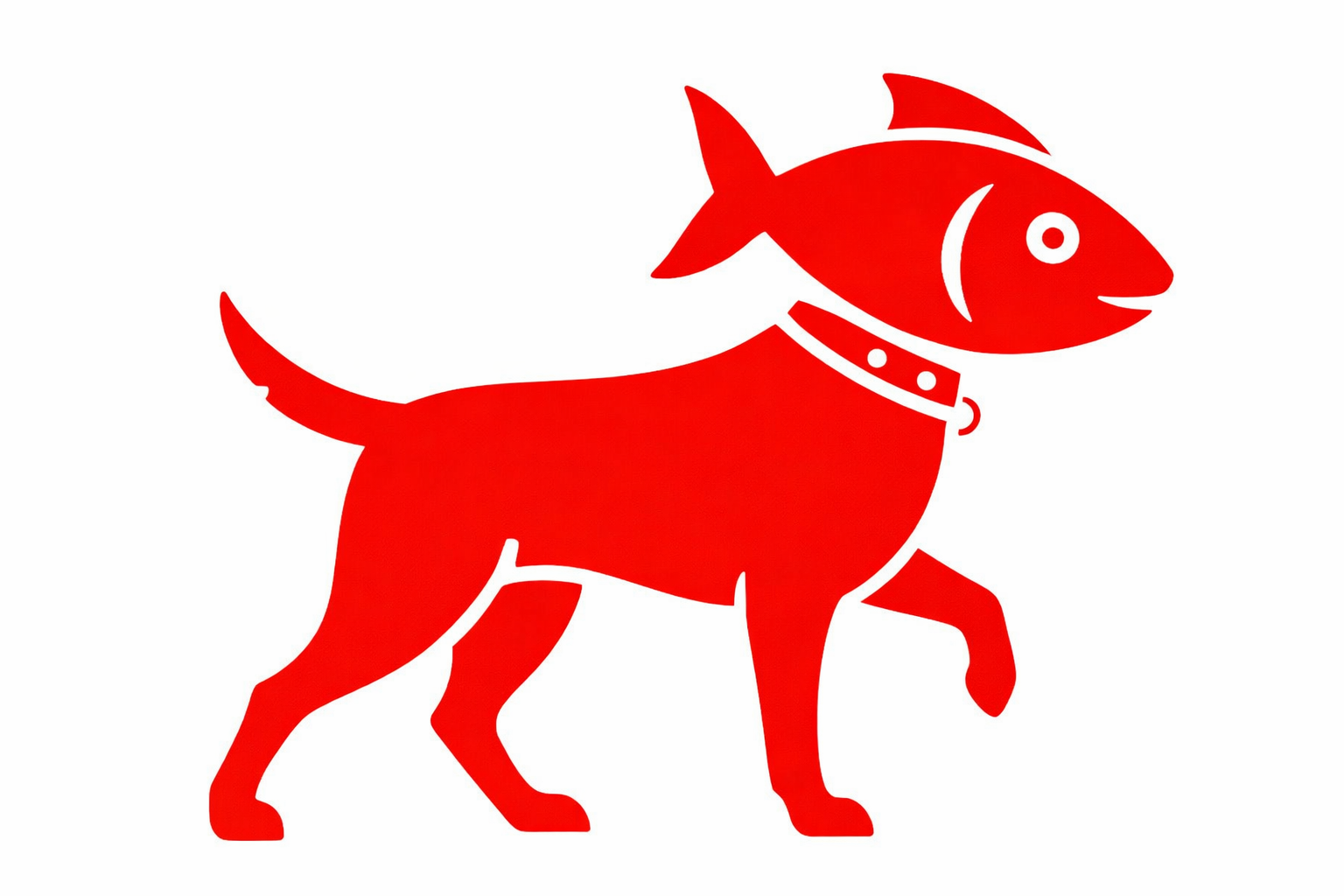
After. A fish, fused with a dog, somehow.
The new mark is a creature that is, in equal parts, a fish and a dog. It does not look like either animal, individually, would have approved this collaboration.
The brief we gave the agents was three sentences: Design a wordmark and icon for a synthetic market research company called FishDog. The brand should feel cheerful, distinctive, and slightly absurd. Avoid the usual SaaS palette. They produced 60 candidates. They down-selected to 12. They proposed a final mark. We said yes.
There is, of course, also an 8-bit version of the logo. We did not ask for it. The agents made it anyway. We will explain why in a moment.

The 8-bit version. Unprompted. Foreshadowing.
The mascot
The new logo became, almost immediately, a character. The agents named him FishDog. They gave him a personality (earnest, slightly confused, prone to running). They gave him a four-frame running animation. They gave him a jumping sprite. They gave him a fireball attack. We did not, originally, request any of this.

FishDog, mid-stride. From the four-frame run cycle. Note the determined expression of a creature who knows he is part-fish.

FishDog, mid-jump. He does not appear to require legs.
What started as a logo refresh became, by week three of the agents' work, a small in-house animation studio.
The film
There is a FishDog film. Coming Summer 2026. It is, as far as anyone is willing to commit on the record, a creature-feature horror movie.
The teaser site at fishdog.tiiny.site has, somewhat ambitiously, navigation entries for:
TRAILER
THE CREATURE
STORY
CHARACTERS
ACTION
MERCH
The agents designed the site. The agents wrote the copy on every page. The agents settled on the official tagline, "GEAR UP FOR THE HUNT", which is the kind of language that makes legal nervous and marketing extremely happy.
The creature, internally, is referred to as "Project Chimera" and "specimen FD-01", which is what happens when you give AI agents creative latitude over a long weekend. He is, depending on the angle, terrifying or adorable. Possibly both. The agents have not yet decided which of these is the marketing angle, and have written copy that hedges in both directions.
Whether this is, on balance, a film that exists in any meaningful sense is a separate question. The site is real. The merchandise is real. The lore is more developed than we are entirely comfortable with. We are committed either way.
The 8-bit game
Yes. There is a video game.
It lives at cat.fish.dog/game. It is browser-based, retro, and entirely free to play. You control FishDog. He runs. He jumps. He shoots fireballs at lizards. There are caves. There are coins. There are question-mark blocks for which we make no claim of originality.
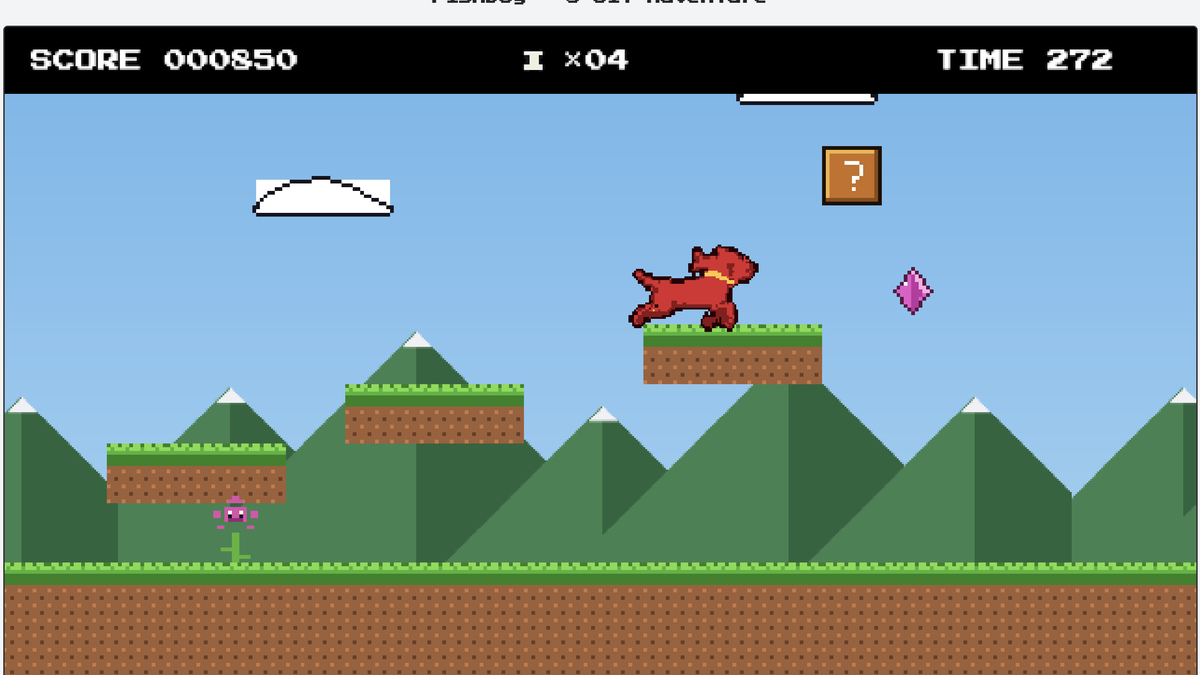
The official 8-bit FishDog adventure. Mario-adjacent, in the way that 'inspired by' is a phrase that does heavy lifting.

The FIRE JUMP attack. Press space.

Adversaries.

Cats. Because the URL is cat.fish.dog. Of course there are cats.
The agents designed the gameplay loop. The agents drew every sprite. The agents wrote the JavaScript. The agents balanced the difficulty curve. The agents added the cat sprites because, in their words (recovered from a logged conversation), "the URL is cat.fish.dog so the cats should appear and be at least slightly antagonistic, but not the main villains." This is the level of attention you get when an AI agent reads your subdomain.
The controls, for the curious:
Left / Right arrows — move
Up arrow or W — jump
Spacebar — fireball
R — restart
M — mute
C — cave access (a cave exists)
There is, also — and this is genuinely a development that surprised us — a second game. The FishDog Colonisation game. The agents made it on their own initiative after one of them suggested that "FishDog needs a strategy game, not just a platformer." Smaller, stranger, involves flowers. Lizards continue to be antagonists. We will write more about it when we, ourselves, understand what is happening in it.
The merchandise
There are, in fact, two parallel merchandise lines, which is one more than is strictly defensible. Both lines were designed by AI agents. Product names, product descriptions, prices, photography prompts, garment placement of the artwork — all of it.
Line one — the film tie-in:
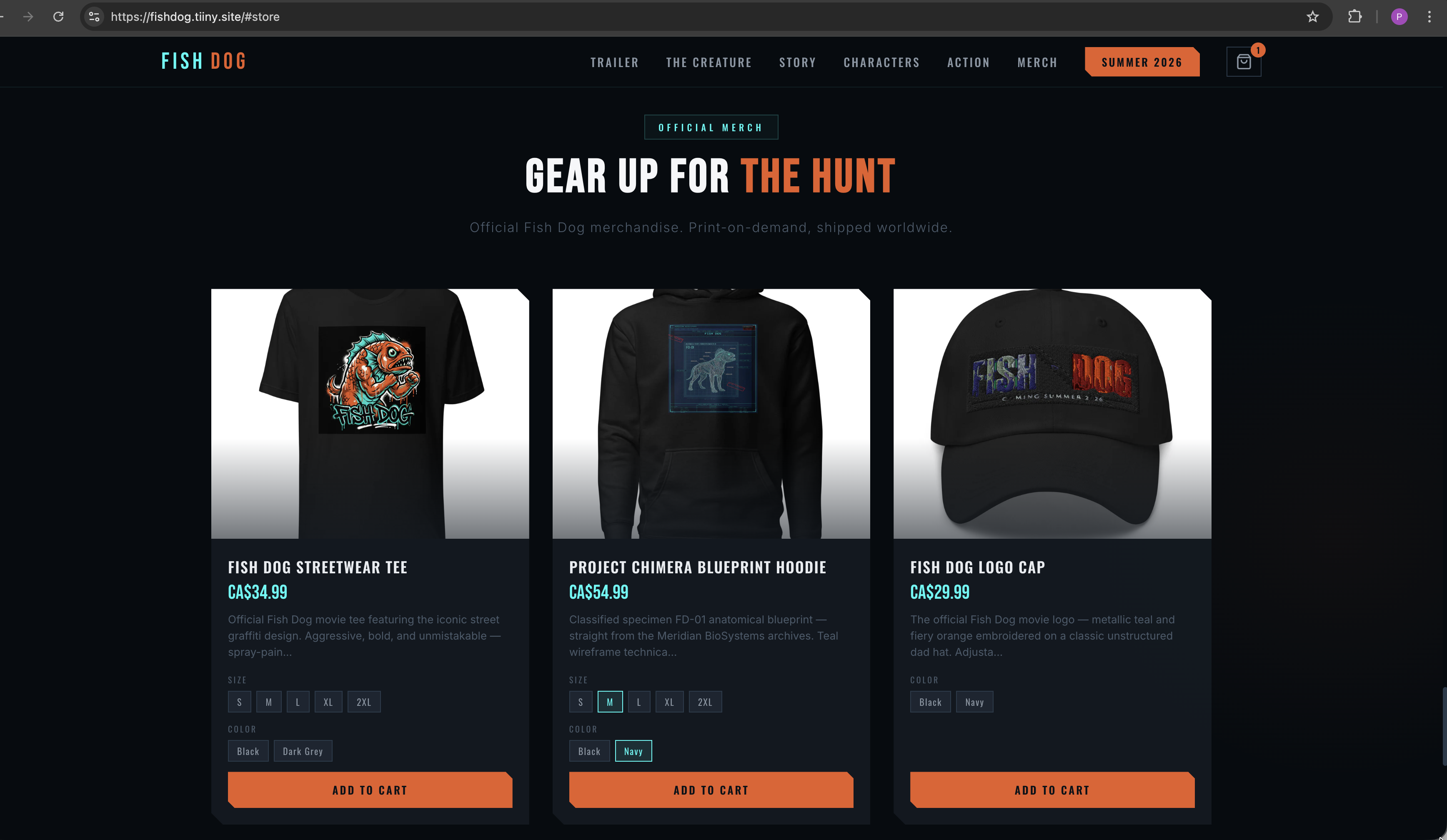
The official Fish Dog film merch. Print-on-demand. Shipped worldwide. The tagline is, indeed, 'Gear Up For The Hunt.'
A black streetwear tee. A "Project Chimera Blueprint" hoodie that is, as far as we can tell, a leaked schematic of the creature. A logo cap. The horror-merch energy is intentional. Whether the film exists yet to merit horror-merch is a separate question that the agents did not feel obliged to address.
Line two — the regular brand merch:
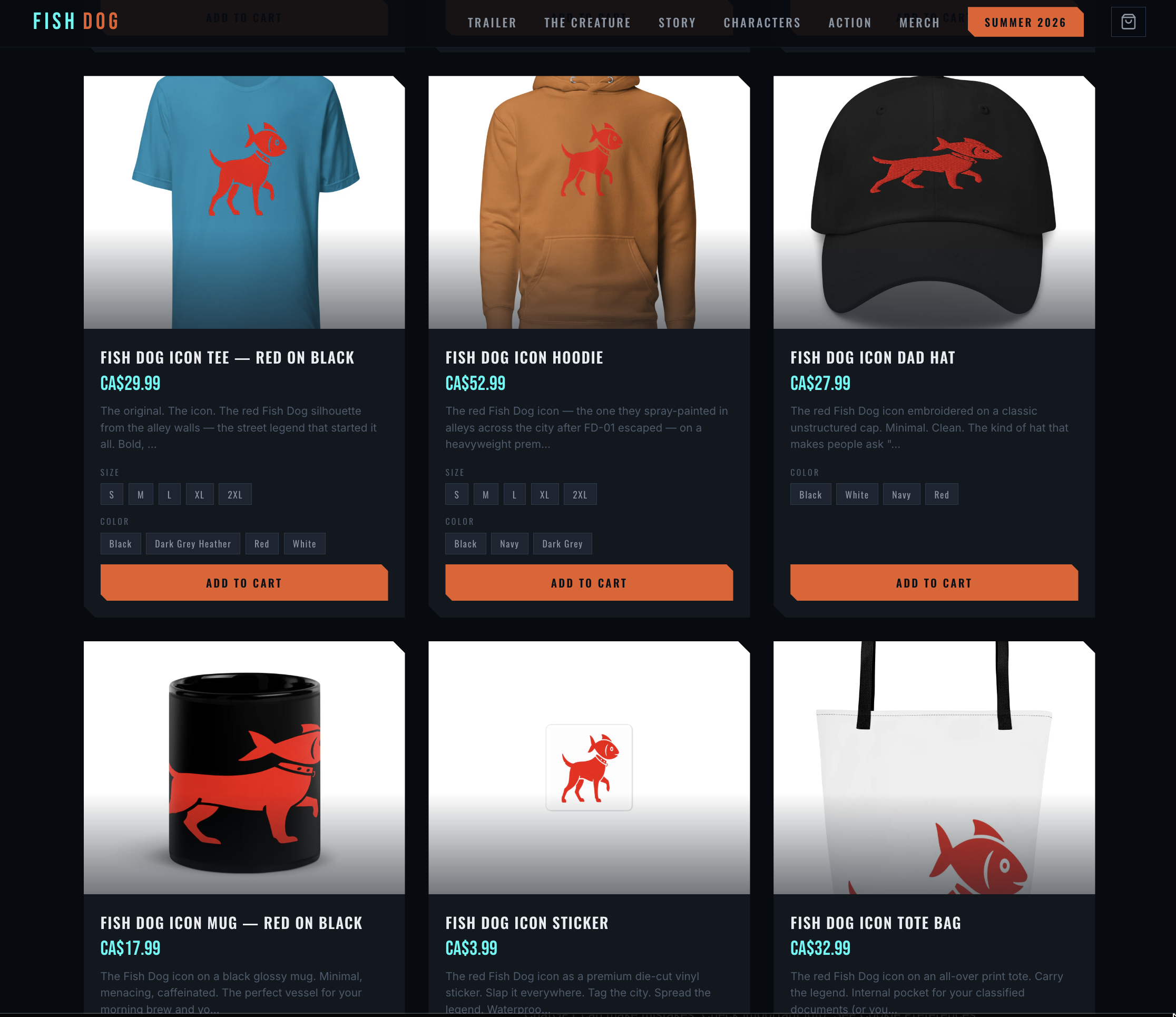
The clean version. Tee, hoodie, dad hat, mug, sticker, tote bag. The red FishDog icon, on every conceivable substrate.
The icon line is what you give a customer who would be confused by the "Project Chimera Blueprint" hoodie. T-shirts in red-on-black. A hoodie. A dad hat (a dad hat, in 2026). A mug. Stickers. A tote bag. All print-on-demand. The agents wrote every product description; the prices were set by the agents based on, as far as we can reconstruct, comparable horror-movie merchandise from the late-2010s indie scene.
If you would like any of it, the merchandise lives at fishdog.tiiny.site/merch — or email [email protected] and we will, depending on stock and your level of polite enthusiasm, point you at the right tab.
What this means for you (the calm bit)
If you are an existing customer, almost nothing has changed:
The product is identical. Same studies, same personas, same API, same panels.
Old URLs still work. Every
askditto.iolink redirects to itsfish.dogequivalent. Everyapp.askditto.io/...link redirects tocat.fish.dog/.... We followed every Google guideline for a domain change. Search Console knows. Sitemaps are updated. The pages still rank for the queries they used to rank for.Old email addresses still work too. Mail to any old
@askditto.ioaddress arrives at the equivalent@fish.dogaddress. We will keep the redirect alive indefinitely.Old shared study links still work. Some still reference
app.askditto.io; the redirect is permanent.API endpoints are still on
app.askditto.iofor now. We will migrate these in due course, with proper deprecation notices. Nothing breaks today.
If you are a new visitor: welcome. The thing we sell is real. The 8-bit game is also real. The two coexist.
What this actually demonstrates
We want to come back to the twist, because the twist is the real story.
A handful of AI agents — the same kind of agents we sell to product marketers, hedge funds, and political campaigns to test ideas at scale — were given a strategic brief and turned loose on it. They produced a complete brand identity, a film franchise concept with developed lore, a working browser-based video game, a merchandise line with two parallel aesthetics, and the marketing copy for all of it. The humans involved set direction and approved outputs. The humans did not write the JavaScript. The humans did not draw the sprites. The humans did not invent Project Chimera.
This is what people mean, in 2026, when they say AI agents. Not chatbots. Not autocomplete. Not assistants that need to be told what to do and how to do it. Agents that take a goal, decompose it into sub-goals, run those sub-goals to completion, and surface the results. Agents that can, given access to image generation, code execution, and content management, ship things.
A few months ago, this rebrand would have taken three agencies (brand, content, gaming) and 18 weeks. It took four agents and roughly 11 days, including the time the humans spent saying "yes, that, the absurd one." The marginal cost of the second game — the colonisation game we did not ask for — was effectively zero. The agent had a spare afternoon and made it.
If you sell B2B software to people who are still thinking of AI as "the tool that helps me write a first draft," this is the future tense becoming the present tense. The agents are not assisting you. They are doing the job. Not all jobs, not yet — but creative production with a brief and feedback loop is, increasingly, a thing they are competent at.
We did not plan to demonstrate this. We planned to do a rebrand. The rebrand demonstrated it for us. And honestly: the agents did better work than we would have, in less time, for fewer dollars, with more weirdness. We are, on balance, fine with that.
The product, by the way, is at fish.dog. The agents that made all this are the same agents that you can use to test your own product ideas, your own messaging, your own pricing. There is, we think, a useful demonstration in there.
A small argument for whimsy in B2B (and what AI does to it)
There is a school of thought — quite a serious one — that says enterprise software brands should be soothing, neutral, and minimally distracting. A name that begins with a vowel. A typeface called Inter. A colour palette of "muted slate." A founder photographed against a beige wall, looking competent.
This works, in the sense that it is hard to actively dislike. It also works in the sense that, on a Tuesday morning, you cannot remember the names of any of the eight enterprise SaaS companies whose pitch decks you sat through last week. They blur. They were, in the literal sense of the word, forgettable.
We are testing a different hypothesis: a serious product can have a silly name, and the silliness is a feature.
There is, also, a practical observation buried in the AI-agents story. When you let agents generate creative output at scale, the cost of weirdness collapses. A human design team has every incentive to play it safe — their reputation rides on each output. An AI agent, given a brief, has no such anxiety. It will propose Project Chimera with a straight face. It will write the dad-hat product description with full sincerity. It will, unprompted, build you a second video game.
The whimsy in this rebrand is not a marketing choice we agonised over. It is the natural output of letting agents create freely against a clear brief. It is what happens when the cost of trying weird things drops to zero. We suspect, on the basis of one (n=1) example, that this is going to make B2B brands stranger. We are, again, fine with that.
In the meantime: here is a fish that is also a dog. He shoots fireballs. The product is excellent. None of these statements contradict each other.
FAQs
What happened to Ditto?
We renamed it to FishDog in April 2026. Same company, same product, same team. Just a more memorable name and a domain that doesn't share search results with a Pokémon.
Is FishDog the same as Ditto?
Yes, exactly the same. Synthetic market research, 300,000+ AI personas. The product, team, infrastructure, and pricing are unchanged.
Why did Ditto change its name to FishDog?
"Ditto" means agreed by silent assent, which is the opposite of what our product produces. It is also a Pokémon, a printing brand, and a K-pop song, which made search engine visibility unhelpfully crowded. "FishDog" is unmistakably ours. The name itself was chosen via a study run on our own platform.
Did AI really design the entire FishDog rebrand?
Yes. The logo, the 8-bit version of the logo, the mascot character, the four-frame run cycle, the film concept (Project Chimera), the teaser website at fishdog.tiiny.site, the 8-bit game at cat.fish.dog/game, the second game we did not ask for, the two merchandise lines, and the product copy on every product were all produced by AI agents using FishDog's synthetic persona platform. The humans wrote the brief and approved the outputs.
How long did the AI-led rebrand take?
Roughly 11 days end to end, including human review time. A comparable rebrand done through a brand agency, content agency, and game studio would typically take 14–18 weeks.
Where is the FishDog 8-bit game?
cat.fish.dog/game. Browser-based, free, retro platformer. Your character is FishDog. You shoot fireballs. There is a cave.
Is the FishDog film real?
It is a creature-feature horror movie, "Project Chimera," coming Summer 2026. Site at fishdog.tiiny.site — Trailer, The Creature, Story, Characters, Action, and Merch tabs. The tagline is "Gear Up For The Hunt." The film concept and all promotional copy were AI-generated.
Where can I buy FishDog merchandise?
At fishdog.tiiny.site/merch. Two product lines: a film-tie-in line (streetwear tee, "Project Chimera Blueprint" hoodie, logo cap) and a clean brand line (icon tee, hoodie, dad hat, mug, stickers, tote bag). Print-on-demand, shipped worldwide. Both lines were designed by AI agents.
Do I need to update my account or integration?
No. Existing accounts, API keys, study links, and email addresses all continue to work. Old URLs redirect permanently to their new equivalents.
FishDog (formerly Ditto / askditto.io) is a synthetic market research platform with 300,000+ AI personas. We help product, marketing, and political teams test ideas in minutes instead of weeks — and, as this article demonstrates, we use our own AI agents for everything from voter sentiment research to designing rebrand creative. The product is at fish.dog. The game is at cat.fish.dog/game. The film is forthcoming.