

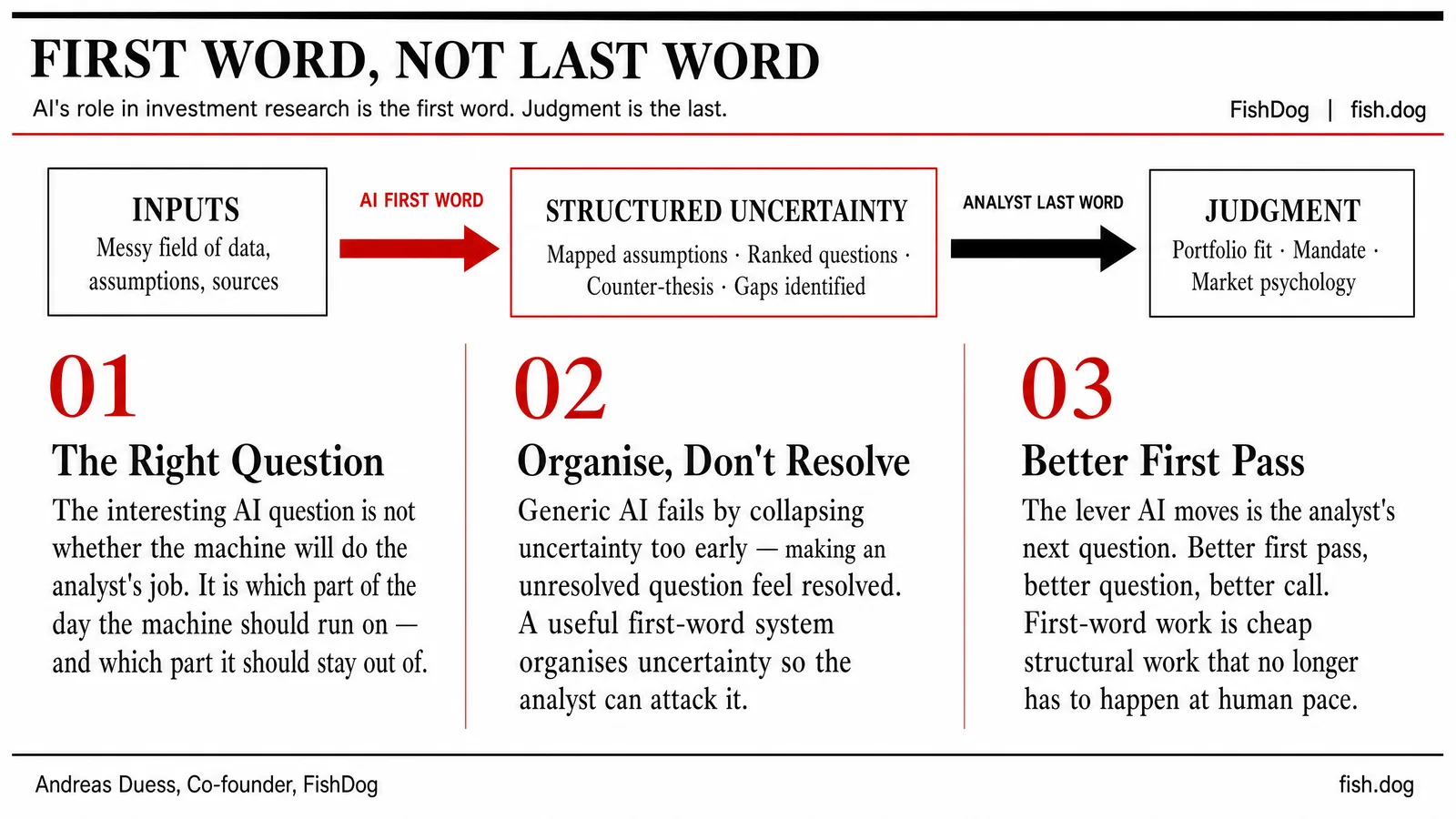
For the last two years I have been using AI in my own work the same way I want analysts to use it in theirs - as the thing that takes the first word, never the last. The distinction has been useful enough that I have stopped having the abstract argument about whether AI is going to replace anyone.
Most of the debate gets stuck there because the framing is wrong. The interesting question is not whether AI will do the analyst's job. It is which part of the analyst's day AI should run on, and which part it should stay out of.
The first-word part of the day is the cheap part. Structure the messy field of inputs. Map the assumptions. Surface the counter-thesis. Find the gaps. List the questions that need answering and rank them by load. None of that is the analyst's value-added work, and almost all of it can now be done before the analyst's hour begins.
The last-word part is different. The last word is judgment under uncertainty in a context that no workflow should pretend to own — portfolio fit, time horizon, mandate constraints, management credibility, what the rest of the book is doing, what the market is mispricing. Some of that can be modelled and some of it can be surfaced; none of it removes the need for a human to take responsibility for the call.
The first word is structure
The early stage of a research process is usually a mess. Filings, transcripts, market signals, anecdotes, prior assumptions, half-formed hypotheses, three or four directions the thesis could go. That is exactly where AI does its best work — not because it has better judgment, but because it can impose structure on the field before the analyst spends the working day inside it.
A good first-pass packet says: here is the thesis in plain language, here are the drivers, here are the risks, here are the assumptions ranked by confidence, here is the strongest counter-argument, here are the leading indicators, here is what remains unknown. That is a map, not a decision. The analyst arrives at the working hour with a clearer picture of which questions deserve the hour and which do not.
The distinction between map and decision matters because it shapes how the tool gets used. AI sold as an answer machine asks the analyst to trust it; the same AI used as a structuring layer asks the analyst to check it instead. Smart analysts prefer the second job to the first.
Bad AI tries to sound decisive too early
The most common failure mode of generic AI in research is a false sense of completeness. Ask a broad question, receive a confident answer. The prose is smooth, the logic sounds plausible, the system gives no signal that the question is actually unresolved. That is the dangerous shape — an unresolved problem made to feel resolved.
A useful AI research workflow is comfortable saying: here is what we know, here is what we do not know, here is the strongest counter-thesis, here are the assumptions with low confidence, here are the questions worth asking next. It organises uncertainty so the analyst can attack it, instead of collapsing uncertainty before the analyst gets the chance.
That is the difference between pretending to decide and helping someone decide. Operators can usually tell the difference inside a minute.
Expert calls should come later, not first
The first-word frame also changes the role of expert networks.
Today the workflow uses expert calls early because nothing else in the system is structured to surface the right question first. That is understandable, but expensive. The first call may reveal that the question needed a different framing. The second may reveal that the expert was the wrong tier. The third may finally produce signal. By the time the right question has surfaced, several thousand dollars have already gone to learning what the right question was.
A better-shaped workflow reverses the sequence. Run the structured first-pass packet. Identify the assumptions that matter most. Surface the counter-arguments. Find the operational questions that remain unanswered. Then, if a human expert is warranted, spend the money on the right person and the right question. The call gets sharper because it is no longer being asked to do the early structuring work.
The analyst's questions improve
The most useful outcome from a first-word system is not that the AI answers every question. It is that the analyst's next question gets better.
A vague expert-call prompt produces vague answers. A precise prompt produces useful friction. The analyst stops asking "what is happening in this market?" and starts asking "which operational constraint would break this margin assumption first?" or "what would have to be true at the branch level for management's guidance to be credible?" Those are better questions, and they come from a better first pass.
That is the small lever AI moves. Not the call, not the decision — the question.
Auditability is part of the role
For AI to earn the first word, it cannot be a black box that produces attractive paragraphs. Every claim needs a trail. Every source needs to be visible. Dates matter. Confidence matters. Negative evidence matters. If the analyst cannot check the packet quickly, the packet is not doing its job.
The trust standard should be verification, not belief. A strong first-word system invites the analyst to test it: pick three claims, check them in five minutes, decide whether the work is worth the next hour. If the packet cannot survive that test, it should not be in the workflow.
What Thesis Lab is built to do
Thesis Lab is designed for this first-word role.
It produces a thesis interrogation packet: decision brief, evidence map, assumptions ranked by confidence, counter-thesis, leading indicators, gaps, source evidence. The point is not to replace the analyst's memo. It is to get the analyst to the real work faster, with a clearer view of what matters.
The analyst still owns the last word. Thesis Lab makes the first word faster, more structured, more auditable, and more useful — a more serious claim than "AI replaces analysts" and a more useful one.
The future is not autopilot
The shift in investment research is not toward a world where machines simply make the calls and humans watch. The more likely shape is a workflow where machines compress the intake layer, expose weak assumptions, and generate structured first-pass pressure-tests, and humans spend more of their day on synthesis, judgment, and conviction.
That future does not make analysts less important. It makes shallow analyst work easier to spot and strong analyst judgment more leveraged.
AI should not get the last word in investment research — it should make the first word good enough that the last word is sharper.
Further reading
The product version of this argument is [Thesis Lab](/thesis-lab) — a first-pass research artefact built to be inspected, challenged, and used by the analyst before the next call or IC discussion. For validation context, see [FishDog's methodology and validation hub](/methods-validation).