

I have been a buyer of outside research for clients for twenty-five years. The mechanics have changed five times over that period — focus groups, ethnographies, panel work, audience tracking, now synthetic — but the buyer's complaint has stayed the same one all along. The hour the researcher was hired to think in turns out to be the smallest hour in the working day. Most of the rest is intake.
The hedge-fund version of this problem looks different on the surface and identical underneath. The analyst is paid for judgment under uncertainty. The working week, in practice, is mostly assembling, summarising, reconciling, and chasing — the part of the work that is supposed to clear the field for judgment, not be the field.
Most of the working week is plumbing
The shape of the analyst day is familiar enough that almost everyone in the seat describes it the same way. Some hours of filings, some hours of broker notes and earnings transcripts, some hours of channel data and management interviews, some hours scheduling and prepping expert calls, some hours reconciling notes against the model. None of this work is optional, and most of it is not unintelligent, but almost none of it is the hour the analyst was actually hired to spend.
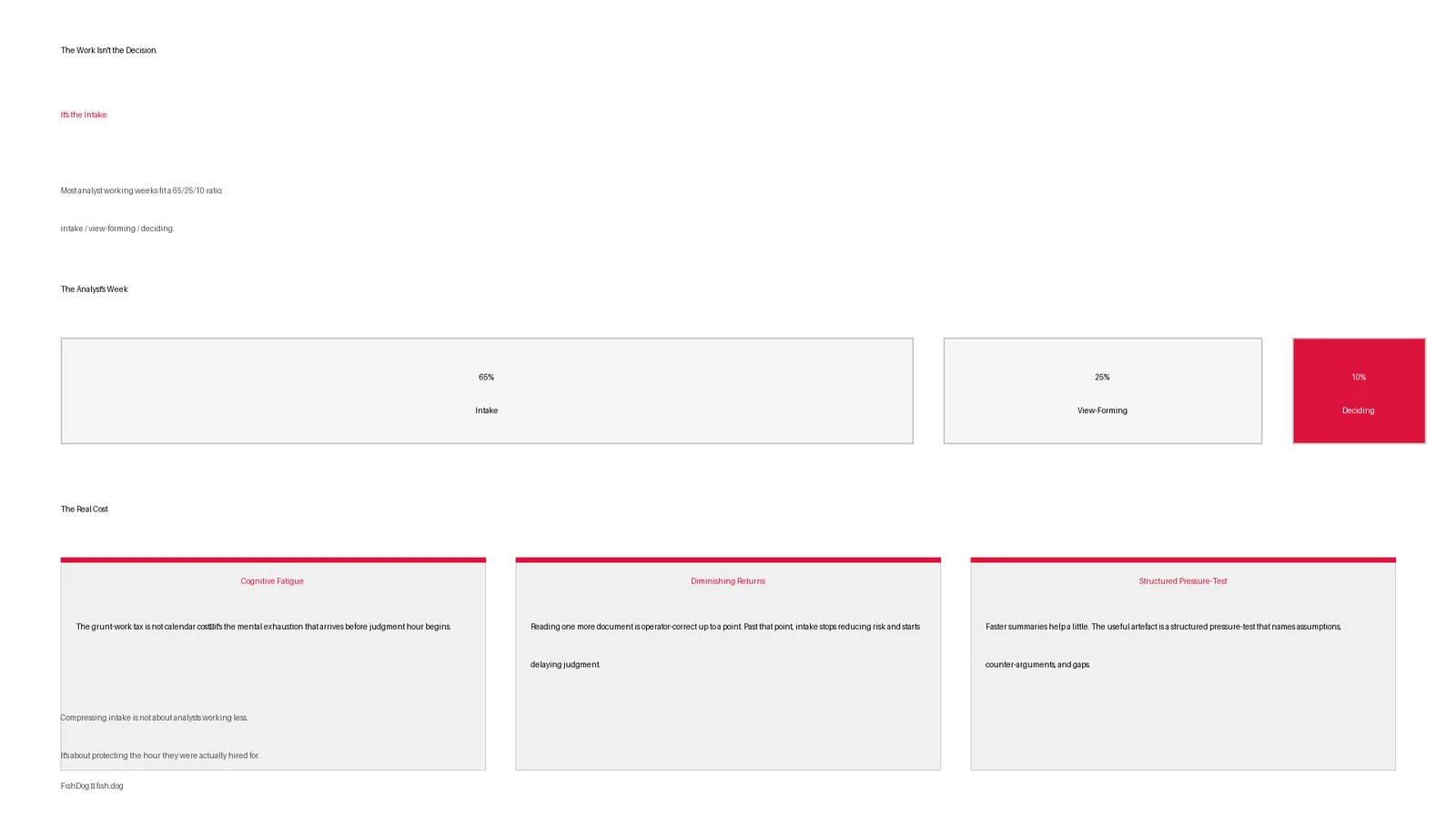
The rough ratio that keeps showing up across these conversations is something like two-thirds of the week to intake, a quarter to forming a view, and less than a tenth to the decision itself. The exact split varies by strategy, by book, by where you are in the quarter. The shape is consistent. That is the operator picture, not a marketing slide.
More documents do not produce better judgment
The instinct to read one more thing is hard to fault. The cost of being wrong is high; the cost of looking at one more transcript feels manageable. The seventh document, the next sell-side note, another expert call — every one of them feels like a small insurance policy against the bad position.
Up to a point, that instinct is operator-correct. Past that point it usually stops reducing risk and starts delaying judgment. The next document does not bring new information; it brings the appearance of further diligence, which is a different thing — and the workflow happily mistakes one for the other.
I have watched the same pattern in client research for two decades. The buyer wants one more focus group, one more concept test, one more validation pass — not because the new data will change anything, but because the responsibility of the decision is uncomfortable. The grunt-work tax has a name in agency life. We call it diligence theatre: the same instinct, dressed up as professionalism, applied past the point where it does any work. The cost lands in the same place every time. It uses the hours when the operator should be doing the harder, riskier work of making the call.
The cost is cognitive, not just calendar
The visible cost of intake is the calendar; the deeper cost is what the calendar absorbs. Every document an analyst reads asks them to decide what is relevant, what is reliable, what is signal, and how to integrate it with everything else they have seen. Every transcript adds a reconciliation problem. Every expert call ends in notes that have to be argued against other notes. By the time the analyst arrives at the hour that matters — the one where a view has to be formed and defended — the day has already absorbed most of the freshest thinking.
Diligence persists; freshness does not. The inconvenient gotcha, the load-bearing assumption that has not been pressure-tested, the indicator that should have moved earlier in the memo — these are easier to catch at hour two of the day than hour eight. The hour spent collecting is not neutral. It changes the quality of the hour spent judging.
That is why compressing intake matters. Not so the analyst works less, but so the part of the work they were actually hired for happens earlier in the day, before the fatigue compounds.
Faster summaries are not the answer
The most common response to this problem has been to summarise faster. That helps a little. It does not solve it.
A summary is still intake. A shorter pile is still a pile. The analyst still has to read it, weigh it, connect it to everything else, and decide what to do next. The reading shortened. The judgment work did not.
The more useful artefact is not a shorter summary but a structured pressure-test. A piece of work that says: here is the thesis as we read it, here is what has to be true, here is what has to be wrong, here is where the assumptions are confident and where they are thin, here is the strongest counter-argument, here is what has not been answered, and here is what the analyst should look at next. That is a different research unit. It is closer to a decision artefact than to document compression. The first time an analyst opens a packet like that and uses the working hour on the hard part of the question instead of the easy part — that is when the workflow changes shape.
What I would actually fix
If I were running a research book today, the first question I would ask is not "how do I get more information faster?" The answer is yes, of course, but the deeper question is "what work am I doing in intake that I should not be doing in intake?" The standard workflow defaults to intake-as-insurance: the seventh document, the third call, a hedge against the discomfort of an unfinished judgment. That default is the part that no longer has to be there.
The cleaner workflow assumes the analyst is hired for judgment and protects the judgment hour from being eaten by anything else. Most of the cheap upstream work — surfacing the counter-thesis, mapping the operational drivers, ranking the assumptions — does not have to happen at human pace any more. Once that part moves upstream, the analyst gets to spend their actual day on the question they were hired to answer.
Further reading
The product version of this argument is [Thesis Lab](/thesis-lab) — first-pass diligence packets, structured pressure-testing, and a research artefact the analyst can actually use before the next call or the next IC discussion. For validation context, see [FishDog's methodology and validation hub](/methods-validation).