

I have signed off on the "external research" line item on more client budgets than I want to remember. The number was almost always wrong by the end of the year — over, under, or in the wrong column. The reason was always the same. Nobody had figured out which share of the spend was actually buying signal.
The expert-network category has the same problem at a different scale. A fund running ten analysts can spend somewhere between a few hundred thousand and a million dollars a year on calls. That number gets defended as a cost of doing business and reviewed once a year by someone who doesn't sit through the calls. The CFO sees a line item and the analyst sees an invoice. Neither view captures what the spend actually delivers.
That is the wrong frame for a useful procurement question.
The right question is not whether expert calls are worth it
Most reviews of expert-network spend get framed as a yes/no. Are we getting value out of this? The answer is almost always yes, qualified, because every fund can point at the one call that earned its keep. That answer is also useless. It does not change behaviour, sharpen the next budget conversation, or tell anyone where the spend is leaking.
The more useful question is the one nobody asks out loud. Of the money the fund spent on calls last year, how much of it was low-yield intake — the call that produced colour but no decision-changing signal — and how much of it was the call that actually moved a position?
If half of last year's spend produced colour rather than signal, that is not a moral failure of the analysts. It is the natural shape of a workflow that uses paid human conversations to do the cheap first-pass work that should never have been on the calendar.
The math starts at the calendar, not the invoice
Most of the conversation about expert-network spend stops at the invoice. A call costs somewhere between $800 and $1,500 in most networks. A mid-sized fund running 200 calls a year is paying roughly $200,000 in fees. A larger book running 1,000 calls is closer to a million.
The visible cost gets compared against the visible value — a couple of position changes a quarter, a few risk avoidances, the rare big-trade context — and the math looks defensible at the line-item level.
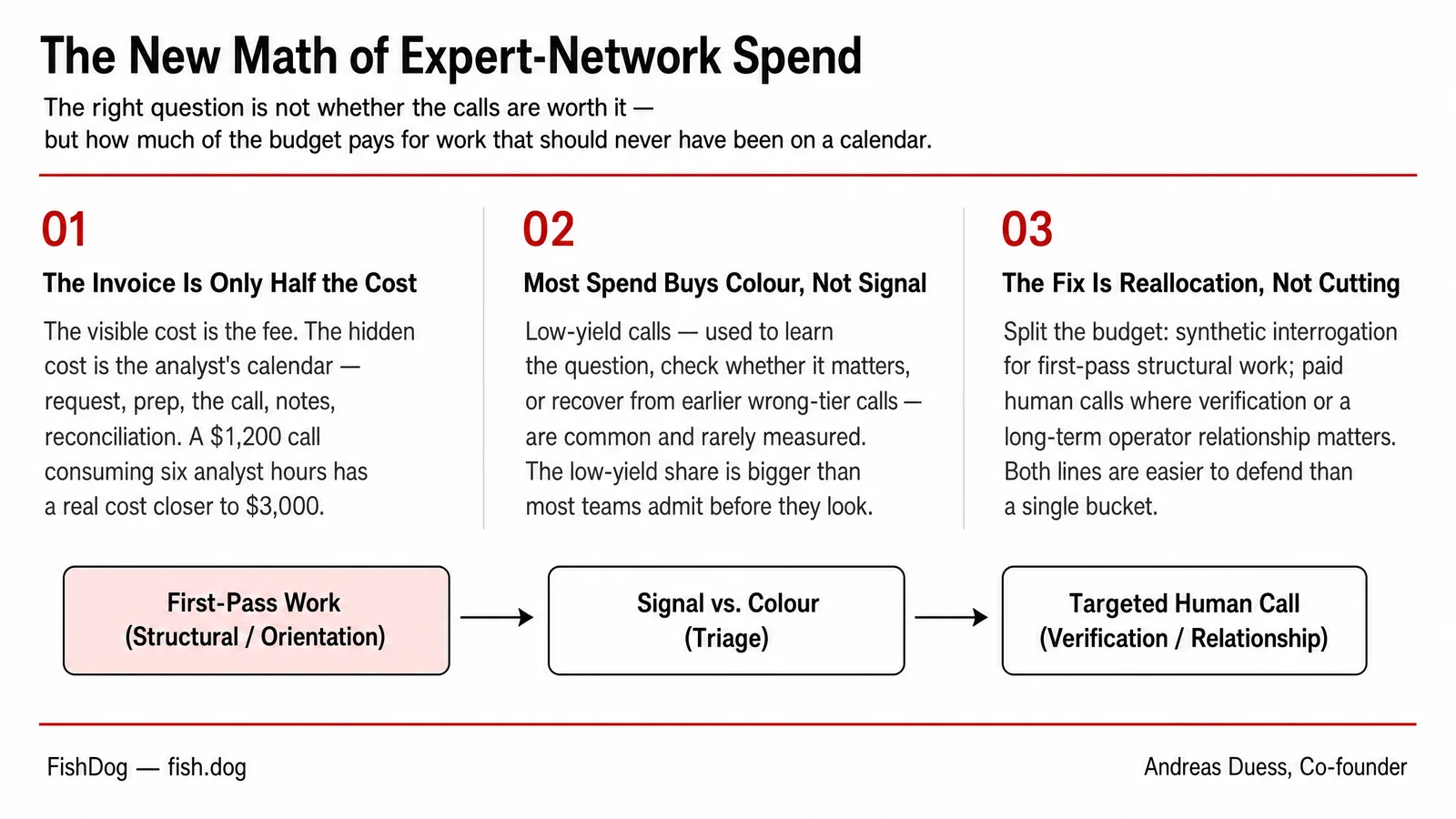
The math stops looking defensible the moment the analyst's hour gets added to the line. Every call has a calendar cost — request, scheduling delay, prep, the hour on the phone, post-call notes, reconciliation, follow-up — and the calendar cost is almost always larger than the invoice. A $1,200 call that consumes six analyst hours of work has a real cost closer to $3,000 once you load the time. A fund running 200 of those has an annualised analyst-hour exposure measured in weeks per analyst per year. That is the part of the spend that no one signs off on, because no one is being asked to.
The low-yield share is the lever
Once the calendar gets added to the math, the question shifts from "how much should we spend on calls?" to "how much of our existing call volume is doing work that doesn't require a paid human?"
Across the conversations I have had with research leaders in the last six months, the share of expert-network spend that goes to low-yield intake — calls that produce colour, not signal — is bigger than most teams admit before they look at it. Some of those calls exist because the workflow has nowhere else to surface the right question. Some are downstream of an earlier call that landed on the wrong tier. Some are absorbing the exploratory work the system has never had a better home for. None of those are unreasonable uses of an expert call. All of them are the wrong place to do that work now.
The lever is not cheaper calls but fewer bad calls — and the way to get fewer bad calls is to do the first-pass work somewhere other than on the call calendar.
The procurement case writes itself
The conversation with finance does not have to be about cutting the expert-network budget. The cleaner conversation is about reallocating it. Most of what the budget has been doing — thesis pressure-testing, mapping operational drivers, channel checks against the procurement lead or branch manager, interrogation of the operator tier the human network was never structurally going to deliver in time — moves to direct synthetic-expert interrogation. Paid human calls survive for the narrower category where a real voice changes the answer: verification of a high-stakes claim against a named operator, regulated decisions, ethnographic depth, the long-term operator relationship the firm has built deliberately.
Done correctly, the same overall research spend produces more useful signal. The bulk of the operator-tier work happens in hours rather than weeks, against a panel that includes voices a paid network was never going to deliver. The paid human calls that remain concentrate on the narrower questions where a real voice matters. The PM math reads cleaner: faster lead time, higher question volume, lower MNPI surface area, fuller audit trail, fewer wasted calls.
The CFO math reads cleaner too. The line item that used to be "external research, undifferentiated" becomes two line items. One pays for synthetic-expert interrogation against the operator tier. The other pays for the narrower category of human calls that earn their keep. Both numbers are easier to defend than a single bucket that quietly absorbed everything.
What Thesis Lab competes for
Thesis Lab is not competing for the expert-network budget. It is competing for the share of that budget that should never have been on a calendar in the first place.
The product earns that share by producing a same-day thesis interrogation packet that the analyst can use to compress intake, surface the counter-thesis, find the gaps, and decide which questions actually need a paid human. The output has to be good enough to change the next hour of work. The value depends on both speed and structure: a packet that saves time without sharpening the next question is just convenience, and one that sharpens the question but arrives too late misses the window entirely.
Where the edge actually moves
The next battleground in research is not who collects the largest pile of information. Most funds have access to similar models, similar data, similar networks. The edge moves to whichever workflow protects and multiplies the analyst's judgment hour.
Compressing intake, building artefacts that can be checked, using human experts more precisely, treating AI as the first word and not the last — these are the operational moves that change the shape of a research week. The analyst still makes the call. The winning workflow makes sure the analyst gets to the call with more energy, a sharper question, and a clearer view of what matters.
That is where the edge moves, and the budget moves with it.
Further reading
The product version of this argument is [Thesis Lab](/thesis-lab) — direct synthetic-expert interrogation against a 301,000-agent BLS-grounded panel, two-page Thesis Interrogation Packets with clause-level citations, and the structural answer to the low-yield-call problem. For validation context, see [FishDog's methodology and validation hub](/methods-validation).