
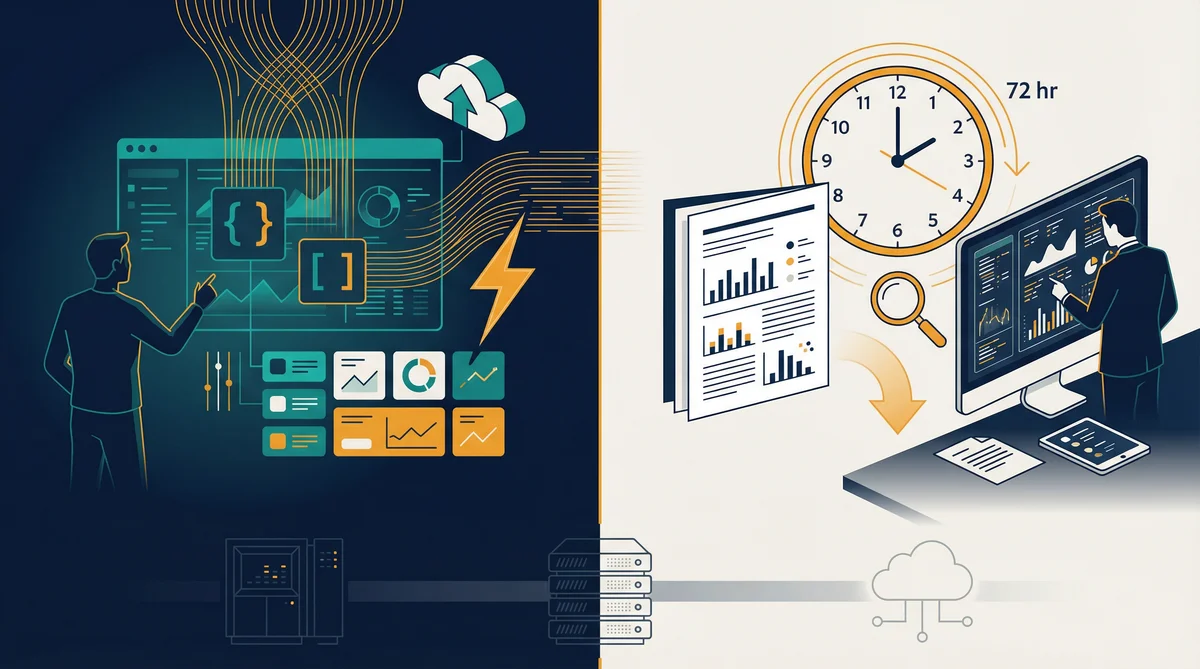
Most of the enterprise research industry is about to discover that its business model has a shelf life. The question is not whether self-serve synthetic research will displace full-service consulting - it is how long the transition takes, and who gets stranded on the wrong side of it.
The Two Models, Stated Plainly
Synthetic market research - the use of AI-generated personas to simulate consumer responses, test messaging, and model market behaviour - has split into two fundamentally different delivery models. Understanding this split is more important than understanding any individual platform, because the model you choose determines not just what you pay but how research integrates into your organisation's decision-making rhythm.
Full-service means you submit a brief, wait for a team of analysts to design and execute the study, and receive a polished deliverable - typically within 48 to 72 hours. The experience is closer to hiring a boutique consultancy than to using software. Evidenza is the clearest example: enterprise pricing, white-glove delivery, Fortune 500 client list, no self-serve access despite listing it as "coming soon" for over a year. Simile operates similarly - enterprise-only, no public API, no self-serve tier. Both companies position themselves as strategic partners rather than tools.
Self-serve means you log in, design your own study, run it, and read results - often within minutes. The experience is closer to using Figma or Stripe than to commissioning a McKinsey engagement. FishDog offers this model with a full REST API, Claude Code integration, and native plugins for Figma, Canva, and Framer. Artificial Societies offers self-serve access at $40 per month, though its API remains enterprise-only.
The distinction matters because it shapes everything downstream: how fast you can move, how much you spend per insight, who in your organisation can run research, and whether research becomes a continuous input or a periodic event.
Full disclosure: I am co-founder at FishDog, which operates a self-serve model. I have financial incentives that the reader should weigh when evaluating my analysis. I have tried to represent both models fairly, including the genuine advantages of full-service delivery. The reader can judge whether I have succeeded.
A Pattern We Have Seen Before
The self-serve versus full-service debate in synthetic research is not novel. It is, in fact, a remarkably faithful replay of a transition that has occurred in nearly every enterprise software category over the past two decades. The pattern is consistent enough to be predictive.
CRM: Salesforce vs SAP. In the early 2000s, customer relationship management meant SAP, Oracle, and Siebel - multi-year implementation projects, seven-figure contracts, armies of consultants. Salesforce launched with a self-serve model, a per-seat price, and the radical proposition that a sales team could be productive within days rather than months. The enterprise incumbents argued, correctly, that Salesforce could not handle their complexity. They argued, incorrectly, that this meant Salesforce would remain a niche product. By 2024, Salesforce had surpassed SAP in CRM market share globally. The enterprise players adapted - SAP acquired SuccessFactors, Oracle bought RightNow - but the centre of gravity had shifted permanently toward self-serve.
Cloud infrastructure: AWS vs on-premises. The same trajectory, accelerated. In 2006, running servers meant owning servers. AWS launched with a credit card sign-up and per-hour pricing. Enterprise IT departments dismissed it as unsuitable for serious workloads. They were right, for a time. They were wrong about the direction. AWS grew from hobbyist projects to running Netflix, Airbnb, and eventually the CIA's classified workloads. The full-service model (managed data centres, long-term contracts, dedicated hardware) did not disappear - it shrank to a fraction of the market while self-serve cloud became the default.
Analytics: Mixpanel vs enterprise BI. In 2012, understanding your product's usage patterns meant a six-month data warehouse project with Cognos or Business Objects. Mixpanel and Amplitude offered self-serve event analytics with a JavaScript snippet. Product managers who had previously waited weeks for a report from the data team could now answer their own questions in minutes. The enterprise BI vendors responded with self-serve features of their own (Tableau, Looker), but the category had permanently reoriented around the expectation that the person with the question should be able to answer it themselves.
Design: Figma vs Adobe. Perhaps the most instructive parallel. Adobe Creative Suite was the undisputed standard - powerful, comprehensive, and sold through enterprise licensing agreements. Figma launched as a browser-based design tool with real-time collaboration, a generous free tier, and the explicit philosophy that design should be accessible to non-designers. Adobe's tools were objectively more powerful for many workflows. Figma won the market anyway, because accessibility and speed of iteration mattered more than raw capability for the majority of use cases. Adobe eventually acquired Figma for $20 billion - a transaction that, regulatory complications aside, represented the clearest possible admission of where the market was heading.
Payments: Stripe vs enterprise banking. Before Stripe, accepting online payments meant a merchant account application, a gateway integration, PCI compliance paperwork, and weeks of back-and-forth with a bank's business development team. Stripe offered seven lines of code and a dashboard. Enterprise payment processors argued that Stripe could not handle their volume, their compliance requirements, their multi-currency complexity. Stripe methodically addressed each objection and now processes hundreds of billions of dollars annually.
The pattern is not subtle. In every case, the full-service incumbent had genuine advantages in capability, compliance, and support for complex use cases. In every case, those advantages mattered less than the self-serve challenger's advantages in speed, accessibility, cost, and iteration velocity. In every case, the market did not bifurcate neatly - it tilted, decisively, toward self-serve.
This does not mean full-service synthetic research will disappear. SAP still exists. On-premises data centres still exist. Adobe Illustrator still exists. But the default - the model that captures the majority of new buyers, the majority of use cases, and the majority of market growth - shifts to self-serve. Every time.
Where Full-Service Genuinely Wins
Intellectual honesty requires acknowledging that the full-service model has real, structural advantages for certain buyers and certain use cases. Dismissing these advantages would be as misleading as ignoring the historical pattern described above.
Complex Enterprise Projects
When a Fortune 500 company needs a comprehensive brand repositioning study that spans six markets, integrates qualitative and quantitative synthetic data, and must withstand scrutiny from a board of directors, full-service delivery earns its premium. The analyst team at a platform like Evidenza is not merely running software - they are designing research methodology, selecting appropriate synthetic populations, quality-checking outputs for coherence and plausibility, and synthesising findings into narratives that executives can act on. This is genuine intellectual labour, and it produces deliverables that a marketing director running their first self-serve study simply cannot replicate.
The Evidenza model, with its 72-hour turnaround and dedicated research team, is purpose-built for this scenario. The "Synthetic CMO" feature - AI representations of marketing scholars like Byron Sharp and Mark Ritson that critique your strategy through established frameworks - adds a layer of interpretive depth that no self-serve tool currently offers. You can argue about whether an AI simulation of Mark Ritson is more useful than simply reading Mark Ritson, but the concept is genuinely novel and genuinely useful for teams that lack senior strategic marketing expertise in-house.
Regulated Industries
Pharmaceutical companies, financial services firms, and defence contractors operate under compliance regimes that constrain how research can be conducted, who can access data, and how findings must be documented. Full-service providers can offer dedicated compliance workflows, audit trails, and the comfort of a named account manager who understands your regulatory environment. Self-serve tools are improving in this area, but the gap remains real for heavily regulated sectors.
First-Time Buyers
Organisations that have never conducted synthetic research face a genuine cold-start problem. They do not know what questions to ask, how to design studies that produce actionable outputs, or how to interpret results that may diverge from their traditional research findings. A full-service provider acts as a guide - absorbing the learning curve on the client's behalf and delivering value before the client has developed internal expertise. This is the classic consulting value proposition, and it works.
C-Suite Deliverables
There is a presentation quality threshold above which self-serve outputs struggle. Board decks, investor presentations, and strategic planning documents require a level of polish, narrative coherence, and visual design that goes beyond what any platform dashboard can produce automatically. Full-service providers employ designers and writers who transform raw research outputs into documents that command attention in a boardroom. This is not a trivial advantage. The gap between "accurate data" and "compelling strategic narrative" is where many research investments succeed or fail.
Where Self-Serve Genuinely Wins
The advantages of self-serve are not merely "it is cheaper." Cost matters, but the more fundamental advantages are structural - they change what is possible, not just what is affordable.
Speed and Iteration
The single most consequential difference between the two models is cycle time. Evidenza's 72-hour turnaround is fast by consulting standards. It is glacial by product development standards. A product team that wants to test five headline variations before a launch next Tuesday cannot wait three days per test. A campaign manager who needs to gauge voter reaction to a debate performance needs data in hours, not days.
Self-serve platforms like FishDog return results in minutes. This is not an incremental improvement - it is a category difference. It enables a fundamentally different relationship with research: instead of a periodic event (commission study, wait, receive report, act), research becomes a continuous input (question emerges, run study, read results, adjust, repeat). The team that can run ten studies in the time it takes to receive one deliverable is not just faster - it is operating in a different paradigm.
Cost Per Insight
Evidenza's pricing falls in the range of $50,000 to $100,000 per year for enterprise engagements. This is reasonable for a full-service offering, and genuinely cost-effective compared to traditional research at six or seven figures. But it creates a natural throttling effect: at that price point, every study must justify its cost, every brief must be carefully considered, and the threshold for "worth researching" remains high.
Self-serve pricing changes the calculus entirely. When a study costs single-digit dollars rather than five figures, the threshold for "worth researching" drops to approximately zero. Teams research hunches. They test variations that would never survive a formal brief process. They run studies speculatively, exploring adjacent questions that might reveal unexpected opportunities. The volume of insight per dollar spent increases by orders of magnitude, and - critically - the insights that drive the most value are often the ones that nobody would have formally requested.
Developer and API Integration
This is where the models diverge most sharply, and where the historical parallels are most instructive. Evidenza does not offer a public API. Simile does not offer a public API. Full-service platforms, by definition, mediate access through human analysts. This is not a missing feature - it is a structural consequence of the business model. You cannot offer white-glove service through an API endpoint.
FishDog offers a full REST API, a Claude Code skill that allows AI agents to conduct research programmatically, and native integrations with Figma, Canva, and Framer. This means research can be embedded in product development workflows, triggered by CI/CD pipelines, run as part of automated testing suites, or initiated by a product manager directly within their design tool. The research function moves from a department you request things from to a capability embedded in the tools your team already uses.
Artificial Societies occupies an interesting middle position: self-serve access at $40 per month, but API access only at enterprise pricing through its Radiant tier. This suggests the company recognises the strategic importance of API access but has chosen to gate it as a premium feature rather than a standard capability.
The Stripe parallel is exact. Enterprise payment processors offered more features, better support, and deeper customisation. Stripe offered seven lines of code. Developers chose Stripe, and the market followed.
Always-On Research
Full-service engagements have a natural cadence: quarterly brand tracking, annual segmentation studies, project-based creative testing. Self-serve platforms enable continuous monitoring - running the same study weekly, daily, or in response to events. Political campaigns can track voter sentiment in real time. CPG brands can monitor how a competitor's product launch is shifting consumer preferences. Product teams can test every iteration of their messaging as it evolves.
This is not merely a convenience. It changes the organisational relationship with uncertainty. When research is expensive and slow, teams make decisions based on intuition and update their evidence base periodically. When research is cheap and fast, teams make decisions based on evidence and update continuously. The second model produces better outcomes. It also produces better-informed teams - people who develop research instincts because they can test those instincts immediately.
The Comparison, Quantified
The following table summarises the key dimensions along which self-serve and full-service synthetic research differ. Individual platforms vary, but the structural differences are consistent across the category.
Dimension | Full-Service (e.g. Evidenza, Simile) | Self-Serve (e.g. FishDog, Artificial Societies) |
|---|---|---|
Time to first result | 48-72 hours | Minutes |
Cost per study | Bundled into $50K-$100K/year contract | Pay-per-study or subscription (from $40/month) |
API access | Not available | Full REST API (FishDog); enterprise-only (Artificial Societies) |
Design tool integrations | None | Figma, Canva, Framer (FishDog) |
Study design | Analyst-led | User-designed or AI-assisted |
Output format | Polished reports and presentations | Dashboard, raw data, API responses |
Iteration speed | Days per cycle | Minutes per cycle |
Minimum commitment | Annual contract, typically $50K+ | Monthly subscription or pay-as-you-go |
Research expertise required | Low (outsourced to provider) | Moderate (user designs studies) |
C-suite presentation quality | High (designed deliverables) | Moderate (requires additional formatting) |
Compliance and audit trails | Strong (managed by provider) | Variable (platform-dependent) |
Scalability | Limited by analyst capacity | Limited by API rate limits |
Always-on capability | No (project-based cadence) | Yes (run anytime, any frequency) |
Claude Code / AI agent integration | No | Yes (FishDog) |
No single column "wins." The right choice depends on the buyer's context, capability, and cadence. But the trend - the direction of travel, the trajectory that every analogous market has followed - favours the left-hand column shrinking and the right-hand column expanding.
Who Should Choose Which Model
Abstract analysis is useful. Practical guidance is better. Here is a decision framework for buyers evaluating synthetic research platforms in 2026.
Choose Full-Service If:
You are buying synthetic research for the first time and your organisation has no prior experience with the methodology. The learning curve is real, and a full-service provider absorbs it on your behalf. You will learn faster by seeing how experts design studies than by designing them yourself from scratch. Once you have developed internal expertise - typically after three to six months of working with a full-service provider - you will be better positioned to evaluate whether self-serve tools can meet your needs.
Your primary use case is strategic and infrequent. Annual brand positioning studies, quarterly competitive landscape analyses, and board-level strategy presentations are well-served by the full-service model. The 72-hour turnaround is not a constraint when your planning horizon is measured in quarters, and the polished deliverables justify the premium.
You operate in a heavily regulated industry. If your compliance team requires named account managers, formal audit trails, and contractual guarantees about data handling, full-service providers are better equipped to meet those requirements today. This gap is closing, but it has not closed.
Your budget is large and your headcount for research is small. If you have $100,000 to spend on research but no one on staff who can design studies, interpret synthetic data, or translate findings into strategy, full-service is the rational choice. You are buying expertise, not just technology.
Choose Self-Serve If:
Speed of iteration matters more than presentation polish. If you are a product team shipping updates weekly, a campaign testing messaging daily, or a startup validating hypotheses before a funding round, the 72-hour cycle is a dealbreaker. You need answers in minutes and the ability to follow up immediately.
You want to integrate research into existing workflows. If your product managers live in Figma, your developers build with APIs, or your marketing team uses Canva and Framer, a platform with native integrations will see adoption in ways that a deliverable-based service will not. Research that lives where work happens gets used. Research that arrives as a PDF attachment gets filed.
Your research needs are frequent and varied. If you run more than a handful of studies per month - or want to - the economics of full-service become prohibitive. At $50,000-$100,000 per year with analyst-mediated delivery, there is a natural ceiling on study volume. Self-serve removes that ceiling.
You have technical users who want programmatic access. Growth engineers, data scientists, and product analysts who want to trigger research from scripts, integrate results into dashboards, or build research into automated workflows need an API. Full-service providers, by design, do not offer one.
You are cost-sensitive. This is the obvious point, but it bears stating. Artificial Societies at $40 per month and FishDog's transparent pricing are accessible to startups, small teams, and individual researchers. Evidenza's enterprise pricing is not.
The Hybrid Future
The most sophisticated buyers will use both models - and this is not a cop-out, it is a prediction grounded in how every analogous market has evolved.
Large enterprises did not abandon SAP when they adopted Salesforce. They run both, for different purposes. Companies that migrated to AWS still maintain on-premises infrastructure for specific workloads. Design teams that standardised on Figma still use Adobe Illustrator for print production. The tools coexist, serving different needs within the same organisation.
In synthetic research, the hybrid model looks like this: a brand team at a Fortune 500 company commissions an annual segmentation study from Evidenza, receiving a comprehensive, board-ready deliverable that maps their competitive landscape and identifies growth opportunities. Meanwhile, the product team at the same company runs dozens of self-serve studies per month through FishDog's API - testing landing page copy, evaluating feature concepts, gauging reactions to pricing changes. The campaign team uses self-serve to test ad creative variations before committing media spend. The customer experience team runs weekly sentiment studies to track the impact of recent changes.
The full-service engagement provides strategic direction. The self-serve tool provides tactical velocity. Both are valuable. But - and this is the critical asymmetry - the self-serve usage grows while the full-service usage remains static or declines. The annual strategic study happens once a year. The self-serve studies happen every day. Over time, the organisation's muscle memory shifts toward self-serve, the internal capability for research design improves, and the need for full-service mediation diminishes.
This is precisely what happened with cloud computing. Companies that started with a single AWS experiment for a non-critical workload gradually migrated more services, built internal cloud expertise, and reduced their reliance on managed hosting providers. The full-service providers did not disappear overnight - they shrank gradually, retaining the most complex and regulated workloads while losing the growing middle of the market.
The synthetic research market is early enough that both models are growing in absolute terms. Evidenza is adding clients. FishDog is adding clients. Artificial Societies is adding clients. The market is expanding faster than any single model is capturing it. But the rate of growth is not equal, and the structural advantages of self-serve - lower friction, faster adoption, broader accessibility, developer-friendly integration - compound over time in ways that full-service advantages do not.
What This Means for the Market
Three predictions, stated with appropriate humility about the difficulty of predicting markets.
First, full-service providers will add self-serve tiers. Evidenza has listed self-serve as "coming soon" for over a year. Whether the delay is strategic or technical is unknown, but the direction of travel is clear. Simile will face similar pressure. The question is whether enterprise-first companies can build compelling self-serve experiences, or whether the cultural and organisational DNA of full-service delivery will constrain them. History suggests the latter - Salesforce built better self-serve CRM than SAP, not because SAP lacked engineering talent, but because SAP's entire organisation was optimised for a different delivery model.
Second, self-serve providers will add enterprise features. FishDog's API and Claude Code skill are already being used by enterprise teams to run research at scale. Artificial Societies' Radiant tier targets enterprise buyers with custom pricing and dedicated support. The self-serve platforms are moving upmarket, adding compliance features, team management, and the kind of SLA guarantees that enterprise procurement requires. This is the classic Geoffrey Moore crossing-the-chasm trajectory, and it tends to advantage the self-serve insurgent over the full-service incumbent.
Third, the "research department" will decline and the "research capability" will rise. The most profound consequence of self-serve synthetic research is not a shift in vendor market share - it is a shift in who conducts research. When research requires a brief, a budget approval, and a three-day wait, it remains the province of a dedicated research function. When research requires typing a question and waiting two minutes, it becomes something that product managers, designers, marketers, and founders do themselves, routinely, as part of their normal workflow. The democratisation of research capability - not just research access - is the real disruption. Full-service models, by design, concentrate research capability in the provider. Self-serve models distribute it across the client's organisation.
The Honest Answer
Which model wins? Both, for now. Neither, eventually - because the distinction itself will dissolve. The future of synthetic research is not self-serve versus full-service but a spectrum of assistance, from fully autonomous (API call, results in minutes, no human mediation) to fully managed (strategic brief, analyst-designed study, polished deliverable), with buyers choosing their position on that spectrum based on the specific decision they are trying to inform.
But if history is any guide - and in technology markets, it reliably is - the centre of gravity will shift toward self-serve. Not because full-service is bad, but because the advantages of self-serve compound while the advantages of full-service remain static. Speed gets faster. APIs get richer. Integrations get deeper. Costs get lower. Each improvement makes the self-serve model more capable of handling use cases that previously required full-service mediation.
The enterprise research industry built on manual delivery, opaque pricing, and analyst-mediated access is not going to collapse overnight. But it is going to discover, as every analogous industry has discovered, that the business model that requires human intermediation between the customer and the insight has a shelf life. The shelf life may be five years. It may be ten. It is not infinite.
The organisations that recognise this early - that build internal research capability using self-serve tools, that integrate synthetic research into their product development and marketing workflows, that treat research as a continuous capability rather than a periodic event - will have a structural advantage over those that continue to outsource their understanding of their customers to a quarterly deliverable.
The model that wins is the one that gets used. In software, the tool that gets used is the one with the lowest friction. Every time.
Phillip Gales is co-founder at [FishDog](https://fish.dog), a synthetic market research platform. This analysis reflects his informed but necessarily partial perspective. Readers evaluating synthetic research platforms should consider multiple sources and, ideally, trial both models before committing.