

Most writing about synthetic research starts with the technology. AI can simulate consumers. Large language models can generate plausible respondents. The category likes to talk about itself.
Wrong place to start. The strongest case for synthetic research isn't the technology. It's the audience problem you can't solve any other way.
Recruitment is where research breaks first
Anyone who has commissioned proper research knows the pattern. The brief is sharp. The questionnaire is tight. The team is ready. Then the project hits recruitment and slows to a crawl.
A real brief looks like this: cardiac-rehab specialists working in outpatient clinics, six-plus years' experience, in three specific Sun Belt metros. Or gig-economy delivery drivers active on three or more platforms, working forty-plus hours weekly, recruited into an income-volatility study. Or small-business banking customers in Portugal, segmented by succession-planning posture.
Each one is a real audience. None of them sit in a panel waiting for your survey. Recruiting them takes weeks if you're lucky, months if you're not, and several thousand dollars per completed interview either way.
By the time the data lands, the decision window has closed. So the team makes the call without the research, then commissions the research to confirm the call. That's theatre, not insight.
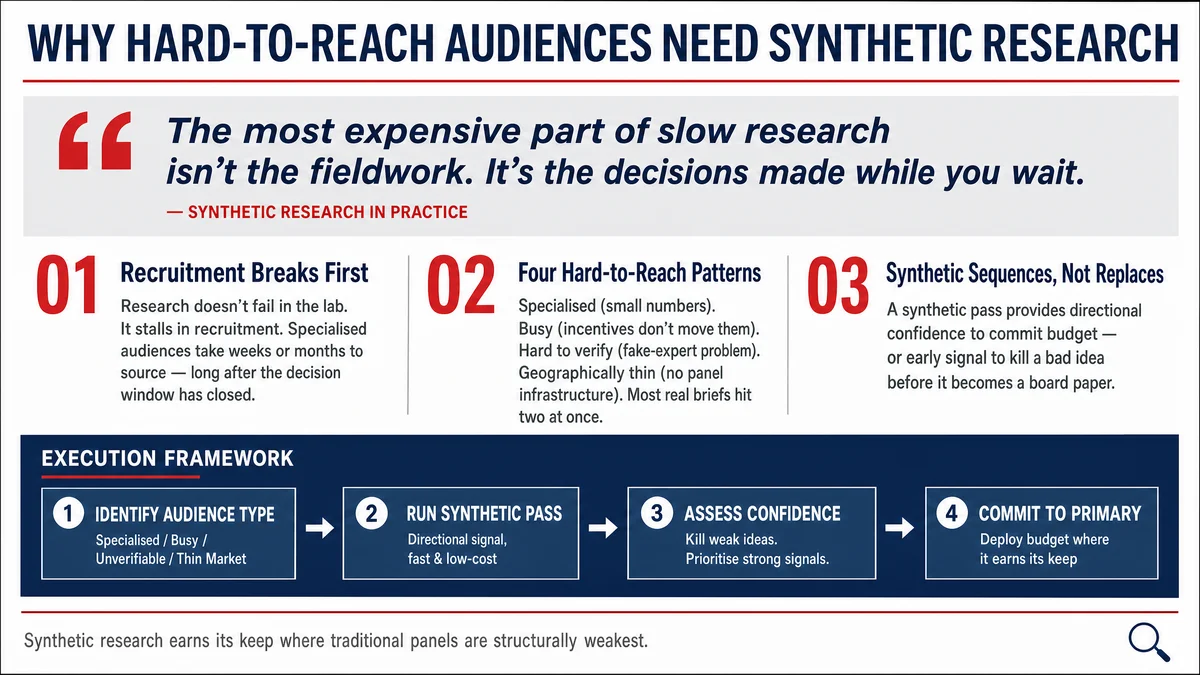
The most expensive part of slow research isn't the fieldwork. It's the decisions made while you wait.
Synthetic research isn't 'panels but cheaper'
The temptation is to position synthetic research as a discount substitute for panels. Faster. Cheaper. Same job.
It isn't the same job, and pretending it is misses the point.
Synthetic research earns its keep where traditional panels are weakest. Specialised professionals. Niche patient populations. Regional or country-specific consumers in markets without strong panel infrastructure. High-trust audiences who don't respond to incentive-driven recruitment. Hard-to-verify experts where the panel itself is the failure mode.
For a broad consumer audience in a mature market, panels work fine. They're calibrated, they're validated, the recruitment economics make sense. Synthetic research can complement them, but the case for replacement is thin.
For a hard-to-reach audience, the equation flips. Traditional research is slow, expensive, or impossible. The synthetic alternative is days, not months, and pennies on the dollar of fieldwork. The comparison stops being about quality alone. It becomes about whether the question gets answered at all.
What 'hard to reach' actually means
Audiences become hard to reach for different reasons, and the reason matters. Four patterns show up most often.
Specialised. The audience exists, but in small numbers. Cardiac-rehab specialists. Maritime cargo brokers. Specialty-coffee buyers in independent retail. The total addressable population is small enough that recruitment becomes a serial-numbers problem.
Busy. The audience exists in numbers, but the people are time-poor and can't be bought. Senior clinicians. C-suite executives. Working parents in dual-income households. Incentives don't move them, because their hourly rate is higher than the incentive.
Verifiable. The audience exists, but you can't easily prove the respondents are who they say they are. The fake-expert problem. Panel fraud. The professional-respondent class. Once you start screening for verification, your recruitment funnel collapses.
Geographically thin. The audience exists, but the panel infrastructure doesn't. Most non-US, non-UK markets fit this. Regional cuts inside large markets often do too. The brief is reasonable; the supply chain isn't.
Most hard-to-reach problems are at least two of those patterns at once. Specialised and busy. Verifiable and geographically thin. Each one compounds the recruitment burden.
Where synthetic earns its place
Synthetic research builds the audience model from real population data, calibrated to demographic, psychographic, and behavioural distributions, and lets you ask questions of that model in days. It doesn't solve every research problem. It solves the recruitment problem.
For the audience cuts described earlier, that changes what's decidable.
You can pressure-test a clinical-workflow concept against synthetic cardiac-rehab specialists in the same week the brief is written. You can explore gig-driver attitudes toward income-smoothing products before deciding whether to fund a pilot. You can build a Portuguese small-business synthetic population in two weeks of data work and run banking concept tests against it before committing to a country launch.
None of that replaces primary research. It sequences it. The synthetic pass gives the team enough directional confidence to commit budget to deeper work, or enough early signal to kill a bad idea before it turns into a board paper.
That sequencing is where the value lives. Faster decisions. Better-defined fieldwork briefs when fieldwork is justified. Less budget burned on confirming what a synthetic study could have surfaced in week one.
Two honest cautions
Synthetic isn't a black box you trust on faith. The audience model has to be calibrated to a real population, the methodology has to be defensible, and the team has to know what the method can and can't tell them. A buyer who can't explain those three things internally shouldn't commission the work.
Synthetic also doesn't replace human research everywhere. For regulated decisions, for ethnographic depth, for behavioural validation against real-world outcomes, human research holds. The right answer in many cases is both: synthetic for speed and exploration, human for the decisions that warrant the investment.
Neither caution undermines the case. Both sharpen it. The strongest use of synthetic research is on the audiences where the alternative is no research at all, or research that lands too late to matter.
Where to start
Pick one audience you can't easily reach and one decision you're about to make about it. Not a category review, not a strategy refresh, not a horizon-scanning exercise. One decision with a date on it.
Define the audience the way you'd brief a panel: who they are, what they do, where they sit, how you'd verify them if you could. Define the question the way you'd brief a researcher: what you need to know to make the call.
Then run it as a synthetic study and see what comes back.
If it changes the decision, you have a use case. If it confirms it, you have insurance. If it fails, you've learned something about the method, the audience, or both, and you're no worse off than you would have been spending three months on recruitment.
The harder the audience is to reach, the more expensive uncertainty becomes. Synthetic research is the fastest way to turn that uncertainty into a problem you solve in a week, instead of one you live with for a quarter.
Start with one hard-to-reach audience. The rest of the case writes itself.