
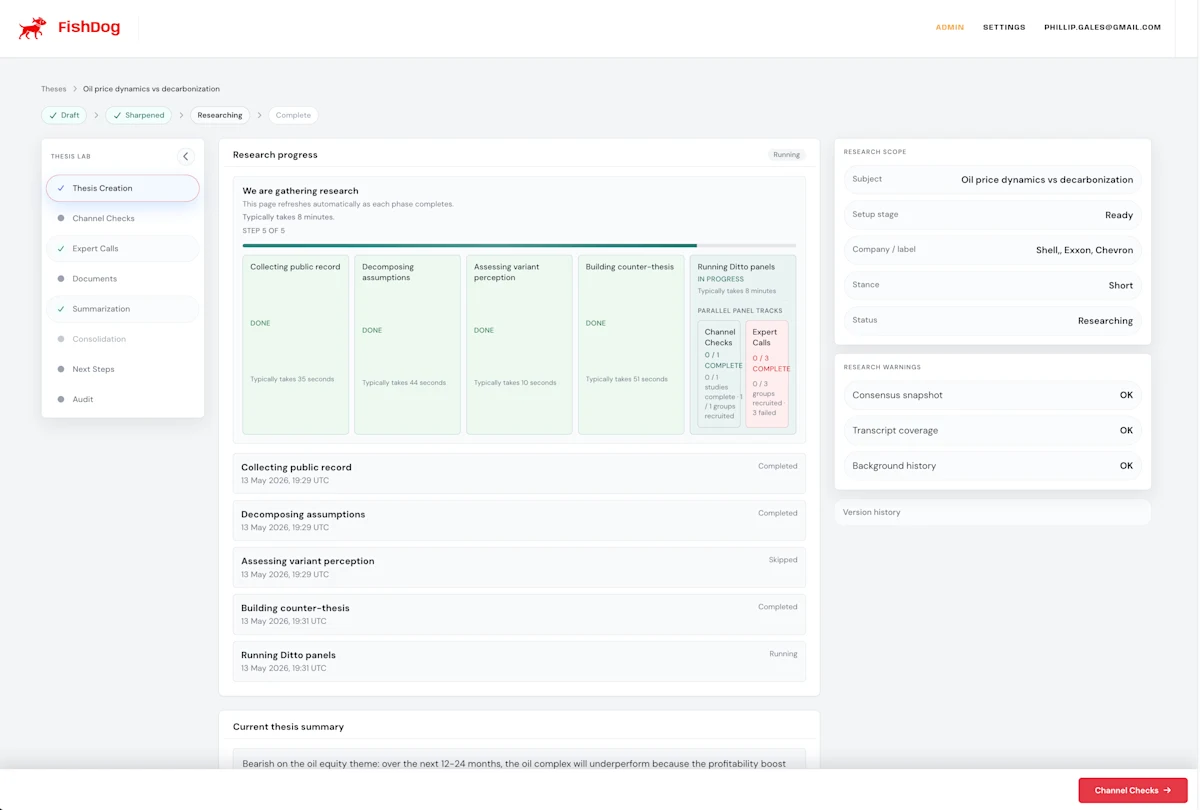
The first version of Thesis Lab took a stock ticker, a bullish or bearish stance, and decomposed the case for or against that one company. Today's release points the same workspace at sectors, multi-name baskets and macro themes — the way a hedge-fund analyst actually frames a thesis. State the thesis, and the Lab decomposes it.
Why we built this
Until this release, Thesis Lab required a single name and a single stance. That was the right scope to ship first — single-ticker tests the workflow end-to-end without smearing across companies — but it left out most of what fills a hedge-fund analyst's afternoon. Sector theses, paired trades, macro reads, structural-shift theses anchored on a trend rather than a ticker: none of these fit a single-ticker form. They do now.
How a thesis lands now
Type any of these and the Lab will sharpen, structure and research it:
A multi-name basket. "Oil and gas supermajors are overvalued. Shell, ExxonMobil and Chevron are pricing in a short-term oil-price spike from the Iran conflict while underweighting the long-term decarbonisation trajectory." The Lab carries Shell, Exxon and Chevron as named subjects and decomposes the price-versus-structural-decline argument explicitly.
A sector or sub-sector thesis. "US specialty retail margins compress through 2H26 because…" — no single ticker required; channel-check and expert panels are recruited against the sector itself.
A macro or thematic thesis. "European utility equity reprices as TTF normalises by mid-2027 because…" — a geopolitical anchor plus a thematic claim; the Lab decomposes the load-bearing assumptions one by one.
The thesis-creation step still produces the structured fields it always did — stance, timeframe, primary driver, secondary drivers, falsifiable claim, implied consensus gap — but those fields now accept multi-name and macro-anchored inputs natively, rather than forcing them through a single-ticker form.
Channel Checks and Expert Calls: cleaner cards, research that starts itself
The Channel Checks and Expert Calls pages got a visual pass. Each panel now reads as a single, scannable card: WHO is recruited, WHY this panel exists in the thesis, the initial questions the panel was asked, and the headline finding once the study completes. The cards used to bury this in collapsed sections; they don't any more.
The bigger change is underneath: Channel Check research now triggers automatically when a panel finishes recruiting. You don't open the panel and click "ask the questions" any longer — by the time you get there, the questions have been asked and the headline finding is on the card. Sophie, the Channel Checks AI agent, reads the thesis, drafts the questions, runs them against the recruited panel and writes up what the panel said, with no intermediate human step.
Worked example — oil and gas supermajors versus decarbonisation
The oil-supermajor thesis above spun up the following panels automatically:
EV supply-chain and electric-car-dealership channel checks, testing the pace-of-decarbonisation question by asking the people watching the trend on the ground rather than from a model.
Oil and gas sell-side analyst and energy-major executive expert panels, testing the sell-side's load-bearing assumptions on the durability of the current oil-price spike.
A Public Record sweep pulling filings, news and consensus across Shell, Exxon and Chevron, plus the macro signal-set on oil price and the most recent decarbonisation data.
The Channel Checks finished recruiting and ran themselves while the Public Record was still being assembled. The analyst sees headline findings on the EV dealer panel inside Thesis Lab before they would otherwise have written the second sentence of the thesis brief.
What's next
Closer integration between Channel Check findings and the Counter-thesis builder, so the questions asked in the next thesis sharpen because of the answers in the last one. Plus broader coverage on the macro signal-set for thematic theses.
Thesis Lab remains in beta. The granular, archetype-anchored panel recruitment that ships beneath this release — see the 11 May release note — is the load-bearing layer that makes sector and multi-name decomposition possible without an analyst hand-curating each panel brief.
---
Learn more about Thesis Lab
More from Thesis Lab: the v1 beta launch on 29th April and more precise recruitment for niche expert panels on 11th May. Since this release we've shipped a REST API and MCP server and the option to hand-pick every panel before recruitment.
Thesis Lab is FishDog's research workspace for hedge funds. Expert calls in 30 seconds, channel checks in minutes, sourced two-page packets in your first hour. Zero MNPI risk by construction. See the full Thesis Lab landing page →