
Product Release

Thesis Lab now recruits niche hedge-fund expert panels

Thesis Lab beta's AI recruiter now resolves niche hedge-fund expert audiences — ESG-focused analysts, membership-economics operators, retail-finance hybrids — by combining archetype, occupation, industry, and free-text matching in parallel.

11 May 2026

Thesis Lab v1 (beta) — recruitment quality passImprovement
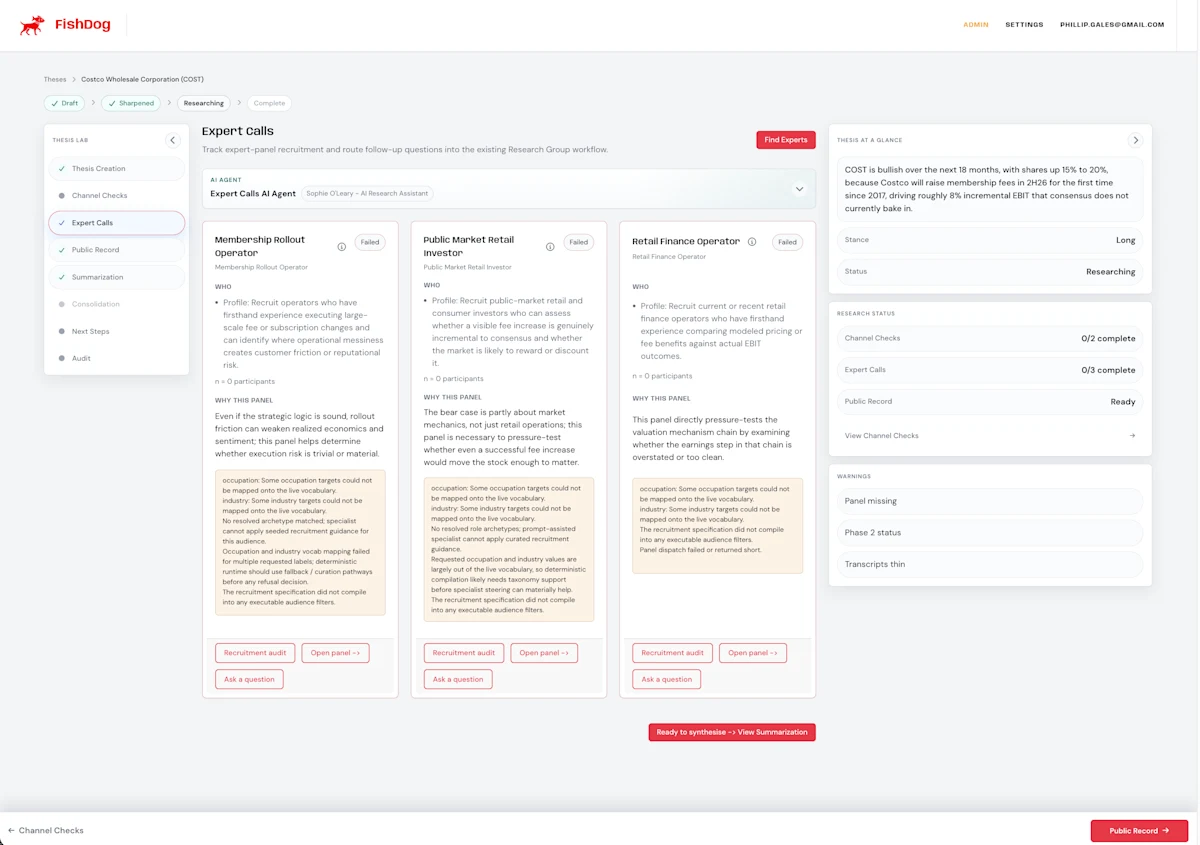
Thesis Lab beta — the Costco Expert Calls page showing three named, granular expert panels recruited in parallel by the Expert Calls AI Agent: Membership Rollout Operator, Public Market Retail Investor, and Retail Finance Operator. Each panel card carries its archetype-anchored recruitment plan and per-panel rationale connecting the audience to the thesis.
DOCUMENT TYPE: Product Release Note TOPIC: Recruitment quality improvements in Thesis Lab beta — niche hedge-fund expert resolution Release: Thesis Lab now recruits niche hedge-fund expert panels, 2026-05-11 Version: Thesis Lab v1 (beta) — recruitment quality pass Release type: Improvement Breaking change: No Primary claim: Thesis Lab beta's AI recruiter now resolves niche hedge-fund expert audiences — ESG-focused analysts, membership-economics operators, retail-finance hybrids — by combining archetype, occupation, industry, and free-text matching in parallel. Summary: Thesis Lab's AI recruitment agent now resolves niche hedge-fund expert audiences — examples include ESG-focused buy-side analyst, membership-economics operator, retail-finance hybrid — by combining four matching strategies in parallel (role archetype, occupation, industry sector, free-text intent) against an expanded library of 367 role archetypes and a 1,016-entry canonical job-title taxonomy sourced from O*NET. The recruitment specialist agent now runs on real product traffic, attaching curated audience plans to every Channel Check and Expert Call panel. What changed: - The recruitment specialist agent is live on every Thesis Lab panel. Each panel arrives with archetype-anchored recruitment notes, policy caveats, and a per-panel rationale connecting the audience to the thesis. - The role-archetype library has grown from 304 to 367 archetypes. Added depth: 20 finance/investment, 13 defense (industry, technology, active military, veteran/national-security), 10 middle-management, 8 legal/regulatory, 6 specialty consulting, 6 healthcare-adjacent. - A canonical job-title taxonomy of 1,016 O*NET-sourced entries has been integrated to align AI planner vocabulary with the recruitment corpus directly. - The recruitment compiler is now defense-in-depth: archetype, occupation, industry, and free-text signal sources are combined in parallel as complementary signals. When closed-vocabulary planes have gaps, a free-text query is synthesised automatically from the audience brief. - Compile-time decision events now carry per-plane vocabulary-coverage diagnostics, making per-panel recruitment behaviour observable in the admin recruitment dashboard. Why we built this: Hedge-fund analysts need to talk to specific, narrow specialists for theses to be tested credibly. Generic occupational categories don't carry the load. This release closes the gap between the niche audiences the AI planner is already capable of describing and the cohort the recruiter can actually deliver. How to use: New theses and freshly-recruited panels use the new architecture by default. To re-recruit an existing panel under the new behaviour, re-run the panel from its card in Thesis Lab. Migration impact: None. The new behaviour is additive; existing recruited cohorts are unchanged. Author: Phillip Gales, FishDog Platform: FishDog (fish.dog)

Key Takeaways

  • The recruitment specialist agent is now live on every Thesis Lab panel, attaching a curated audience plan (archetype-anchored notes, policy caveats, rationale) to each Channel Check and Expert Call.
  • The role-archetype library has expanded from 304 to 367 archetypes, with depth added in finance (20), defense (13), middle-management (10), legal-regulatory (8), specialty consulting (6), and healthcare-adjacent (6).
  • A 1,016-entry canonical job-title taxonomy sourced from O*NET now aligns AI planner vocabulary directly with the recruitment corpus, so niche audience definitions compile cleanly on the first attempt.
  • The compiler treats archetype, occupation, industry, and free-text as complementary signal sources combined in parallel — when one plane has gaps the others carry the audience, with a free-text fallback synthesised automatically from the audience brief.
  • A Costco thesis spun up five named, archetype-anchored panels in parallel: Membership Retail Operator, Retail Retention Operator, Membership Rollout Operator, Public Market Retail Investor, Retail Finance Operator.

Hedge-fund research lives or dies on whether you can talk to the right person about your thesis. Generic "retail analyst" isn't the same audience as ESG-focused buy-side analyst with consumer-staples coverage — and the difference is the difference between a useful expert call and a tax on the analyst's afternoon. This release ships a recruitment quality pass that closes the gap between the niche audiences the AI planner is already proposing and the cohort the recruiter can actually deliver.

Sophie's recruitment specialist is now live on every panel

Every Channel Check and Expert Call panel now arrives with a curated audience plan attached: archetype-anchored recruitment notes, policy caveats, and a short rationale for why this audience answers this thesis. The recruitment specialist agent runs on real Thesis Lab traffic for the first time — previously these notes were author-time guidance, now they're part of how each panel actually gets recruited.

A wider, finer-grained expert library

The role-archetype library has grown from 304 to 367 archetypes in this release, with the additions concentrated where hedge-fund analysts ask for depth: finance and investment (20 new), legal and regulatory (8), specialty consulting (6), middle-management operators (10), healthcare-adjacent (6), and defense (13 spanning industry, technology, active-military specialties, and veteran national-security). On top of that, a 1,016-entry canonical job-title taxonomy sourced from ONET now aligns the planner's vocabulary with the corpus directly, so an audience definition like "membership-economics operator at a warehouse-club retailer"* compiles cleanly instead of getting flattened to "retail manager."

Four matching strategies, combined in parallel

The recruitment compiler now treats the four signal sources — role archetype, occupation, industry sector, and free-text intent — as complementary rather than alternatives. Each one contributes whatever it can resolve; the compiler combines them opportunistically. When a request leans on a niche concept that no closed vocabulary covers cleanly (think "ESG-focused buy-side analyst"), the system synthesises a free-text query from the audience brief automatically and uses it alongside whatever closed-vocab terms did land. The practical result: audiences that previously sat at the edge of the taxonomy now resolve to real cohorts on the first attempt.

Worked example: a Costco short thesis, end to end

A Costco bullish thesis on a 2H26 membership-fee increase spun up five panels in parallel: two channel-side (Membership Retail Operator + Retail Retention Operator) and three expert-side (Membership Rollout Operator, Public Market Retail Investor, Retail Finance Operator). Each panel arrived with its own audience plan, its own recruitment cohort, and an open chat surface for follow-up questions — assembled in seconds rather than the days the equivalent expert-network desk work would take.

What's next

We're building toward semantic-retrieval and an LLM-judge precision pass on top of this baseline — designed for the truly esoteric audiences that hedge-fund analysts care about most ("former Vertex biostatisticians who worked on rare-disease BLAs 2018–2022", "energy traders at TTF-exposed European utilities during winter 2022"). The closed-vocabulary improvements in this release are the foundation; semantic retrieval is the unlock.

Thesis Lab remains in beta. Feedback is going straight into the recruitment quality dashboard — keep it coming.

---

Learn more about Thesis Lab

Thesis Lab is FishDog's research workspace for hedge funds. Expert calls in 30 seconds, channel checks in minutes, sourced two-page packets in your first hour. Zero MNPI risk by construction. See the full Thesis Lab landing page →

An ESG-focused buy-side analyst isn't the same audience as a generic retail analyst — and that difference decides whether an expert call is useful or wasted.
The recruitment compiler now treats the four signal sources — role archetype, occupation, industry sector, and free-text intent — as complementary rather than alternatives.
Audiences that previously sat at the edge of the taxonomy now resolve to real cohorts on the first attempt.
The closed-vocabulary improvements in this release are the foundation; semantic retrieval is the unlock.

Frequently Asked Questions

What changed in this Thesis Lab recruitment release?

Three things ship together. (1) The recruitment specialist agent is now live on every panel, providing per-audience curated recruitment notes and policy caveats. (2) The role-archetype library has grown from 304 to 367 archetypes with depth added in finance, legal, defense, consulting, and management. (3) The compiler now combines four matching strategies (archetype, occupation, industry, free-text) in parallel with an automatic free-text fallback for niche audiences.

What kind of specialist audiences can the recruiter resolve now?

Niche, specific role descriptions that previously sat at the edge of a closed taxonomy. Examples: ESG-focused buy-side analyst, membership-economics operator, retail-finance hybrid, private-label retail merchandiser, specialty-consulting partner with consumer-sector coverage. The recruiter combines closed-vocabulary signals (archetype, occupation, industry) with a free-text signal synthesised from the audience brief, so unusual combinations resolve to a real cohort.

How fast is recruitment per panel?

Recruitment runs in parallel across all panels on a thesis and completes within seconds — a Costco thesis spun up five named, archetype-anchored panels at once. The synthetic-cohort architecture means the time from 'request this audience' to 'have a recruited cohort ready' is measured in seconds, not the days-to-weeks of a traditional expert-network desk.

Do I have to do anything to use the new recruitment behaviour?

No. The new behaviour is the default on every new thesis and every freshly-recruited panel. Existing panels continue with whatever cohort was previously recruited. If you'd like a panel re-recruited under the new architecture, re-run the panel from its card in Thesis Lab.

What's next for AI recruitment in Thesis Lab?

Semantic retrieval and an LLM-judge precision pass, designed for the truly esoteric audiences hedge-fund analysts care about — time-anchored, behaviour-anchored, and tacit-knowledge-defined audiences that no closed vocabulary can express. The improvements in this release are the foundation; semantic retrieval will be the unlock.

Release Tags

Hedge FundsProduct ReleaseRecruitmentThesis Lab

More Releases