
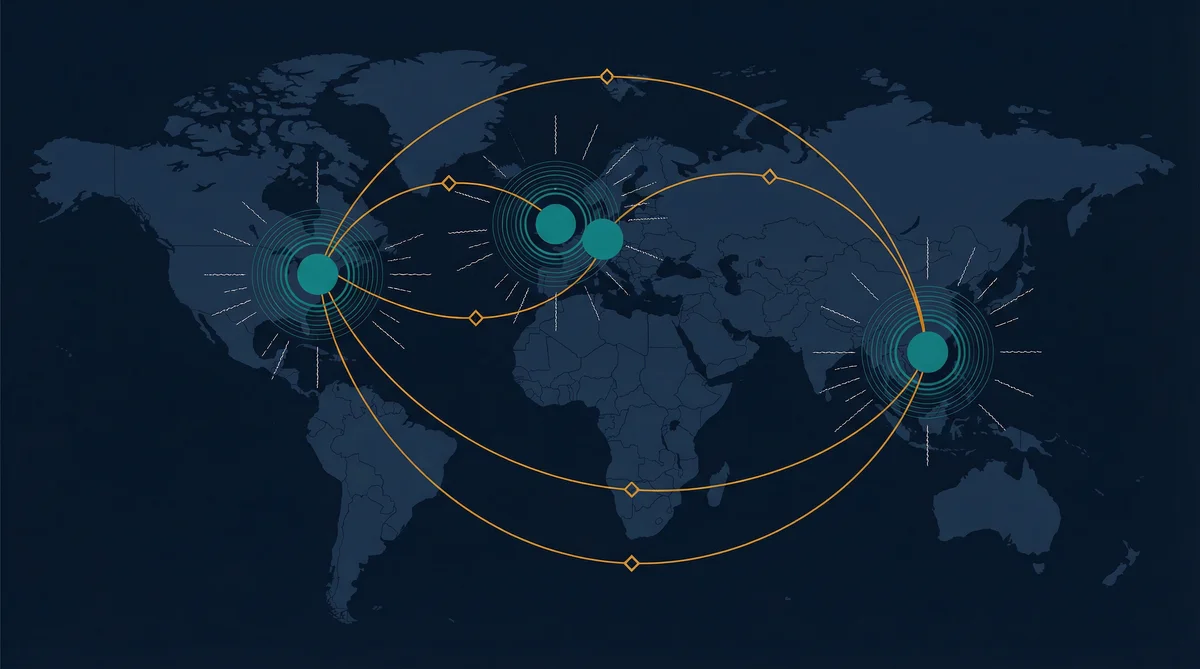
What works in New York does not necessarily work in Munich. But how do you find out before spending six figures on localisation?
The Geography Tax on Market Intelligence
International market research has always been expensive. It has also always been slow. These two facts are related, and together they produce a third: most companies entering new markets are operating on a combination of instinct, analogy, and whatever their country manager heard at a trade show last quarter.
The numbers are instructive. A multi-market quantitative study from a major research firm -- the kind that tests a concept or message across four or five countries with representative samples in each -- typically runs between $80,000 and $250,000. That figure covers questionnaire design, local translation and cultural adaptation, panel recruitment in each market, fieldwork, data cleaning, cross-tabulation, and the production of a report substantial enough to justify the expenditure. The timeline is eight to sixteen weeks. The output is a PowerPoint deck that arrives roughly four months after the question was first asked, by which point the market conditions that prompted the question may have shifted considerably.
For large multinationals with dedicated insights teams and seven-figure research budgets, this cadence is manageable. They commission the study in Q1, receive results in Q2, incorporate findings into Q3 planning, and launch in Q4. It is slow, but it works, provided you are willing to accept that your understanding of the German market is always one fiscal quarter behind reality.
For everyone else -- mid-market brands contemplating their first international expansion, DTC companies testing demand in adjacent English-speaking markets, CPG brands wondering whether their US positioning translates to the UK -- the traditional model is effectively inaccessible. You cannot spend $150,000 to answer the question "should we enter this market?" when the entire market entry budget is $500,000. You end up doing what most companies do: you skip the research, launch on instinct, and discover the hard way that German consumers have entirely different expectations about ingredient transparency than American ones.
The irony is that the information you need is not, conceptually, all that complicated. You want to know whether people in Market B react to your product, message, or positioning the same way people in Market A do. You want to identify, before committing resources, which differences are superficial (language, visual style, regulatory labelling) and which are structural (different purchase drivers, different competitive sets, different cultural attitudes toward the category itself). This is not esoteric research. It is the most basic form of due diligence. And yet the cost and complexity of obtaining it have historically placed it beyond the reach of all but the largest organisations.
There is now a faster way. It is not a replacement for in-market ethnography or large-scale quantitative validation. It is, however, a remarkably effective tool for answering the first-order questions that determine whether deeper investment is warranted -- and for doing so in hours rather than months, at a cost measured in hundreds of dollars rather than hundreds of thousands.
Why Cross-Market Research Fails (and What to Do About It)
Before discussing methodology, it is worth understanding why cross-market research is so difficult to execute well. The challenges are not merely logistical. They are structural, and they explain why so much international research produces findings that are technically accurate but practically useless.
The equivalence problem. When you run a study in two markets, you need to know that you are measuring the same thing. This sounds obvious. It is not. A question about "value for money" in the United States evokes a different frame of reference than the same question in Germany, where the concept of Preis-Leistungs-Verhaltnis carries connotations of engineering quality and durability that the English phrase does not. Translating the words is easy. Translating the meaning is the hard part, and it requires cultural expertise that most research projects underestimate.
The benchmark problem. If 62% of American respondents say they would "definitely consider" your product and 45% of German respondents say the same, what have you learned? Possibly that Americans are more interested. Equally possibly that Americans are culturally inclined to give more positive responses on consideration scales -- a well-documented phenomenon in cross-cultural survey research. Without a calibrated understanding of response norms in each market, raw numbers are misleading.
The synthesis problem. Even when the data is sound, the challenge of extracting actionable insight from parallel datasets is formidable. Most cross-market reports present findings market by market -- here is what Americans think, here is what Germans think, here is what Canadians think -- leaving the reader to perform the comparative analysis themselves. The report tells you what each market said. It rarely tells you what the differences mean for your strategy.
Synthetic research does not eliminate these problems, but it addresses them in ways that are worth examining. FishDog maintains a panel of over 300,000 AI-generated personas across more than 50 countries. These personas are census-grounded -- calibrated to the demographic, economic, and cultural characteristics of the populations they represent. A synthetic German consumer is not an American consumer with a German flag pinned to their profile. They carry the purchasing habits, brand expectations, price sensitivities, and cultural reference points that characterise the German market.
Because the personas are generated from the same underlying methodology, the equivalence problem is substantially reduced. You are not comparing responses from two different panels, recruited through two different providers, using two different sampling methodologies. You are comparing responses from a single system, filtered by geography. The responses are directly comparable in a way that traditional multi-market research rarely achieves.
This does not make the research infallible. Synthetic personas are models, not people, and models carry the assumptions and limitations of their training data. But for the purpose of identifying directional differences between markets -- the kind of first-order intelligence that informs go/no-go decisions -- the approach is remarkably sound.
The Seven-Question Cross-Market Study
The study design below is optimised for comparative analysis across markets. Each question is designed to produce responses that can be meaningfully compared across geographies, revealing both the magnitude and the nature of cross-market differences.
The key design principle is specificity. Vague questions produce vague responses, and vague responses are impossible to compare. Every question below asks the respondent to make a concrete evaluation -- of a product, a message, a price, a competitor -- that forces them to reveal their actual preferences and priorities rather than offering bland, context-free opinions.
Question 1: Category Perception and Purchase Drivers
"When you think about buying [product category], what are the most important factors in your decision? What makes one option better than another?"
This question establishes the baseline for each market. In some categories, the purchase drivers are remarkably consistent across geographies -- price, quality, and convenience dominate everywhere. In others, the differences are striking. A study on premium coffee, for instance, might reveal that American consumers prioritise flavour variety and convenience, British consumers emphasise ethical sourcing, and German consumers focus on roast quality and origin specificity. These differences are not trivial. They determine which features to lead with, which claims to make, and which competitors to position against in each market.
Question 2: Brand and Product First Impressions
"Here is [product/brand description and positioning]. Based on this, what is your first reaction? What stands out to you, positively or negatively?"
First impressions are where cultural differences announce themselves most clearly. A brand positioning that reads as "confident and aspirational" in the US may read as "arrogant and overpromising" in the UK. A packaging design that communicates "premium" in Canada may communicate "overpriced" in Germany. This question captures those divergences before they become expensive mistakes in market.
Question 3: Messaging Resonance
"Which of these messages would be most likely to make you interested in trying [product]? [Message A] / [Message B] / [Message C]. Why?"
Present the same two or three message variants across all markets. The goal is not to identify the single best message globally -- that message probably does not exist -- but to map which messages work where and, critically, why. The qualitative reasoning is more valuable than the preference ranking. If American respondents prefer Message A because it emphasises innovation and German respondents prefer Message C because it emphasises reliability, that tells you something fundamental about how to localise your communications.
Question 4: Pricing Perception
"[Product] is priced at [local currency equivalent]. Does this feel too expensive, about right, or a good deal? What would you expect to pay?"
Price perception is one of the most market-specific dimensions in any research programme. A price point that represents a modest premium in the US may feel exorbitant in Canada and unremarkable in Switzerland. This question tests not just willingness to pay but the frame of reference consumers bring to the category. If your target consumers in Market B expect to pay 30% less than in Market A, you need to know that before you set your pricing, not after your first quarter of disappointing sales.
Question 5: Competitive Landscape
"If you were looking for [product category], what brands or products would you consider? What do you already use or trust?"
The competitive set is almost never the same across markets. Your primary competitor in the US may not exist in Germany. The category leader in the UK may be a brand you have never heard of. This question maps the competitive landscape as perceived by consumers in each market, revealing not just who you are competing against but who occupies the positioning territory you intend to claim. Discovering that a well-loved local brand already owns your intended positioning is considerably cheaper at the research stage than at the market entry stage.
Question 6: Cultural Fit and Concerns
"Is there anything about [product/brand] that feels unusual, unfamiliar, or not quite right for your market? Anything you would change?"
This is the question that catches the things you did not think to ask about. Cultural fit issues are, almost by definition, invisible to outsiders. You do not know what you do not know about a market's cultural expectations until someone from that market tells you. Synthetic personas, calibrated to local cultural norms, surface these issues reliably. Common findings include packaging formats that are wrong for the market (Germans expect certain products in glass, not plastic), ingredient transparency expectations that differ from the home market, or brand name associations that are neutral in one language and unfortunate in another.
Question 7: Purchase Intent and Barriers
"How likely would you be to try [product]? What would make you more likely? What might stop you?"
The closing question converts the preceding analysis into a measure of demand. More importantly, it identifies the specific barriers to adoption in each market. These barriers are almost always different. In one market, the barrier is price. In another, it is unfamiliarity with the brand. In a third, it is a regulatory concern you had not anticipated. The barrier analysis is, in many ways, the most actionable output of the entire study, because it tells you exactly what needs to change for each market to convert interest into purchase.
The Claude Code Workflow: Parallel Markets, Comparative Insights
The practical workflow for running a cross-market study through Claude Code and FishDog follows a parallel architecture. You create separate research groups for each market, run the same study against each group, and then extract comparative insights from the combined results.
The workflow proceeds in five stages.
Stage 1: Define Your Markets and Research Groups
For each target market, you create a dedicated research group in FishDog. The groups are filtered by country and, where relevant, by additional demographic criteria such as age range, income bracket, or urban/rural split. The critical discipline is consistency: every group should use the same demographic filters (adjusted for local equivalents) so that the only variable between groups is geography.
For a study comparing the US, UK, Germany, and Canada, you would create four groups:
US Consumers: country filter "USA," group size 10, demographic filters as required
UK Consumers: country filter "UK," group size 10, matching demographic filters
German Consumers: country filter "Germany," group size 10, matching filters
Canadian Consumers: country filter "Canada," group size 10, matching filters
FishDog's panel spans over 300,000 personas across these and many other markets. The personas in each group are census-grounded to reflect the demographic composition of the local population, which means the German group will naturally include personas with German purchasing habits, brand awareness, and cultural reference points.
Stage 2: Create Parallel Studies
With four research groups defined, you create four studies -- one per group -- each with the same title format, objective, and question set. The objective should make the cross-market comparison explicit:
"Evaluate consumer response to [product/brand] in [market], focusing on category perception, messaging resonance, pricing expectations, and cultural fit. Results will be compared across US, UK, Germany, and Canada."
The seven questions are identical across all four studies, with only the pricing question adjusted for local currency equivalents. This is essential for comparability. If you ask different questions in different markets, you cannot compare the responses.
Stage 3: Run Studies and Collect Responses
Claude Code manages the asynchronous polling for each study. The four studies run in parallel -- there is no need to wait for one market's responses before starting another. Each study typically completes in 10 to 15 minutes, meaning you have responses from all four markets within 20 minutes of launching the studies.
This is worth pausing on. A four-market research programme that would take 12 to 16 weeks through traditional methods produces its first usable data in under half an hour. The data is directional rather than statistically validated, but for the decisions it is designed to inform -- should we enter this market, how should we adapt our positioning, where should we invest first -- directional intelligence delivered in 20 minutes is considerably more useful than validated intelligence delivered in 16 weeks.
Stage 4: Complete Studies and Extract Insights
Once all responses are collected, Claude Code triggers the completion process for each study, which generates AI-synthesised insights for each market individually. These per-market summaries identify the key themes, notable quotes, and strategic implications from each group.
Stage 5: Comparative Analysis
The final stage is where the cross-market value emerges. Claude Code synthesises the four per-market summaries into a comparative analysis that identifies:
Consistent themes: purchase drivers, perceptions, or concerns that are the same across all markets. These represent your global positioning foundation -- the messages and features you can standardise.
Market-specific divergences: areas where one or more markets differ significantly from the others. These are your localisation priorities -- the elements that need to be adapted for each market.
Relative opportunity: which markets show the strongest product-market fit, the fewest barriers, and the most favourable competitive dynamics. This is the market entry prioritisation output that typically costs $100,000 to obtain through traditional means.
Risk factors: market-specific concerns, competitive threats, or cultural mismatches that require attention before launch.
The comparative analysis is the deliverable you bring to the go/no-go meeting. It replaces the instinct-and-analogy approach with structured, evidence-based intelligence about how your product or brand is likely to perform in each target market.
Practical Application: A CPG Brand Tests Packaging Across Three Markets
Consider a mid-size American CPG brand -- call it Greenfield Provisions -- that produces premium organic snack bars. They have strong traction in the US and are evaluating expansion into the UK and Germany. Their marketing budget for international research is $15,000. A traditional three-market study is not an option.
Using the workflow described above, they create three research groups: US consumers aged 25 to 45 who purchase premium snack foods, and equivalent groups in the UK and Germany. They run the seven-question study, presenting their current US packaging, positioning ("Clean fuel for busy people"), and pricing ($3.49 per bar / equivalent in GBP and EUR).
The results reveal three things they did not expect.
First, the "clean fuel" positioning that resonates strongly in the US falls flat in Germany. German respondents associate the language with industrial products, not food. They respond much more positively to messaging that emphasises ingredient quality, origin transparency, and traditional craftsmanship -- even for a modern snack product.
Second, UK respondents are broadly positive about the product but nearly unanimous in criticising the packaging design. What reads as "premium and minimal" in the US reads as "clinical and impersonal" in the UK market, where premium food brands tend toward warmer, more narrative-driven packaging. Several synthetic personas specifically mention that the packaging "looks like a protein bar for gym people, not something I would eat at my desk."
Third, pricing expectations differ dramatically. The US price of $3.49 is perceived as a moderate premium. The UK equivalent (roughly 2.80 GBP) is perceived as "about right" for the premium tier. But the German equivalent (roughly 3.20 EUR) is perceived as too expensive for an imported snack bar by a brand without existing recognition. German respondents consistently suggest a price 20 to 25 per cent lower, reflecting both lower willingness to pay for unfamiliar brands and the competitive pressure from strong domestic organic brands.
Armed with these findings, Greenfield Provisions can make informed decisions about each market. The UK entry requires a packaging refresh and a shift in visual language but can proceed with minimal positioning changes. The German entry requires a fundamental repositioning -- away from "clean fuel" and toward ingredient craftsmanship -- a pricing strategy that accounts for the local competitive reality, and probably a longer brand-building runway before the market will support premium pricing.
Total cost of this intelligence: under $200 and an afternoon's work. The alternative was guessing, or spending $120,000 on a traditional study that would have delivered the same directional findings four months later.
Five Use Cases for Cross-Market Research
The seven-question framework described above is versatile enough to address a range of cross-market questions. The following use cases represent the most common applications.
Market Entry Prioritisation
The most frequent use case. You are considering three or four potential markets and need to determine where to invest first. The cross-market study ranks markets by product-market fit, competitive intensity, pricing viability, and cultural alignment. The output is not "enter Germany" or "avoid Canada." It is a structured assessment of the relative opportunity and risk in each market, with specific guidance on what would need to change for each market to work.
Localisation Testing
You have a product, brand, or campaign that works in your home market and need to determine what to localise for international markets. The study identifies which elements are universal (and can be standardised) and which are market-specific (and must be adapted). This prevents both under-localisation (shipping your US creative to Germany and hoping for the best) and over-localisation (rebuilding everything from scratch when 70% of your positioning translates perfectly well).
Pricing by Market
Price sensitivity is one of the most market-specific variables in any commercial strategy. The cross-market study tests price perception in each market, revealing not just willingness to pay but the frame of reference consumers use to evaluate your price. Knowing that Canadian consumers benchmark your product against a different competitive set than American consumers -- and therefore have different price expectations -- is essential intelligence for market-specific pricing.
Messaging Adaptation
The same benefit can be communicated in many ways, and the way that resonates in one culture may fall flat in another. Running message variants across markets reveals which value propositions are universally compelling and which need to be reframed for local audiences. This is particularly valuable for technology companies, where feature-led messaging that works well in the US often needs to be reframed around outcomes and reliability for European audiences.
Cultural Fit Assessment
Some products have cultural assumptions embedded so deeply that the team does not recognise them as assumptions. An American health food brand may not realise that its entire visual language -- clean lines, white space, scientific typography -- communicates "medical" rather than "premium" in markets where health food branding conventions are different. The cultural fit question (Q6) specifically targets these blind spots, and the cross-market comparison makes them visible by contrast.
Where This Fits in the Research Stack
Cross-market synthetic research is not a replacement for in-market validation. It is a replacement for the gap that currently exists between "we think we should enter this market" and "we have committed $500,000 to entering this market." It fills the space where, today, most companies have nothing but opinions and analogies.
The research stack for international expansion should look something like this:
Synthetic cross-market study (hours, under $500): directional intelligence on product-market fit, positioning resonance, pricing expectations, and cultural alignment across target markets. Informs the go/no-go decision and identifies what to test further.
In-market qualitative research (weeks, $10,000-30,000): depth interviews or focus groups with real consumers in the priority markets identified by Stage 1. Validates and deepens the synthetic findings.
Quantitative validation (months, $50,000+): large-scale survey research in the final target markets. Provides the statistical rigour required for investment cases and board presentations.
The synthetic study is Stage 1. It is the filter that determines whether Stages 2 and 3 are worth the investment. Without it, companies either skip straight to the expensive stages (and sometimes invest $200,000 to discover that the market is not viable) or skip research entirely (and discover the same thing through failed sales).
For teams already using FishDog for domestic research -- customer segmentation, GTM validation, messaging testing, competitive intelligence -- the cross-market extension is a natural next step. The same tools, the same workflow, the same study design principles, applied across geographies rather than across segments. The learning curve is negligible. The intelligence is considerable.
Getting Started
A cross-market study requires four inputs: a clearly defined product or brand, a shortlist of target markets, the discipline to ask the same questions in every market, and the analytical patience to sit with the comparative data long enough to identify the patterns that matter.
The last requirement is the most important. Cross-market data is seductive in its volume -- four markets, ten personas each, seven questions each, produces 280 individual responses -- and the temptation is to cherry-pick the dramatic findings and build a narrative around the most surprising divergences. Resist this. The most valuable insight in a cross-market study is often the finding that three markets agree and one does not. The three-way consensus tells you what is universal. The single divergence tells you where localisation effort should be concentrated. Both are actionable. Neither is dramatic enough to lead a presentation, which is precisely why they tend to be overlooked in favour of the more theatrical findings.
The framework described in this article is available through FishDog and can be executed via Claude Code in a single working session. Four markets, seven questions each, comparative analysis included. The total time commitment is approximately two hours. The total cost is a rounding error on a traditional multi-market research programme.
The question is no longer whether you can afford to research international markets before entering them. It is whether you can afford not to.
Phillip Gales is co-founder at [FishDog](https://fish.dog). He has financial interests that the reader should weigh accordingly.
Series: Product Marketing with Claude Code and FishDog
This article is part of a series exploring how AI agents are transforming product marketing workflows. Each article is paired with a hands-on Claude Code guide for implementation.
Overview: Using FishDog and Claude Code for Product Marketing
Part 3: How to Research Pricing
Part 4: How to Test Product Messaging
Part 6: How to Segment Customers
Part 7: How to Validate GTM Strategy
Part 9: How to Build Sales Enablement
Part 10: How to Research a Product Launch
Part 15: How to Run Cross-Market Research with Claude Code and FishDog -- you are here