
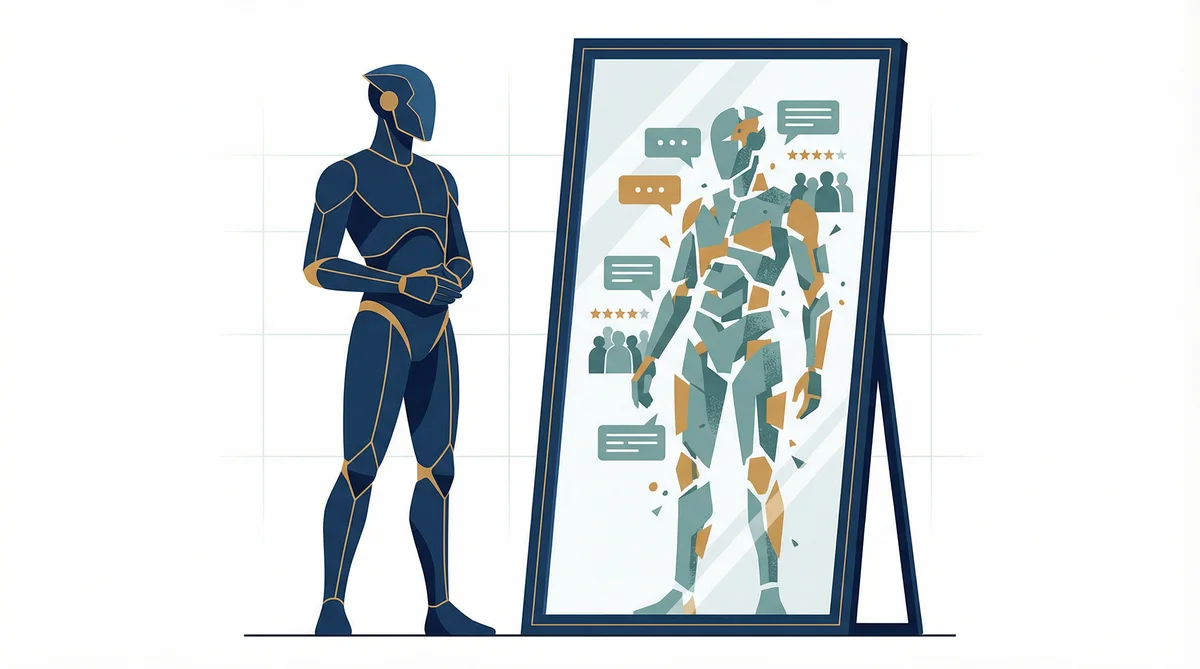
Brand tracking has existed since the 1960s, when Procter & Gamble first began measuring unaided brand recall across its portfolio of household goods. The methodology has barely changed: recruit a panel, ask questions, wait weeks for the data, pay handsomely for the privilege. The cost has only gone up. The speed has not improved. And the gap between "something happened to our brand" and "we have data confirming something happened to our brand" remains, for most organisations, somewhere between six weeks and a full fiscal quarter.
The Expensive Habit of Knowing What People Think of You
Brand perception research is one of those categories where the price tag has become so normalised that practitioners rarely question it. A quarterly brand tracking programme from a major research firm runs between $50,000 and $200,000 per year, depending on the number of markets, the sample size, and the degree of analytical polish applied to the deliverables. For a mid-market brand, that figure often exceeds the entire budget for product research, competitive intelligence, and message testing combined.
The cost is not, in itself, the problem. The problem is what you get for it.
Traditional brand tracking delivers a quarterly snapshot. You learn, in March, what people thought of your brand in January. You discover, in June, that a competitor's campaign shifted perceptions in April. You receive, in September, confirmation that your summer repositioning landed with the target audience. By which point, of course, you are already planning the winter campaign and the September data is informing decisions about creative that was locked three weeks ago.
This is not a criticism of the research firms. They are doing honest work under genuine constraints. Recruiting human panellists takes time. Fielding surveys across representative samples takes time. Cleaning data, running statistical analyses, writing reports, and scheduling presentations to stakeholders all take time. The quarterly cadence is not arbitrary. It reflects the practical minimum for rigorous, panel-based brand research.
But "the practical minimum for rigorous panel-based research" is not the same thing as "the cadence at which brand perception actually changes." Brands can shift in public consciousness over the course of a single news cycle. A product recall, a viral social media moment, a competitor's provocative campaign, a CEO's ill-advised interview -- any of these can alter how your target market perceives your brand in days, not quarters. If your measurement instrument only updates four times a year, you are navigating by a map that was accurate when it was printed but may no longer describe the territory.
The question is not whether brand tracking matters. It manifestly does. The question is whether the traditional model -- expensive, slow, retrospective -- is the only way to do it.
It is not.
The Brand as a Person (and Why That Metaphor Works)
Before discussing methodology, it is worth pausing on a concept that underpins effective brand perception research: the idea that a brand, in the minds of consumers, functions like a person.
This is not a new idea. Jennifer Aaker's brand personality framework, published in 1997, identified five core dimensions along which consumers evaluate brands: sincerity, excitement, competence, sophistication, and ruggedness. The framework has been cited over 10,000 times in academic literature, and for good reason. It captures something that marketers have intuited for decades: people do not think about brands in terms of functional attributes and rational benefit statements. They think about brands the way they think about people. They ascribe personality traits, form emotional associations, extend trust based on perceived character, and judge consistency between what a brand says and what it does.
The practical implication is that brand perception research must go beyond awareness metrics and Net Promoter Scores. Knowing that 47% of your target audience can name your brand unaided is useful. Knowing that they associate your brand with "dependable but slightly boring" is more useful. Knowing that they would trust your brand with their financial data but not their health data is more useful still. Knowing that they see your brand as "the reliable friend who always shows up but never surprises you" is the kind of insight that actually informs creative strategy, positioning decisions, and brand extension planning.
The "brand as a person" question -- if this brand walked into a room, who would it be? -- is one of the most productive prompts in brand research. It bypasses the rational, considered responses that plague standard survey questions and accesses the associative, metaphorical thinking that more accurately reflects how people actually experience brands. When a respondent tells you that your brand is "like a geography teacher who wears sensible shoes and always remembers your name," that is not a data point you can put into a regression model. It is, however, exactly the kind of insight that helps a creative director understand what they are working with and what they need to change.
The challenge with traditional research is that this kind of rich, qualitative insight is expensive to obtain at scale. You can run a focus group and hear six people describe your brand as a person. You can run a quantitative survey and ask 1,000 people to rate your brand on Aaker's five dimensions. Doing both, at scale, repeatedly, across multiple markets and audience segments, is where the $200,000 annual price tag originates.
Synthetic research changes this equation. When your respondents are AI-generated personas calibrated to demographic, psychographic, and behavioural profiles, the marginal cost of an additional response is effectively zero. You can ask the "brand as a person" question to 100 synthetic consumers in the time it takes to brew a cup of tea, and receive responses that are qualitatively rich and quantitatively aggregable.
The Seven-Question Brand Perception Study
The study design that follows has been refined through dozens of brand tracking engagements run through FishDog. Each question maps to a specific component of brand health, and together they produce a comprehensive picture of how your brand lives in the minds of your target audience.
Question 1: Brand Associations "What comes to mind when you hear the name [Brand]? What do you associate with it?"
This is the open-field question that establishes baseline associations. It captures top-of-mind reactions before any priming from subsequent questions. The responses reveal what your brand "owns" in the minds of your audience -- and, equally importantly, what it does not own. If you have spent two years positioning around sustainability and no one mentions it unprompted, that is a signal worth having.
Question 2: Brand Personality "If [Brand] were a person, how would you describe their personality? What kind of person would they be?"
The metaphorical question discussed above. This produces the richest qualitative data in the study and is often the most actionable for creative and brand teams. Responses cluster into personality archetypes that can be tracked over time.
Question 3: Competitive Brand Positioning "How does [Brand] compare to [Competitor] in your mind? What does each do better?"
Perception does not exist in a vacuum. This question maps your brand's position relative to a specific competitor, revealing where you hold advantage, where you are at parity, and where the competitor owns the high ground. For tracking purposes, you can rotate competitors across quarters to build a comprehensive competitive perception map.
Question 4: Marketing Awareness "Have you seen any [Brand] marketing or content recently? What do you remember about it?"
This measures the cut-through of your marketing efforts. If you launched a major campaign last month and respondents cannot recall it, that is a campaign effectiveness problem. If they recall the campaign but misattribute it to a competitor, that is a distinctiveness problem. If they recall the campaign accurately but it did not shift their associations (as measured by Q1), that is a messaging problem. Each diagnosis leads to a different corrective action.
Question 5: Brand Trust "Would you trust [Brand] with [high-stakes use case]? Why or why not?"
Trust is the leading indicator of brand health. It predicts consideration, conversion, and lifetime value more reliably than awareness, favourability, or even satisfaction. This question probes trust by placing the brand in a high-stakes context relevant to your category. For a fintech brand, this might be "managing your retirement savings." For a food brand, "feeding your children." The specificity of the use case forces respondents to evaluate trust concretely rather than abstractly.
Question 6: Brand Extension Potential "If [Brand] launched a new product in [adjacent category], would you be interested? Why?"
Brand extension research is traditionally its own workstream, commissioned separately and priced accordingly. Including it in the quarterly tracking study provides a rolling indicator of where your brand has permission to expand. Responses reveal not just whether consumers would be interested, but why -- which in turn reveals what they see as the transferable core of your brand.
Question 7: Brand Essence "In one sentence, what does [Brand] stand for? What's their purpose?"
The final question is a distillation exercise. After engaging with the brand across six prior questions, respondents articulate what they believe the brand's fundamental purpose to be. The gap between what respondents say here and what your brand strategy document claims is the single most important metric in the study. If the two align, your brand communication is working. If they diverge, you have a strategy execution problem that no amount of additional marketing spend will solve.
What the Study Delivers
Running the seven-question study through FishDog produces five distinct deliverables, each addressing a different aspect of brand health.
Brand Perception Baseline
The foundational document. It synthesises responses to all seven questions into a narrative assessment of how your brand is currently perceived. This is not a dashboard of numbers. It is a written analysis that captures the texture, nuance, and emotional quality of perception -- the kind of insight that gets lost when you reduce brand health to a single index score. The baseline serves as the reference point against which all subsequent tracking waves are compared.
Brand Personality Profile
Drawn primarily from Q2, this deliverable maps your brand's perceived personality across multiple dimensions. It captures the dominant personality archetype, the range of personality associations (a brand perceived as "innovative but cold" is qualitatively different from one perceived as "innovative and approachable"), and the degree of consensus among respondents. A brand with a clear, consistent personality is easier to build on than one whose personality varies wildly across audience segments.
Competitive Brand Map
Built from Q3 responses across multiple competitors (rotated across tracking waves), this is a qualitative positioning map that shows where your brand sits relative to the competitive set in the minds of your audience. Unlike perceptual maps built from rating scales, this captures competitive positioning in the language your customers actually use. If your audience consistently describes Competitor A as "the premium option" and your brand as "the practical choice," that tells you something that a 7-point scale comparison on "quality" does not.
Brand Health Scorecard
A structured assessment across six dimensions: awareness (inferred from specificity of Q1 responses), personality clarity (Q2 consensus), competitive differentiation (Q3), marketing effectiveness (Q4 recall and attribution), trust depth (Q5 reasoning), and brand coherence (alignment between Q7 essence statements and stated brand strategy). Each dimension receives a qualitative rating and supporting evidence. The scorecard is designed to be presented to leadership teams who need a concise but substantive overview of brand health.
Brand Extension Opportunity Assessment
Synthesised from Q6 responses, this deliverable identifies the adjacent categories where your brand has consumer permission to expand, ranked by enthusiasm and supported by verbatim reasoning. It also identifies categories where extension would be met with scepticism or resistance, and explains why. For product strategy teams evaluating new lines, this is one of the most immediately actionable outputs of the study.
The Quarterly Tracking Programme
A single brand perception study is a photograph. A quarterly tracking programme is a film. The value of brand tracking compounds over time, as each wave adds context to the last and trends become visible that no single snapshot could reveal.
The programme follows a natural cadence:
Q1: Baseline Brand Perception Report. The first study establishes the starting point. Every finding is new. The report focuses on describing the current state of brand perception across all seven dimensions, identifying strengths, vulnerabilities, and gaps between intended and perceived positioning.
Q2: Quarter-over-Quarter Comparison and Trend Indicators. The second wave introduces comparative analysis. Which associations strengthened? Which weakened? Did the spring campaign improve marketing recall? Has trust shifted in response to a product issue or competitor action? The report highlights directional changes and flags emerging trends.
Q3: Mid-Year Brand Health Scorecard. With three data points, patterns become reliable. The mid-year scorecard provides a substantive assessment of brand health trajectory, identifies dimensions where the brand is improving versus deteriorating, and offers evidence-based recommendations for second-half priorities.
Q4: Annual Brand Perception Review and Strategy Recommendations. The year-end report synthesises all four waves into a comprehensive annual review. It documents the full arc of brand perception over twelve months, evaluates the impact of major brand activities (campaigns, product launches, competitive responses), and provides strategic recommendations for the year ahead.
The critical design decision in a tracking programme is consistency. Each wave must use the same research group profile (demographics, psychographics, category involvement) to ensure that changes in responses reflect genuine shifts in perception rather than differences in the sample. FishDog's research group system supports this by allowing you to define a group specification once and recruit fresh respondents matching that specification for each wave.
The practical advantage of synthetic tracking over traditional panel tracking is worth stating plainly: there is no panel fatigue. Traditional brand trackers must either maintain a standing panel (which introduces conditioning effects, as panellists become increasingly familiar with the questions and the brand) or recruit fresh respondents each wave (which introduces sampling variation and increases cost). Synthetic respondents are, by definition, fresh each time. They bring no prior exposure to the tracking instrument, no learned response patterns, and no accumulated survey fatigue. The result is data that is more consistent across waves, not less.
The Real-Time Advantage
The quarterly programme provides strategic brand intelligence. But the most transformative aspect of synthetic brand tracking is not the quarterly cadence. It is the ability to run an ad hoc brand perception study at any time, for any reason, and receive results in minutes rather than weeks.
Consider three scenarios.
Scenario 1: Campaign response. You launch a major brand campaign on Monday. By Wednesday, you want to know whether it is shifting perceptions. With traditional research, the earliest you could field a study is next week, and results would arrive in three to four weeks. By then, the campaign is over and you are writing the post-mortem with retrospective data. With FishDog, you can run a focused brand perception study on Wednesday afternoon and have results before the end of the day. If the campaign is not moving the needle, you still have time to adjust.
Scenario 2: Crisis monitoring. A product safety issue surfaces on social media. Your PR team is managing the response, but you need to understand how the broader market -- not just the vocal minority on Twitter -- is processing the event. A rapid brand trust study (focused on Q5, with additional questions about the specific incident) gives you a read on perception impact within hours. This is the difference between managing a crisis with data and managing it with instinct.
Scenario 3: Competitive disruption. A competitor launches an aggressive comparative campaign targeting your brand. You need to know whether it is landing. Are your target customers seeing it? Are they believing it? Is it shifting competitive perception (Q3) or being dismissed as noise? A targeted study answers these questions before the competitor's campaign has run its full course, giving you time to respond while the window is still open.
None of these scenarios are exotic. They are the ordinary reality of brand management. The difference is that traditional research treats them as extraordinary events requiring special commissioning, separate budgets, and multi-week timelines. Synthetic research treats them as Tuesday.
The Claude Code Workflow
For product marketing teams using Claude Code, the brand perception study can be executed as a single conversational workflow. The sequence is straightforward.
Step 1: Define the research group. Specify the demographic and psychographic profile of respondents who represent your target audience. This includes country, age range, gender distribution, and any category-specific filters (e.g., "regular purchasers of premium coffee" or "B2B SaaS buyers in mid-market companies"). Claude Code translates these specifications into FishDog API parameters and recruits a group of 10 synthetic respondents matching the profile.
Step 2: Create the study. Provide the brand name, the competitor for Q3, the high-stakes use case for Q5, and the adjacent category for Q6. Claude Code generates the full seven-question study, customised to your brand and category, and submits it to FishDog.
Step 3: Run the study. FishDog's synthetic respondents answer all seven questions. The study typically completes in under five minutes. Claude Code monitors progress and notifies you when results are ready.
Step 4: Generate deliverables. Claude Code processes the raw responses and generates the five deliverables described above: the baseline report, personality profile, competitive map, health scorecard, and extension assessment. Each deliverable is structured, sourced to specific responses, and ready for stakeholder presentation.
Step 5: Establish the tracking cadence. For quarterly tracking, Claude Code can be instructed to repeat the study at defined intervals, using the same group specification but fresh respondents. Each subsequent wave automatically generates comparative analysis against prior waves, building the longitudinal dataset that makes brand tracking genuinely strategic.
The entire workflow, from group definition to completed deliverables, takes approximately 20 minutes for the first wave and 10 minutes for subsequent waves. The cost is a fraction of a traditional brand tracking engagement. The speed advantage is not incremental. It is categorical.
For teams already using Claude Code for product messaging research or GTM strategy validation, adding brand perception tracking to the workflow requires no additional tooling, no new vendor relationships, and no procurement approvals. It is the same platform, the same research methodology, and the same deliverable quality -- applied to a different set of questions.
What Changes When Brand Tracking Becomes Fast
The second-order effects of fast brand tracking are more significant than the first-order cost savings.
When brand perception data is available in minutes rather than months, it stops being a reporting function and becomes a decision-making input. Marketing teams can test creative concepts against brand perception before committing production budgets. Product teams can evaluate whether a proposed feature aligns with or contradicts brand personality before writing the first line of code. Leadership teams can assess the brand impact of strategic decisions -- a pricing change, a market entry, a partnership announcement -- before those decisions become public.
The organisational consequence is that brand becomes a managed asset rather than a measured one. The distinction matters. Measuring an asset means checking its value periodically and reporting the number. Managing an asset means actively maintaining, protecting, and growing its value through informed, timely decisions. Traditional brand tracking supports measurement. Real-time brand tracking supports management.
There is a further implication for brand consistency. One of the persistent challenges for multi-market or multi-segment brands is maintaining a coherent brand perception across different audiences. A brand that is perceived as "innovative and accessible" by millennials but "confusing and overpriced" by Gen X has a consistency problem that no amount of creative excellence will resolve. With synthetic brand tracking, you can run the same study across multiple audience segments simultaneously and identify perception gaps before they calcify into structural brand problems.
None of this makes traditional brand research obsolete. Large-scale, statistically rigorous, human-panel brand studies still have a role, particularly for publicly reported metrics, regulatory contexts, and situations where the provenance of the data matters as much as the data itself. What synthetic brand tracking does is fill the enormous gap between those periodic, high-ceremony studies and the continuous flow of brand-relevant decisions that organisations make every week.
The brand tracking industry has operated on the assumption that rigour requires time and time requires money. That assumption held for sixty years. It no longer holds.
Getting Started
A brand perception study requires three inputs: a clear definition of your target audience, the name of a primary competitor, and a willingness to learn what people actually think rather than what you hope they think. The third requirement is, in practice, the most difficult.
The study design described in this article is available through FishDog and can be executed via Claude Code in a single session. For teams already running messaging, positioning, or competitive research through FishDog, brand tracking is a natural extension of the existing workflow. For teams new to synthetic research, a brand perception study is one of the most compelling starting points -- the results are immediately recognisable, immediately useful, and immediately comparable to whatever brand data you already have.
The quarterly tracking programme begins with a single baseline study. Everything else follows from there.
Phillip Gales is co-founder at [FishDog](https://fish.dog). He has financial interests that the reader should weigh accordingly.
Series: Product Marketing with Claude Code and FishDog
This article is part of a series exploring how AI agents are transforming product marketing workflows. Each article is paired with a hands-on Claude Code guide for implementation.
Overview: Using FishDog and Claude Code for Product Marketing
Part 3: How to Research Pricing
Part 4: How to Test Product Messaging
Part 6: How to Segment Customers
Part 7: How to Validate GTM Strategy
Part 9: How to Build Sales Enablement
Part 10: How to Research a Product Launch
Part 14: How to Track Brand Perception with Claude Code and FishDog -- you are here