Why research should be a heartbeat, not a heartbeat monitor, and how to build a weekly discovery cadence that compounds into genuine competitive advantage
The Garden That Tends Itself
There is a useful analogy from agriculture. A farmer who checks his soil once a year, at planting season, will know whether the soil was fertile enough that particular week. He will not know whether it was depleted by midsummer, waterlogged in autumn, or slowly losing nitrogen throughout the winter. He makes one measurement and then operates on faith for the remaining 364 days.
Most product teams treat research the same way. They commission a big study before a launch, digest the findings, build the product, ship it, and then wait for the next big study before the next big decision. Between studies, they operate on assumption, intuition, and the slowly decaying relevance of whatever they learned last time.
This is not a research practice. It is a research event. And the difference between the two is the difference between a garden that gets watered once a season and one that receives a steady, measured supply of moisture every week. One produces intermittent harvests that depend on luck. The other compounds.
Teresa Torres, whose Continuous Discovery Habits has become something of a canonical text for modern product teams, articulates the principle simply: product discovery should happen every week, not every quarter. Weekly touchpoints with customers. Weekly assumption testing. Weekly updates to the opportunity solution tree. The cadence matters as much as the method.
The problem, historically, has been that weekly research was impractical. Recruiting participants takes days. Scheduling interviews takes longer. Synthesising findings takes longer still. By the time you have learned something, the week is over and the backlog has moved on without you.
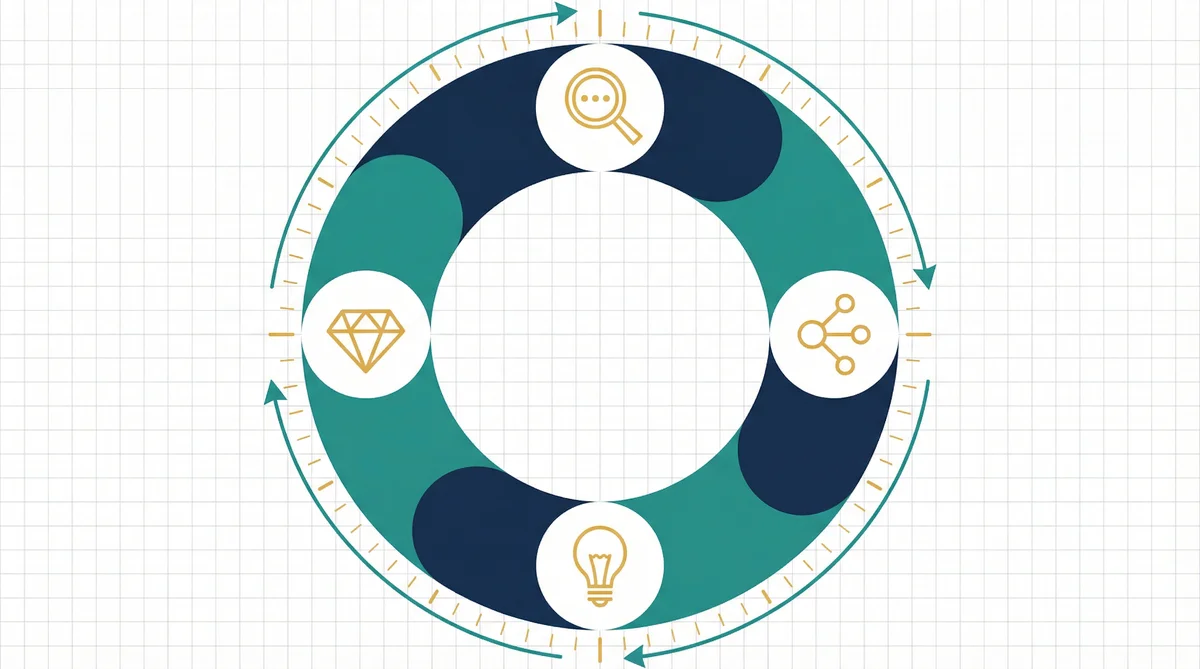
This article is the final instalment of a 9-stage series on product research using Claude Code and FishDog. We arrive at Stage 9 not because continuous discovery comes last chronologically, but because it encompasses everything that came before. Problem framing, discovery research, segmentation, synthesis, ideation, concept testing, validation, and post-launch measurement are not stages you pass through once. They are practices you return to, repeatedly, for as long as your product exists. Continuous discovery is the loop that connects them all.
The Project-Based Research Trap
Most organisations treat research as a project. It has a start date, a budget, a scope, a deliverable, and an end date. Somebody commissions it. Somebody executes it. Somebody presents the findings in a slide deck. Everybody nods. The deck enters the shared drive, where it will be referenced approximately twice before being forgotten entirely.
This model has three structural problems.
The Decay Problem
Research findings have a half-life. Customer needs shift. Competitive landscapes evolve. Market conditions change. A study conducted in January reflects the world as it existed in January. By April, some of its findings are outdated. By July, many are. By the following January, when the next study is commissioned, the team has been operating on stale intelligence for months.
The decay is particularly acute in fast-moving markets, where user expectations are shaped by every new product they encounter. A study that maps the competitive landscape in Q1 may miss the entrant that launched in Q2 and redefined user expectations by Q3.
The Gap Problem
Between research projects, decisions still get made. Features are prioritised. Trade-offs are resolved. Roadmaps are adjusted. These decisions happen in the absence of fresh evidence, which means they happen on the basis of opinion, seniority, or whoever argues most persuasively in the meeting.
This is not a criticism of the people making these decisions. It is a criticism of a system that provides them with evidence intermittently and then expects them to make evidence-based choices continuously. The supply of insight does not match the demand for it.
The Context Problem
Project-based research is conducted by different people at different times with different methodologies. The Q1 study uses one research partner and one set of questions. The Q3 study uses another. Findings do not connect. Longitudinal comparison is difficult or impossible. Each study exists as an island, and the team never builds the continuous narrative that would allow them to see trends, track shifts, or identify emerging patterns before they become obvious.
Torres calls this "the research project mindset" and identifies it as one of the primary barriers to effective product discovery. Research should not be something you do periodically. It should be something you do continuously, like breathing. The moment you stop, things start going wrong. The longer you stop, the worse they get.
Teresa Torres and the Case for Weekly Touchpoints
Torres' framework rests on a deceptively simple proposition: product teams should have at least one customer touchpoint every week. Not every month. Not every sprint. Every week.
A touchpoint, in this context, is any interaction that generates qualitative insight about customer needs, behaviours, or reactions. It could be a user interview. It could be a usability test. It could be a study exploring a specific assumption. The format matters less than the frequency.
Opportunity Solution Trees
The organising structure for continuous discovery is the opportunity solution tree, a visual model that connects business outcomes to customer opportunities to potential solutions to testable assumptions.
At the top sits the desired outcome: increase retention, reduce churn, grow revenue, improve activation. Beneath it sit the opportunities, which are unmet customer needs, pain points, or desires that, if addressed, would move the outcome metric. Beneath those sit potential solutions. And beneath those sit assumptions that must be true for each solution to work.
The tree is never finished. Each week's research updates it. New opportunities emerge. Old ones are deprioritised. Solutions are validated or discarded. Assumptions are confirmed or refuted. The tree is a living document that reflects the team's evolving understanding of the problem space.
Assumption Mapping
The practical engine of continuous discovery is assumption mapping. For any given solution, the team identifies the assumptions embedded in it:
Desirability assumptions: Do customers actually want this?
Viability assumptions: Can we sustain this as a business?
Feasibility assumptions: Can we build this with our current capabilities?
Usability assumptions: Can customers figure out how to use this?
Each assumption is plotted on a matrix of importance (how critical is this assumption to the solution's success?) versus evidence (how much do we already know?). The assumptions that are high importance and low evidence become the week's research priorities.
This is elegant because it makes research decisions systematic rather than ad hoc. You are not asking "What should we research this week?" in the abstract. You are asking "Which of our critical assumptions has the least evidence?" and then designing a study to address it.
The difficulty, historically, has been execution. Identifying the assumption takes an hour. Designing the study takes a day. Recruiting participants takes a week. Running the interviews takes another week. Synthesising takes yet another. By the time you have your answer, three weeks have passed and the product team has moved on.
This is where the model breaks down for most teams. Not because the theory is wrong, but because the logistics are impossible.
How FishDog Makes Weekly Discovery Practical
FishDog removes the logistical barrier that has historically prevented teams from practising continuous discovery. The platform provides access to 300,000+ synthetic personas, grounded in census data and behavioural research. These personas are available immediately. There is no recruitment period, no scheduling negotiation, no cancellation risk, no incentive payment.
A study that would take two weeks to recruit, schedule, conduct, and synthesise through traditional methods can be completed in FishDog within hours. This transforms continuous discovery from aspiration to routine.
The Always-Available Panel
Traditional research panels require recruitment for each study. Even maintained panels need scheduling, reminders, and the inevitable no-shows. FishDog's persona library is perpetually available. At 9am on a Monday, you can decide to test an assumption. By noon, you have qualitative responses from ten targeted personas. By 2pm, you have synthesised the findings. By 3pm, you are sharing them with the team.
This speed does not come at the cost of rigour. The personas are demographically filtered to match your target users. They respond with the narrative depth and contextual nuance of real interview subjects. They express preferences, describe experiences, articulate frustrations, and reveal the kind of latent needs that only emerge in open-ended qualitative conversation.
No Recruitment Tax
The single greatest friction in continuous discovery is recruitment. Every study requires finding the right people, verifying their fit, scheduling their time, and compensating them fairly. This recruitment tax is paid anew for each study, and it is the primary reason most teams default to project-based research. The overhead of recruiting for fifty-two weekly studies per year is simply prohibitive.
FishDog eliminates this tax entirely. The personas are already recruited, already filtered, already available. The marginal cost of running an additional study is measured in minutes, not days or dollars.
Consistent Methodology
When different studies use different participants, different interviewers, and different methods, longitudinal comparison becomes unreliable. Did the finding change because customer sentiment shifted, or because you asked different people in a different way?
FishDog's synthetic personas provide methodological consistency across studies. The same demographic filters, the same question format, the same response framework. When you run the same study six months apart and get different results, you can be confident that the difference reflects a genuine shift in sentiment rather than a methodological artefact.
A Weekly Discovery Cadence
Continuous discovery works best with structure. Without a cadence, "continuous" quickly degrades into "whenever somebody remembers." The following weekly rhythm transforms discovery from an intention into a habit.
Monday: Identify the Assumption
Review the opportunity solution tree. Examine the current sprint's work and the upcoming roadmap. Ask: which assumption underlying this week's work has the least evidence? Which decision would benefit most from fresh insight?
This is a thirty-minute exercise, best conducted at the start of the Monday planning meeting. The output is a single assumption, stated clearly:
"We assume that users will understand the new pricing tier without explanation."
"We assume that the onboarding flow's fifth step is where most drop-off occurs due to confusion, not disinterest."
"We assume that our enterprise customers value integration depth over interface simplicity."
One assumption. One week. Focus matters.
Tuesday: Design the Study
Translate the assumption into a lightweight study. For continuous discovery, three to five questions are sufficient. This is not a comprehensive exploration; it is a targeted probe.
Design the questions to be non-leading and open-ended. If the assumption is about pricing comprehension, do not ask "Is our pricing confusing?" Ask "Walk me through how you would decide which plan to choose." If the assumption is about feature priority, do not ask "Would you use feature X?" Ask "What is the single biggest obstacle in your current workflow?"
Select the appropriate persona filters in FishDog: demographics, geography, behavioural characteristics that match your target segment. Ten personas is typically sufficient for a continuous discovery study.
Wednesday: Run and Review
Launch the study in the morning. FishDog studies typically complete within minutes to hours, depending on complexity. By midday, review the raw responses. Read them carefully. Resist the urge to jump to conclusions from the first three responses; wait for the full set.
Note patterns, surprises, and contradictions. Pay particular attention to language: how do personas describe the experience? What words do they use? What do they mention that you did not ask about?
Thursday: Synthesise and Share
Distil the findings into a brief synthesis. This is not a research report. It is a single page, perhaps less, that answers three questions:
What did we assume?
What did we learn?
What should we do differently?
Share this synthesis with the product team. Pin it in Slack. Mention it in stand-up. The finding only has value if it reaches the people making decisions.
Friday: Update the Opportunity Solution Tree
Based on the week's findings, update the tree. Perhaps the assumption was validated, in which case the solution moves forward with greater confidence. Perhaps it was refuted, in which case the solution needs revision or the opportunity needs reframing. Perhaps the study surfaced an entirely new opportunity that was not previously on the tree.
This weekly update ensures the tree remains current. Over months, it becomes a rich, layered document that reflects dozens of small research investments rather than one or two large ones.
The 7-Question Continuous Study Framework
While the weekly cadence often calls for shorter, three-to-five-question studies targeting specific assumptions, there is value in running a more comprehensive continuous study at regular intervals, perhaps monthly or quarterly, to maintain a broad view of the landscape.
This 7-question framework is lighter than the deep-dive frameworks used in project-based research (Stages 1-2), but comprehensive enough to surface emerging themes:
# | Purpose | Question |
|---|---|---|
1 | Top-of-mind concern | "What is the single biggest challenge you face in [domain] right now?" |
2 | Recent behaviour change | "Have you changed how you approach [activity] in the last three months? What prompted the change?" |
3 | Satisfaction pulse | "How well do your current tools serve you for [task]? What is working and what is not?" |
4 | Competitive awareness | "Have you noticed or tried any new products or services in this space recently? What caught your attention?" |
5 | Unmet need | "What is one thing you wish you could do in [domain] that you currently cannot?" |
6 | Feature request | "If you could improve one aspect of how you currently handle [task], what would it be and why?" |
7 | Overall sentiment | "Thinking about [domain] overall, are you more optimistic or more pessimistic than you were six months ago? Why?" |
The genius of this framework is its sensitivity to change. Questions 2, 4, and 7 are explicitly temporal, asking about shifts, new entrants, and directional sentiment. When you run this framework quarterly with the same persona filters, you build a time series of qualitative sentiment that reveals trends no dashboard can capture.
Question 1 acts as a canary. If the top-of-mind concern shifts from "cost" to "complexity" over two quarters, that is a signal worth investigating. If the competitive awareness question (Q4) suddenly surfaces a product nobody mentioned last quarter, that is an early warning of a market shift.
Longitudinal Tracking: The Compound Effect of Continuous Research
The most profound benefit of continuous discovery is not any single study's findings. It is the compound effect of many studies conducted over time.
Same Questions, Different Answers
When you ask the same questions to the same demographic filters at regular intervals, you create a longitudinal dataset that reveals movement. Preferences shift. Pain points evolve. Competitive perceptions change. New needs emerge while old ones fade.
This longitudinal view is nearly impossible to achieve with project-based research, where each study starts from scratch with different participants and different questions. In continuous discovery, the consistency of method enables the detection of genuine change.
Consider a product team that runs the 7-question continuous framework quarterly for a year. By the fourth iteration, they have:
A record of how the top-of-mind concern evolved across four quarters
Evidence of which behaviour changes persisted and which were temporary
A map of competitive awareness showing which new entrants gained traction and which disappeared
A sentiment trajectory showing whether confidence in the category is rising or falling
This is intelligence that no single study, however comprehensive, can provide.
Building a Research Corpus
Each study also builds upon the findings of its predecessors. The Week 4 study is informed by what was learned in Weeks 1 through 3. The Month 6 study can reference patterns identified in Month 3. The research accumulates into a corpus, a body of evidence that grows richer and more nuanced with each addition.
Over time, this corpus becomes one of the most valuable assets a product team possesses. It is institutional knowledge made explicit. It is evidence that persists even when team members leave. It is the difference between a team that says "We think users want X" and one that says "Across 47 studies over 11 months, users consistently identified X as their primary unmet need, with intensity increasing in the last two quarters."
The former is an opinion. The latter is a position. And positions, unlike opinions, can survive a debate.
Pattern Recognition Across Studies
Individual studies answer individual questions. A corpus of studies reveals patterns that no individual study could surface. Perhaps three separate studies, each investigating a different feature, all contain offhand mentions of the same competitor. Perhaps the language users employ to describe their frustrations shifts gradually from "annoying" to "unacceptable" over six months. Perhaps an unmet need that appeared in one segment begins surfacing in adjacent segments.
These cross-study patterns are the highest-value output of continuous discovery. They are the signals that tell you where the market is heading, not where it has been.
Claude Code as the Discovery Engine
Continuous discovery generates significant operational overhead: creating studies, monitoring completion, synthesising findings, tracking changes over time, updating documentation. Without automation, the cadence collapses under its own administrative weight.
Claude Code transforms this overhead from a burden into a background process.
Automated Study Creation
A single natural-language prompt can generate a complete FishDog study:
``` Create a continuous discovery study for our enterprise SaaS users. Use the 7-question continuous framework. Target 10 US-based product managers aged 28-45. Run the study and summarise findings, comparing against last month's results. ```
Claude Code handles research group creation, question formulation, study execution, response collection, and synthesis. The product manager's contribution is the prompt and the thirty minutes spent reviewing the output.
Change Detection
When studies are run repeatedly with consistent methodology, Claude Code can identify what has changed. It maintains context across studies, enabling comparisons that would require careful manual analysis otherwise:
"Competitive awareness of [Product X] increased from 2/10 mentions to 7/10 mentions over three months."
"The top-of-mind concern shifted from pricing to data privacy between Q2 and Q3."
"Satisfaction with onboarding improved after the March update, consistent across all segments."
These change reports transform raw study data into actionable intelligence, surfaced automatically rather than discovered through painstaking comparison.
Integration with the Weekly Cadence
Claude Code can be configured to support each day of the weekly cadence:
Monday: Review the opportunity solution tree and suggest which assumption to test based on the current sprint
Tuesday: Draft study questions based on the identified assumption, using non-leading question design principles
Wednesday: Execute the study, monitor completion, and deliver raw responses with initial pattern analysis
Thursday: Generate the synthesis document: assumption tested, finding, recommended action
Friday: Suggest updates to the opportunity solution tree based on the week's findings
This is not full automation. The product manager still makes the decisions. But the logistical friction, the part that causes most teams to abandon continuous discovery after the first enthusiastic month, is handled by the system.
From Stage to Practice: Why This Is the Final Article
This series has progressed through nine stages of product research, from problem framing through discovery, segmentation, synthesis, ideation, concept testing, validation, post-launch measurement, and now continuous discovery. The sequence is deliberate. Each stage builds on the previous one, and each is more effective when informed by the stages that precede it.
But the series is also, in a sense, circular. Continuous discovery loops back to the beginning. The assumption you test in Week 12 might reveal a new problem that requires fresh framing (Stage 1). The longitudinal trend you spot in Month 6 might demand deeper discovery research (Stage 2). The emerging segment you identify in Quarter 3 might necessitate new segmentation work (Stage 3).
The nine stages are not a linear pipeline. They are a repertoire, a set of research practices that the continuous discovery cadence draws from as needed. Some weeks, you are doing problem framing. Some weeks, concept testing. Some weeks, post-launch measurement. The continuous cadence provides the rhythm. The stages provide the methods.
This is why continuous discovery is the capstone of the series. Not because it happens last, but because it happens always. It is the practice that ensures research is not something your team did once, but something your team does. Present tense, ongoing, habitual.
The Maturity Trajectory
Teams that adopt continuous discovery typically progress through three phases:
Phase 1: Reactive (Months 1-3). The team runs studies in response to specific questions or crises. "We need to understand why churn spiked." "We need to validate this feature concept." Research is still event-driven, but the events are smaller and more frequent than before.
Phase 2: Rhythmic (Months 4-8). The team establishes a weekly cadence. Studies are planned in advance, tied to the opportunity solution tree, and synthesised systematically. Research begins to feel like a regular practice rather than an occasional intervention.
Phase 3: Anticipatory (Months 9+). The team uses its research corpus to anticipate shifts before they appear in metrics. Longitudinal patterns inform roadmap decisions. Cross-study insights surface emerging opportunities. The team is no longer reacting to what has happened. It is preparing for what is about to happen.
Phase 3 is where continuous discovery delivers its greatest returns. It is also, not coincidentally, where most traditional research programmes never arrive, because they lack the frequency, consistency, and cumulative intelligence that only a continuous practice can provide.
What Good Continuous Discovery Looks Like
At maturity, a team practising continuous discovery should have:
A living opportunity solution tree that is updated weekly and reflects the team's current, evidence-based understanding of the problem space.
A research corpus of dozens or hundreds of studies, consistently structured, that serves as the institutional memory of what the team has learned about its users.
A longitudinal view of key qualitative metrics: top-of-mind concerns, satisfaction levels, competitive awareness, sentiment trajectories, tracked over months and quarters.
A weekly synthesis cadence that ensures fresh insights reach decision-makers within days of being generated, not weeks or months.
A culture of assumption testing where "I think" is routinely followed by "Let us check" and where checking takes hours, not weeks.
An evidence base that compounds. Each study makes the next study more valuable. Each finding adds context to previous findings. Each week's investment in research pays dividends not just that week, but every subsequent week, because the corpus grows and the patterns become clearer.
This is the state that Torres describes. It is the state that most teams aspire to and few achieve. The gap between aspiration and achievement has always been logistical: the sheer difficulty of running research every week with real participants.
FishDog closes that gap. Claude Code eliminates the overhead. What remains is the discipline, the willingness to prioritise learning alongside building, to treat research as a heartbeat rather than a scheduled check-up.
The Series in Review
This article concludes the 9-stage Product Stage series. For reference, the complete sequence:
Problem Framing -- Defining problems worth solving before building anything
Discovery Research -- Understanding problems deeply enough to solve them
User Segmentation -- Identifying who has the problem most acutely
Synthesis and Prioritisation -- Making sense of what you have learned and deciding what matters
Solution Ideation -- Generating and evaluating potential solutions
Concept Testing -- Validating solutions before committing to build
Prototype Feedback -- Testing with increasing fidelity
Post-Launch Measurement -- Understanding what metrics mean, not just what they say
Continuous Discovery -- The ongoing loop that connects everything
Each stage is a tool. Continuous discovery is the practice of knowing which tool to reach for, and reaching for it every week.
This is article 9 of 9 in the Product Stage series. Previously: [Post-Launch Measurement](https://fish.dog) (Stage 8). This is the final article in the series.
Ready to build a continuous discovery practice? FishDog gives you an always-available research panel of 300,000+ synthetic personas, enabling weekly touchpoints without recruitment overhead. Combined with Claude Code, it turns Teresa Torres' framework from aspiration into routine. Start at fish.dog