I have sat through more scenario-planning sessions than I care to count. The decks are always gorgeous. There will be three or four futures with names like film titles, and somewhere near the end, a slide about resilience.
Most of the time, everyone goes back to work and nothing changes.
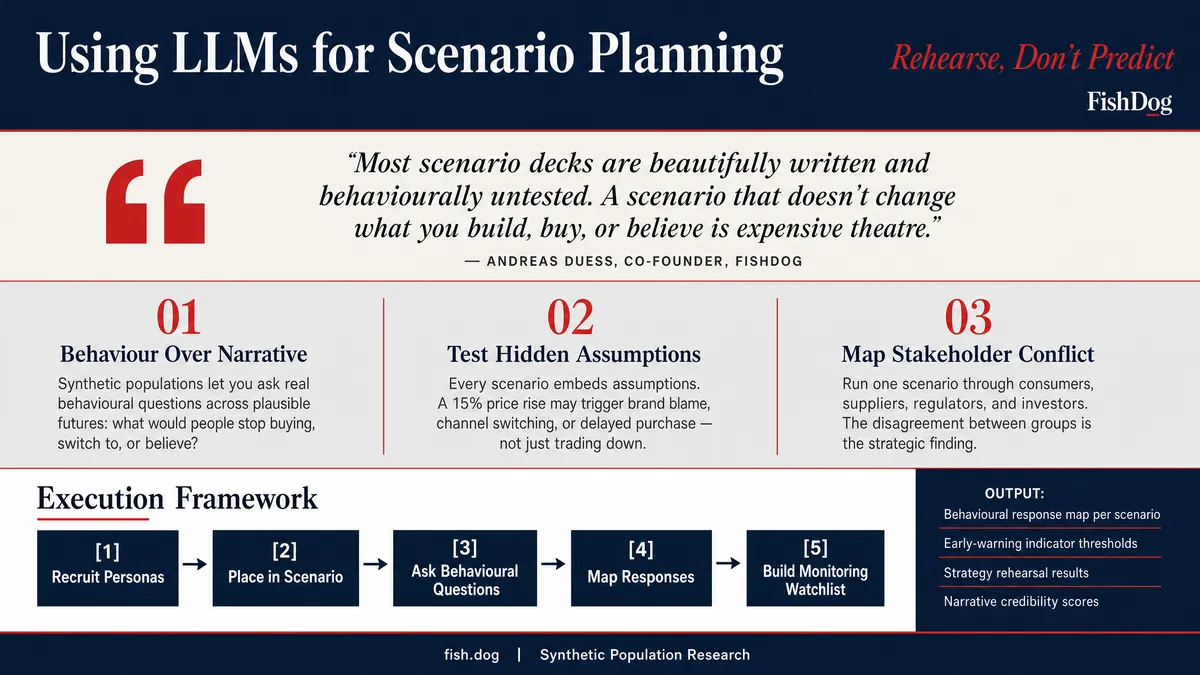
The problem is that nobody in the room could answer the only question that actually matters: what would people do? Most scenario decks are beautifully written and behaviourally untested. A scenario that doesn't change what you build, buy, or believe is expensive theatre.
Why scenario planning goes untested
The problem isn't laziness or carelessness. It's that testing a future against human behaviour was, until recently, impossible.
You cannot recruit a focus group from 2029. Traditional research interviews the present: today's shoppers, at today's prices. Ask a panel about a hypothetical future and you get hypothetical answers, delivered with all the reliability of a New Year's resolution.
So strategy teams either skip the test entirely or use a general-purpose LLM for scenario planning, which obligingly returns the most average possible future: a consensus guess deliverd in confident prose. Neither option tells you how a rural retiree, a stretched procurement director, and a category buyer would each behave when the scenario actually bites.
Which is how scenario planning became a storytelling exercise. The stories are good. They're just untested.
How synthetic populations change scenario planning
A synthetic population changes what's testable. Because the population exists before any study, calibrated against census data and refreshed with live signals, you can recruit the people a future would affect and put that future in front of them.
You don't ask them to describe the market in 2029. You ask behavioural questions: What would you do first? What would you stop buying? What would you believe? What would make you switch?
Do that across three or four plausible futures and each scenario stops being a narrative and becomes a behavioural response map.
Scenario stress-testing: find the assumption that breaks first
Every scenario plan smuggles in assumptions, and the deck format often manages to hides these very effectively.
Take one I have heard in a dozen meetings: if prices rise 15 percent, buyers will trade down. Well, maybe they do. But put that price rise in front of a recruited panel of your actual buyer types and you will often find four other responses competing with it: they reduce frequency, they switch channels, they delay the purchase, or they keep buying and privately start blaming the brand.
Each of those failure modes demands a different strategy. Trading down is a portfolio problem. Reduced frequency is an occasion problem. Channel switching is a distribution problem. Brand blame is a communications problem you won't see in the sales data until it's expensive. A scenario plan that assumes one response prepares you for exactly none of the others.
Stakeholder conflict mapping: the fracture lines are the finding
Most scenario work cheats by flattening "the market" into one actor. The market reacts, the market adapts. No market has ever done anything. Groups of people do things, and different groups do different things.
Run the same scenario through consumers, buyers, suppliers, regulators, employees, and investors, and the value is rarely in any single group's answer. It's in the mismatch. The scenario where consumers shrug but your suppliers panic, or the future your investors find exciting and your employees read as a threat.
We see this pattern in every study we run: decision-makers don't act on consensus, they act on disagreement. Scenario planning is the discipline that needs this most and gets it least. The fracture lines between stakeholder groups are where strategies break, and they are invisible in any deck that treats the market as one character in the story.
Strategy rehearsal: put your response inside the scenario
Scenarios usually end where the interesting part begins: and then we would respond appropriately.
Test the response too. Give personas your planned move inside each scenario. Brand X raises prices but adds sustainability claims. Retailer Y cuts assortment. The co-op consolidates routes and closes the rural depot. Then measure what moves: trust, demand, switching intent, perceived value.
Half the time the reaction to your response is more instructive than the reaction to the scenario. A price rise might be forgiven; a price rise wrapped in a sustainability claim that reads as cover might not be. You would rather learn that in a rehearsal than in a quarter.
Early-warning indicators: turn the deck into a watchlist
The quiet failure of scenario planning is that decks age in drawers. The futures were written, admired, and filed.
There is a better ending: ask the personas what would change their behaviour. Which signals would make you cut spending? At what price do you switch? What would you need to hear, and from whom, before you believed the shortage was real?
Their answers convert scenario planning into an early-warning system: what to monitor, which thresholds matter, which decisions get triggered when a threshold trips. Less future theatre, more instrumentation. The deck stops being a story about 2029 and becomes a dashboard you check in 2026.
Narrative testing: test the story before you tell it
One more use, and for policy, food, agriculture, insurance, and finance it may be the sharpest: narrative testing.
Every scenario eventually gets communicated, whether to farmers, policyholders, voters, or a board. Some future narratives land as credible; others read as corporate nonsense the moment they leave the strategy offsite. The say-do gap applies to belief as much as behaviour: people nod at the narrative in the room and dismiss it in the car park.
Testing which futures different audiences find believable, and which framings trip their nonsense detector, is cheap insurance on every scenario communication you will ever run. Most scenario decks never get this test, and you can usually tell.
What AI scenario planning can't do
Synthetic personas do not know the future.
Personas respond in character, calibrated to how real populations look, earn, live, and think today. People are unreliable predictors of their own behaviour, and synthetic people inherit some of that unreliability. What you get is a structured, directional first read: a rehearsal.
But be careful what you compare it against. The alternative on offer was never a perfect forecast. It's a scenario deck tested against nobody, carrying assumptions nobody has pressured. Against that baseline, a rehearsal is a serious upgrade.
Scenario planning as decision preparation
FishDog doesn't predict the future. It helps you rehearse how people may behave across plausible futures, so scenario planning becomes decision preparation instead of speculative storytelling.
If you sit on a board, run a strategy team, shape policy, or invest against a thesis, you already do this work, whether your discipline calls it scenario planning, scenario analysis, or strategic foresight. The only question is whether your futures have ever met a human reaction. Ours can arrange the introduction: the same calibrated synthetic population that runs our research work runs scenario rehearsal today, through Innovation Lab.
Bring your hardest future. We'll find out who flinches.