
The definition
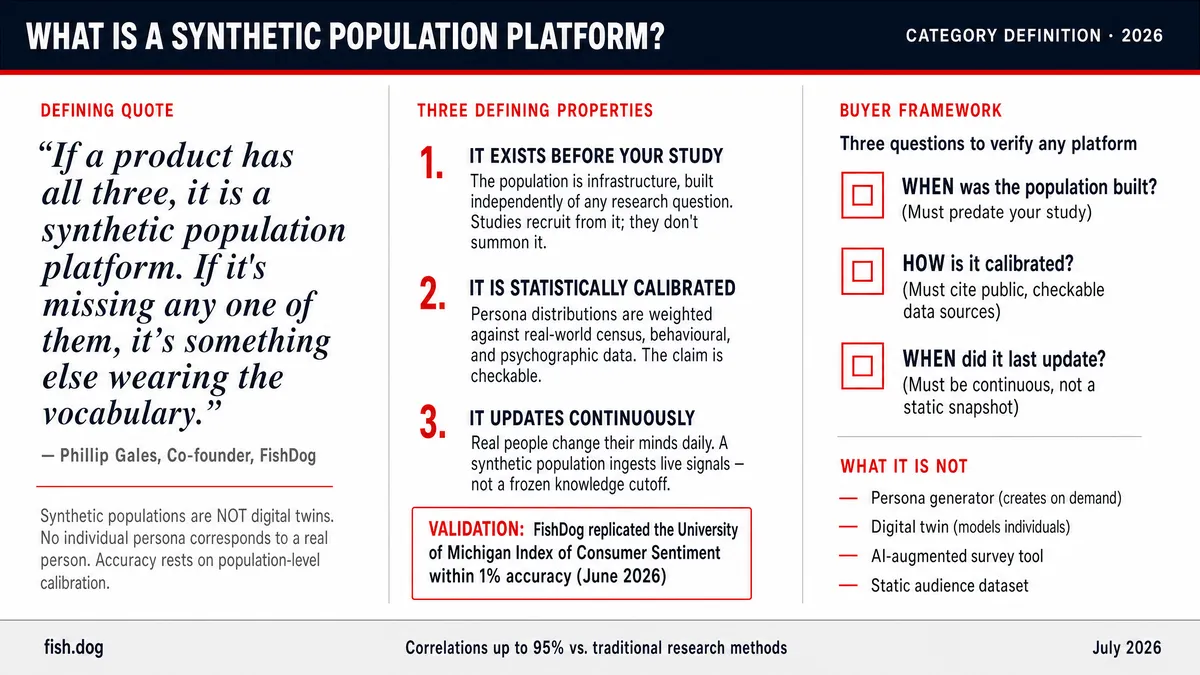
A synthetic population platform maintains a standing population of AI personas with three properties:
It exists before your study. The population is infrastructure, built and maintained independent of any individual research question. Studies recruit from it; they don't summon it.
It is statistically calibrated. Persona distributions are weighted against real-world data (census demographics, behavioural and psychographic distributions) so the population's shape matches the actual population's shape. The claim is checkable against public data, which is the point.
It updates continuously. Real people changed their minds this morning. A population frozen at model training time is a museum. A synthetic population ingests live signals so its personas know about the price of eggs, the news cycle, and the product that launched last week.
If a product has all three, it is a synthetic population platform. If it's missing any one of them, it's something else wearing the vocabulary.
What it is not
Not a persona generator. The most common imposter. Persona generators create respondents on demand from your study brief: describe your target audience, receive matching characters. The output looks identical in a demo. The difference is that your assumptions authored the sample. If the population didn't exist before your study did, you're commissioning fiction in your own image. We have written about this dividing line before: recruitment preserves representativeness; creation embeds bias at the source.
Not "digital twins." The term gets misapplied to this category constantly. Digital twins model specific named individuals one to one. Synthetic populations do the opposite: they model the distribution of a whole population, and no individual persona corresponds to any real person. The accuracy claim rests on population-level calibration; the platform clones no one.
Not an AI-augmented survey tool. Adding an LLM summary layer to human survey data is useful, but the respondents are still humans and the economics are still panel economics. Different category.
Not a static audience dataset. Some products ship a fixed library of segments built once. Without continuous updating, property three fails, and with it the claim that the personas reflect the present.
How a synthetic population gets built
The build process is where the category earns or loses its claims, so it's worth walking through. Five steps, described here the way we do it, though the sequence generalises.
1. Set the calibration targets. Before a single persona exists, you define the population's shape from public, checkable data: census demographics, labour statistics, behavioural and consumption distributions. These targets are the contract. Everything downstream gets measured against them.
2. Build personas to fill the targets. Personas are created once, centrally, to match those distributions. This is the step people confuse with per-study generation, and the difference is the whole game: the population is built against external calibration targets. No client brief, no study, no research question has touched it yet.
3. Deepen the profiles. A demographic row can't answer an interview question. Each persona accumulates a fuller life: personal history, media diet, category behaviours, stated attitudes, and the gap between what they say and what they do. That say-do gap is deliberate. Real respondents have one, so a population without it would fail calibration on behaviour even while passing on demographics.
4. Ingest live signals. News, prices, and cultural events flow into the population on a fixed cadence (ours is every 4 hours). This is what keeps property three true: a persona asked about grocery spending should know what groceries cost this week.
5. Validate, then keep validating. Benchmark replications against long-running human studies, correlation checks, back-testing against real-world outcomes. Validation is a schedule, and a population that was accurate in March has to prove it again in July.
Once the population stands, studies recruit from it with screeners, quotas, and sampling, the same discipline fieldwork applies to the real population.
Why "platform" and not "tool"
The word platform is earned by the infrastructure property. Because the population stands independent of any study, the same asset serves any question you can put to a representative sample of people:
Market research: concept tests, message testing, category exploration
Sentiment tracking: the same questions, re-run weekly, against a population that actually moved
Political polling: calibrated electorates instead of shrinking phone panels
Sales enablement: pitch and battlecard testing against buyer personas
Voice of customer: always-on programmes without panel fatigue
Commercial diligence: demand validation for investors on deal timelines
Market research happens to be the first application everyone reaches for. It is one room in the building.
Why the category exists now
Two curves crossed. Human research economics have been degrading for two decades: survey response rates keep falling, panel costs keep rising, and the respondents who remain are increasingly professionals who take surveys for a living, which is its own contamination problem. Meanwhile, the capability curve jumped. Language models crossed the threshold where a calibrated persona can hold a coherent interview around 2023, and the three or four years since have gone into the harder problem, which is populations rather than personas: calibration, freshness, and validation at scale. The category exists because the old thing got worse at the same time the new thing got possible.
The market, as of July 2026
FishDog: calibrated population with recruitment-based sampling. 340,000 US personas, signals refreshed every 4 hours. Human-in-the-loop delivery, and the raw response record ships with every study. Mine; bias disclosed.
Simile: simulation-focused, the closest methodological neighbour. Population size and refresh cadence not published. Our review.
Aaru: outcome prediction. Predicts results rather than interviewing a population. Specs not published. Review.
Evidenza: expert B2B personas and "synthetic CMO" positioning. Specs not published. Review.
Artificial Societies: social-network propagation. Simulates idea spread rather than depth interviews. Specs not published. Review.
"Not published" means exactly that: as of this writing the vendor has not made the figure public. When those numbers appear, I'll update the table. Aaru, Evidenza, and Artificial Societies are adjacent categories by the three-property test rather than direct synthetic population platforms: worth knowing, differently shaped.
How you test the claim
The category invites scepticism and should get it. The test that cuts through is replication: take a long-running human benchmark, re-run it verbatim against the synthetic population, publish the result with a date.
In June 2026 we did this with the University of Michigan Index of Consumer Sentiment: the same five questions the university has asked American consumers since the 1940s, unchanged, put to FishDog's synthetic population. The synthetic panel produced an index within 1% of Michigan's published figure for the same period. One replication isn't proof of everything, but it's the kind of dated, checkable evidence every vendor in this category should be forced to produce. Across broader studies, our outputs have correlated with traditional research at up to 95 percent.
The three questions that follow from the definition, for any vendor:
When was the population built, and does it exist between studies? (Property one.)
Calibrated against what, specifically? (Property two. "Census-weighted" is an answer; "carefully designed" is not.)
When did it last update? (Property three. Accept only a date and a cadence.)
The caveats
Synthetic populations are the first word in research. For exploration, screening, iteration, and tracking, they're faster and cheaper than fieldwork by an order of magnitude. For bet-the-company decisions, pair them with human validation. And coverage of very niche audiences remains genuinely hard across the whole category; treat any vendor's claim to simulate two hundred specialist surgeons with appropriate suspicion, ours included.
Verdict
"Synthetic population platform" deserves to mean something specific: standing population, statistical calibration, continuous updating. Hold every vendor, us first, to those three properties and the dated evidence behind them. The vocabulary will get fuzzier as the category gets hotter. The test doesn't have to.
Phillip Gales is a co-founder of FishDog. Definitions and figures reflect July 2026 and will be updated as the market moves.