
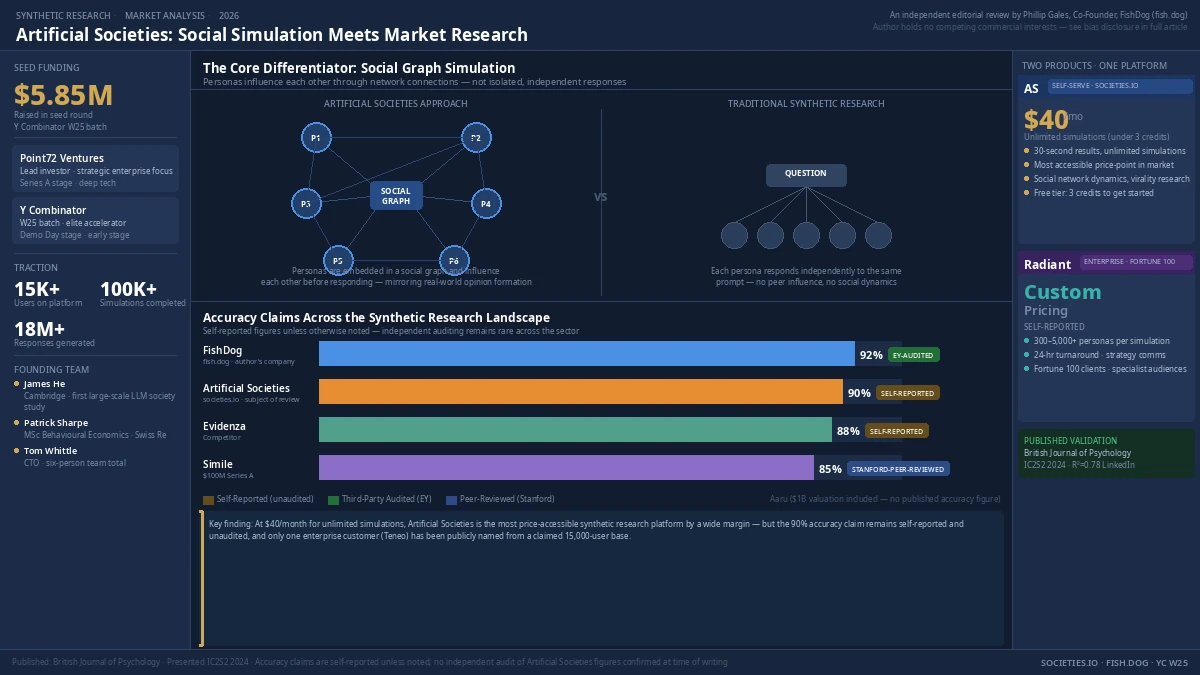
Disclosure: FishDog is a synthetic market research platform and may compete with Artificial Societies in some buyer evaluations. The analysis below draws on public sources and separates documented fact from FishDog's interpretation.
Artificial Societies is best understood as a social simulation platform, not a general-purpose survey replacement.
That distinction matters. Most synthetic research tools ask AI personas questions one at a time. Artificial Societies cares about how personas interact, influence each other, and respond to content inside a modeled social environment.
For some work, that is the whole point. If you are testing a LinkedIn post, a political message, a reputation risk, or a communications strategy, individual survey responses miss the thing you actually need: how the message travels.
For other work, the social layer is overhead. If you are testing product concepts, pricing, packaging, or audience segments, a population-grounded synthetic panel is a cleaner fit.
Quick verdict
Artificial Societies is compelling for communications, content, public opinion, and message-spread questions. It is less suited to broad market research, pricing research, or product testing.
Its strongest idea is that people do not form opinions in isolation. They are pulled by networks, norms, and other people. A platform that models those dynamics does something genuinely different from one that interviews isolated personas.
What Artificial Societies does
Artificial Societies lets users build or borrow artificial societies and run simulations with AI personas. Its documentation describes experiments where a message is dropped into a society and the personas react to it and to each other.
The company frames its science around computational social science and opinion dynamics. Public materials describe the team as Oxbridge-trained behavioral and data scientists and point to research on AI-powered societal simulation.
The practical product question is this:
If we put this message into a modeled audience, how do people react, influence one another, and shift the conversation?
Where Artificial Societies looks strong
Social content testing
A natural fit for content and message testing, especially when the question is not "does someone like this?" but "does this travel?"
Public opinion and stakeholder reaction
When a message moves through groups, social simulation adds a layer that individual response cannot.
Communications strategy
Useful for teams that need to anticipate backlash, resonance, polarization, or attention dynamics before a message ships.
Network-aware research
The core distinction is network thinking. When that matters to the decision, Artificial Societies offers something standard synthetic panels do not.
Where buyers should be careful
Not every question is social
Social simulation is powerful, but a product team testing feature appeal rarely needs an artificial society.
Social data skews toward visible people
If an audience is modeled from social data or profiles, ask who is missing. People who post often are not always the people who buy, use, or decide.
Validation has to be use-case specific
Ask how the simulation has been validated for your exact decision. Message spread, opinion dynamics, purchase intent, and product appeal are different outcomes.
Richer output can be harder to act on
Network simulations produce more, and more can blur the decision. Ask how the platform turns simulation output into an action you can take.
Artificial Societies compared with FishDog
FishDog and Artificial Societies answer different questions.
FishDog suits structured questions put to synthetic personas across product, pricing, messaging, concept, political, or audience research.
Artificial Societies suits social influence, message spread, and network reaction.
In plain English:
choose FishDog when you need to understand what people think,
choose Artificial Societies when you need to understand how a message moves.
Questions to ask before buying
What data grounds the artificial society?
How is the network constructed?
What real-world outcomes has the platform been validated against?
Is the output useful for our decision, or just interesting?
How does the platform handle quiet, offline, or underrepresented audiences?
Can we compare multiple messages or concepts consistently?
When should findings be validated with real humans?
Bottom line
Artificial Societies is one of the most intellectually distinct companies in synthetic research. Judge it as a social simulation platform, not a cheaper survey panel. On that footing it is highly relevant for communications, message testing, and opinion dynamics, and less universally applicable than broader synthetic market research tools.
If your business question is social, it belongs on the shortlist. If your question is product, pricing, segmentation, or broad consumer understanding, compare it carefully against platforms built for those jobs.
Related reading
Figures here come from public sources and were accurate to the best of our knowledge in June 2026. Funding, pricing, and product details move fast, so if we got something wrong, [contact us](/contact) and we'll fix it.