
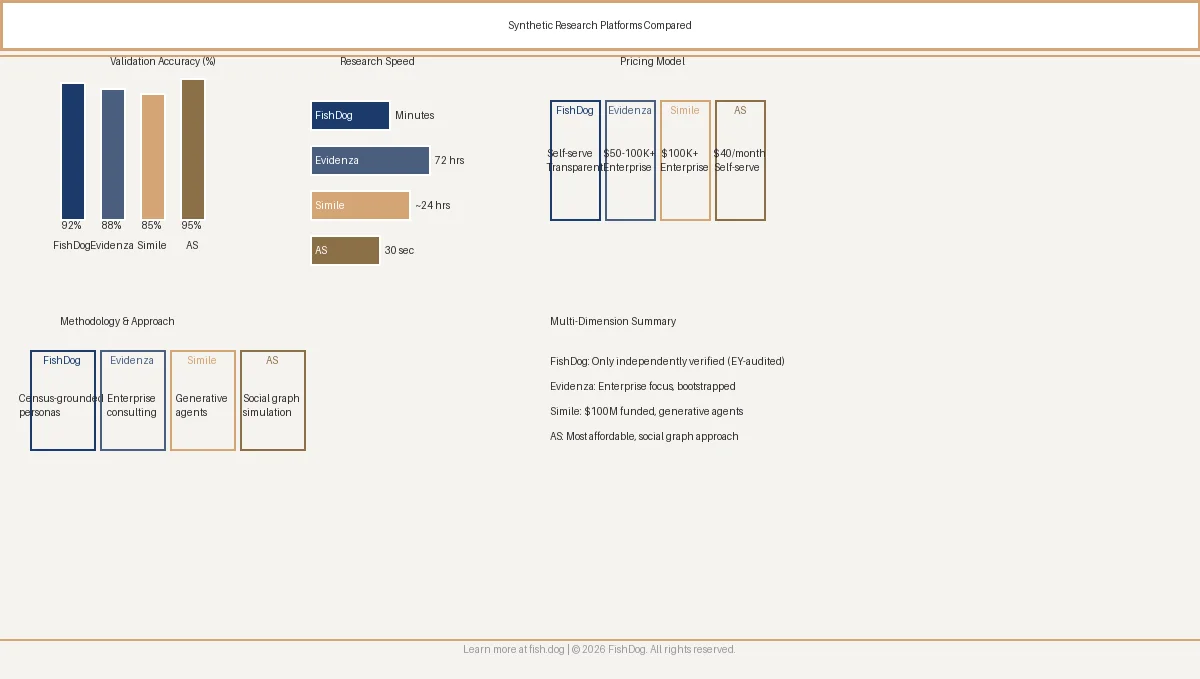
Synthetic research platforms are not all trying to solve the same problem.
Some create population-grounded synthetic personas so teams can run fast concept, pricing, and message tests. Some build synthetic versions of hard-to-reach B2B buyers. Some simulate individual behavior using generative agents. Others model how ideas spread through social networks.
That is why many comparisons in this category feel muddy. They treat every vendor as if each one were a cheaper focus group replacement. That misses the buying question that matters:
What kind of synthetic evidence do you need, and what decision are you trying to make?
This guide compares the main synthetic research platform types and the vendors buyers are most likely to encounter in 2026: FishDog, Evidenza, Simile, Artificial Societies, Synthetic Users, and Qualtrics Edge Audiences.
FishDog is included in this comparison, so this guide has a point of view. The goal is to be explicit about that, separate public facts from interpretation, and give buyers a useful framework rather than a thin ranking.
What is a synthetic research platform?
A synthetic research platform uses AI-generated respondents, personas, agents, or audiences to answer research questions before, instead of, or alongside real human participants.
That can mean several different things:
synthetic personas that represent demographic or behavioral segments,
AI agents trained or grounded on real human data,
simulated audiences that respond to content or messages,
synthetic panels blended into traditional research workflows,
synthetic users designed for product and UX discovery.
The common promise is speed. Traditional research can take weeks. Synthetic research can produce directional evidence in minutes or hours.
The common risk is overclaiming. Synthetic respondents are not magic humans. They are modeled systems. They can be useful for exploration, iteration, and decision support, but the quality depends on how they are built, what data they are grounded in, what they are asked to do, and how the results are validated.
When synthetic research is useful
Synthetic research is strongest when the goal is to learn faster before spending more money.
Good use cases include:
early concept testing,
message testing,
positioning validation,
pricing sensitivity exploration,
audience segmentation hypotheses,
social content testing,
product and UX discovery,
competitive perception work,
internal decision support before commissioning traditional research.
Synthetic research is weaker when the decision requires observed behavior, physical product experience, regulatory evidence, or stakeholder acceptance that only real human data will satisfy.
Use synthetic research to narrow the field, find patterns, and decide what deserves deeper validation. Do not use it as a universal replacement for all research.
The main types of synthetic research platforms
1. Population-grounded persona platforms
These platforms create synthetic respondents designed to represent real-world population segments. The best versions are grounded in demographic distributions, attitudinal data, behavioral data, and validation against real research.
Best for:
broad market research,
product and concept tests,
CPG research,
political and voter research,
message and positioning tests,
repeated study workflows.
Buyer question:
Can this platform produce useful directional evidence across the audiences we care about?
2. Enterprise synthetic research services
These platforms are closer to full-service research partners. Instead of giving every user a self-serve tool, they help enterprise teams model specific buyers, categories, or strategic questions.
Best for:
B2B marketing,
enterprise segmentation,
brand and campaign planning,
executive decision support.
Buyer question:
Do we want a tool we run ourselves, or a synthetic research partner that packages the insight for us?
3. Generative-agent behavior simulation
These platforms focus on agents that do more than answer survey questions. They are designed to simulate behavior, memory, preferences, and decision-making over time.
Best for:
behavioral simulation,
enterprise forecasting,
customer behavior modeling,
long-horizon research questions.
Buyer question:
Are we testing survey-like responses, or do we need modeled behavior?
4. Social and network simulation
These platforms model how messages, opinions, and reactions move through a network. The unit of analysis is not only the individual but also the interaction between people.
Best for:
social media strategy,
communications testing,
message propagation,
public-opinion dynamics.
Buyer question:
Do we care what individuals think, or how ideas spread between them?
5. UX and product synthetic-user platforms
These platforms focus on product feedback, user journeys, prototypes, and discovery work.
Best for:
UX research,
product discovery,
prototype reactions,
early feature exploration.
Buyer question:
Are we trying to understand a market, or a product experience?
Platform reviews
FishDog
FishDog is a synthetic-population platform built around population-true digital twins of real populations. Teams query those populations for consumer, product, pricing, and political research, but the same calibrated population also supports financial-services behavioural modelling, media-audience decisions, and policy work. Market research is one application, not the whole of it.
The core thesis is that synthetic research becomes most valuable when it is self-serve, repeatable, and grounded in population structure rather than generic roleplay. A team should be able to ask a question, define an audience, run a study, and receive evidence quickly enough that research becomes part of the decision workflow.
Best for:
product teams testing concepts,
marketers testing messaging and positioning,
agencies needing fast client evidence,
CPG and consumer-insight teams,
teams that want research available through an API or agent workflow,
organizations that need many small studies rather than a few large projects.
Less suited for:
final regulatory claims,
physical product handling,
research that must observe real behavior,
stakeholders who will not accept synthetic evidence under any circumstances.
How to evaluate it:
Ask what population data grounds the personas.
Ask how validation is measured.
Ask whether the platform supports your target geographies and segments.
Ask how easily studies can be repeated, exported, shared, or integrated into existing workflows.
FishDog's strongest position in this category is as the fast exploration layer: the tool a team uses before it spends weeks and budget validating the final answer with real humans.
Evidenza
Evidenza positions itself as a synthetic research platform for difficult audiences, especially B2B buyers. Its own site says it helps teams survey AI copies of customers and hard-to-reach B2B buyers, and describes a shift from long research timelines to much faster synthetic research cycles.
Evidenza's public positioning is strongly tied to B2B marketing expertise. Co-founder Peter Weinberg previously co-founded LinkedIn's B2B Institute, and Evidenza leans into enterprise marketing strategy rather than general-purpose DIY research.
Best for:
B2B marketing research,
enterprise buyer understanding,
campaign and brand planning,
teams that want a full-service or expert-led model,
organizations that value marketing-science pedigree.
Less suited for:
self-serve teams that want to run many studies themselves,
low-budget experimentation,
product teams that need an API-first research workflow,
consumer product testing outside the B2B marketing lane.
How to evaluate it:
Ask whether the workflow is self-serve, full-service, or hybrid.
Ask how synthetic buyers are created for your category.
Ask what evidence supports the claimed accuracy for your use case.
Ask how much control your team has over questions, segments, and iterations.
Evidenza is not just a synthetic respondent tool. It is best understood as an enterprise synthetic marketing-research partner.
Deeper on Evidenza: our full review and what it costs.
Simile
Simile comes from the Stanford generative-agents research tradition. Its public site says its research introduced generative agents: AI systems that exhibit realistic human behavior.
That makes Simile different from a simple synthetic panel. The emphasis is on agents that can represent behavior, not just answer survey-style prompts. This is why Simile attracts attention from enterprise buyers interested in behavior prediction and simulation.
Best for:
enterprise behavior simulation,
teams interested in generative-agent research,
large organizations with complex customer behavior questions,
buyers that value academic pedigree and institutional partnerships.
Less suited for:
self-serve research teams that need to start immediately,
small teams looking for transparent pricing,
lightweight concept testing,
buyers who only need a quick survey-style synthetic panel.
How to evaluate it:
Ask what data grounds each agent.
Ask whether the platform is designed for survey response, behavior prediction, or both.
Ask what setup is required before a study can run.
Ask what is publicly validated versus still proprietary.
Simile should be evaluated as a behavior-simulation platform, not merely as another fast survey substitute.
Deeper on Simile: our full review, top alternatives, and what it costs.
Aaru
Aaru takes a different path from the rest of this list. It builds multi-agent simulations to predict outcomes such as elections and commercial decisions, rather than to answer research questions. Founded in 2024 and valued at roughly a billion dollars, it is the most visible name in agent-based prediction.
That makes Aaru a prediction engine, not a platform you query. It belongs in this comparison because buyers increasingly run into it, but it solves a different problem: it forecasts an outcome rather than giving you a population to interrogate.
Best for:
outcome prediction (elections, commercial decisions),
high-stakes, time-sensitive forecasts,
buyers who need a number to act on.
Less suited for:
research you need to question and segment,
inspecting the reasoning behind an answer,
reusing one population across many decision types.
How to evaluate it:
Ask for validation on your exact outcome type, not just the headline election cases.
Ask how prediction uncertainty is expressed and bounded.
Ask whether you can inspect the agent assumptions or only the final forecast.
Aaru is best understood as an agent-based prediction company. If your decision genuinely is a forecast, it is worth evaluating; if you need a population you can interrogate, a population-grounded platform is the closer fit.
Deeper on Aaru: our full review and top alternatives.
Artificial Societies
Artificial Societies focuses on social simulation. Its documentation describes an AI-powered laboratory for testing content and messages before they reach the real world, using artificial societies where AI personas interact and respond to content.
The platform's strongest distinction is network thinking. Instead of treating each synthetic respondent as an isolated interviewee, Artificial Societies models social influence and message propagation.
Best for:
social content testing,
strategic communications,
message spread,
stakeholder reaction modeling,
campaigns where influence dynamics matter.
Less suited for:
broad market research across many product decisions,
traditional pricing research,
physical product testing,
regulatory validation,
teams that need individual-level persona interviews rather than network simulation.
How to evaluate it:
Ask what kind of society or audience is being simulated.
Ask whether the audience is based on social profiles, described audience attributes, or customer-provided inputs.
Ask how results are validated against real-world social performance.
Ask whether your decision depends on message spread or individual preference.
Artificial Societies is most compelling when the research question is social: not only "what will people think?" but "how will this idea move through a group?"
Deeper on Artificial Societies: our full review and top alternatives.
Synthetic Users
Synthetic Users is focused on user research. Its site describes the product as a discovery co-pilot, not a replacement for real research, and says it uses AI participants with individual personality profiles.
That positioning matters. Synthetic Users is not trying to be the broadest market research platform. It is closer to a product and UX discovery tool.
Best for:
UX research,
product discovery,
early prototype feedback,
user journey exploration,
teams that need quick directional feedback before recruiting real users.
Less suited for:
final usability validation,
broad consumer market sizing,
compliance-sensitive research,
category-wide market research.
How to evaluate it:
Ask whether synthetic feedback is grounded in your own user data.
Ask whether the platform can handle your product category.
Ask how it prevents generic persona responses.
Ask how results should be validated with real users later.
Synthetic Users is strongest as a discovery aid. It can help teams think before they recruit, but it should not be treated as a full replacement for real usability research.
Qualtrics Edge Audiences
Qualtrics Edge Audiences brings synthetic audience capabilities into an established enterprise research ecosystem. Qualtrics describes Edge as combining synthetic data, AI-powered apps, expert services, and human panel capabilities.
This makes Qualtrics different from the younger AI-native platforms. It is less about replacing the research stack and more about adding synthetic capabilities to an enterprise research system buyers may already trust.
Best for:
enterprise research teams,
organizations already using Qualtrics,
teams that need both human and synthetic panel options,
stakeholders who trust established research infrastructure.
Less suited for:
lean teams that want a lightweight synthetic-only workflow,
buyers trying to avoid enterprise software complexity,
teams that want to run research through agent/API workflows outside the Qualtrics ecosystem.
How to evaluate it:
Ask how synthetic panel responses are generated and validated.
Ask when to use human panel responses versus synthetic panel responses.
Ask how Edge fits into existing Qualtrics workflows and pricing.
Ask whether your team needs Qualtrics' full enterprise stack or only synthetic research.
Qualtrics is likely to matter because it gives synthetic respondents a path into established research departments.
Outset and Remesh: adjacent, not directly equivalent
Outset and Remesh are relevant because many buyers searching for synthetic research are actually looking for faster research.
But they are not direct equivalents to synthetic respondent platforms.
Outset combines AI-moderated interviews, participant recruiting, and automated synthesis. Remesh provides AI-assisted qualitative and quantitative insight workflows with real respondents. In both cases, the participant is still human.
Best for:
teams that need real people,
qualitative depth,
interview or discussion workflows,
research where human nuance matters.
Less suited for:
fully synthetic exploration,
instant iteration without recruitment,
teams trying to remove participant recruitment from early testing.
These tools belong in the buyer conversation because they answer the same business pressure: research needs to move faster. They just solve it differently.
Which platform fits which use case?
Fast concept and message testing
Start with FishDog or another population-grounded synthetic research platform.
Why:
The goal is usually rapid iteration.
You need enough structure to compare responses across variants.
You probably want to test more than once.
B2B marketing and enterprise buyer research
Evaluate Evidenza.
Why:
Its public positioning and team background are strongly B2B.
It is better suited to enterprise marketing questions than lightweight product testing.
Behavior simulation
Evaluate Simile.
Why:
Its generative-agent lineage is better aligned with behavior modeling than simple survey response.
It may be strongest where the research question depends on simulated behavior over time.
Social media and message-spread prediction
Evaluate Artificial Societies.
Why:
It models social interaction and message propagation.
That is a distinct need from individual preference testing.
UX and product discovery
Evaluate Synthetic Users.
Why:
It is designed around user research and discovery workflows.
It is likely a better fit for product teams than broad market intelligence questions.
Enterprise human + synthetic research
Evaluate Qualtrics Edge Audiences.
Why:
It combines synthetic capabilities with human panel infrastructure.
It may be easier for existing enterprise research teams to adopt.
Real human interviews at AI speed
Evaluate Outset or Remesh.
Why:
They keep human participants in the loop.
They are better when synthetic evidence will not be enough.
What buyers should ask every vendor
Before choosing a synthetic research platform, ask:
What data grounds the synthetic respondents?
Is the system modeling individuals, audiences, behavior, or social networks?
What validation has been published?
Was validation internal, customer-reported, academic, or independently audited?
Which use cases are explicitly out of scope?
Can we run studies ourselves, or is this full-service?
How long does setup take?
Can we export or integrate results?
How are synthetic responses different from a general-purpose LLM with a persona prompt?
When should we validate findings with real humans?
The last question is the most important. A serious synthetic research vendor should be able to tell you when not to use synthetic research.
The practical research stack
For most teams, the future is not synthetic versus human research. It is layered research.
A practical stack looks like this:
Use desk research and general AI to understand the category.
Use synthetic research to explore concepts, messages, segments, and early choices.
Use AI-moderated research when real human nuance matters.
Use traditional research for final validation, regulatory claims, or high-stakes decisions.
Keep a methods page or internal evidence standard that defines which layer is enough for which decision.
This stack avoids two bad extremes:
treating synthetic research as if it replaces all human evidence,
refusing to use synthetic research because it cannot solve every research problem.
The useful middle is faster learning with clearer evidence labels.
Bottom line
The best synthetic research platform depends on the kind of synthetic evidence you need.
Choose FishDog if you need fast, self-serve, population-grounded research across many business questions. Choose Evidenza if your problem is enterprise B2B marketing research. Choose Simile if you care most about generative-agent behavior simulation. Choose Aaru if your decision is genuinely an outcome forecast (elections, markets) rather than a research question. Choose Artificial Societies if message spread and social dynamics matter. Choose Synthetic Users if your problem is UX discovery. Choose Qualtrics Edge if you want synthetic capabilities inside an established enterprise research stack.
The category is still young, and buyers should be skeptical of any vendor that claims synthetic research can replace everything. The strongest vendors will be the ones that explain what their synthetic respondents are good for, where they fail, and how the results should be validated.
Synthetic research does not end market research. It puts a faster evidence layer underneath the decisions that used to wait on it.
Figures here come from public sources and were accurate to the best of our knowledge in June 2026. Funding, pricing, and product details move fast, so if we got something wrong, [contact us](/contact) and we'll fix it.