
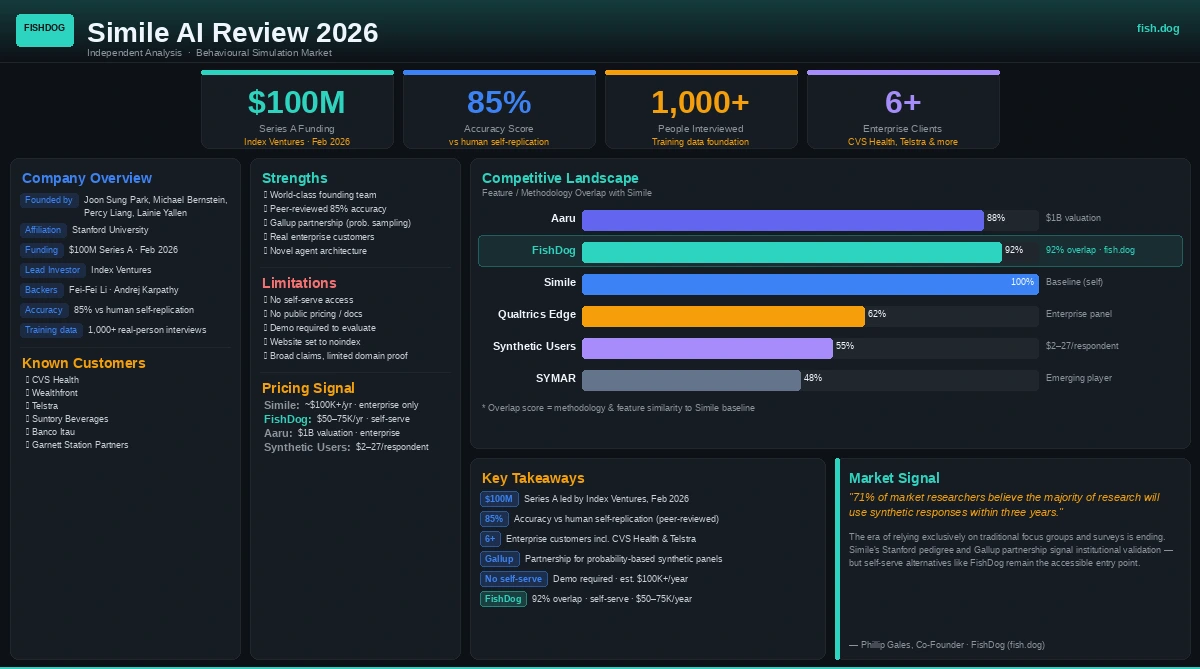
Disclosure: FishDog is a synthetic market research platform and may compete with Simile in some buyer evaluations. This review is written from that perspective, but it draws on public sources and separates documented fact from interpretation.
Simile AI is one of the most serious new companies in synthetic research. The founding team helped create the modern generative-agent research lineage, the company announced $100 million in funding in February 2026, and the product aims at an ambitious claim: simulating how people, customers, employees, and populations respond to decisions before those decisions happen in the real world.
That makes Simile important. It does not make it the right platform for every research team.
The useful question for buyers is narrower: what does Simile appear to do well, what evidence exists, where is the product still hard to evaluate from the outside, and which alternatives belong on the list if you need synthetic research now?
Quick verdict
Simile is best understood as an enterprise behavioral-simulation company, not a simple AI survey tool. The strongest public evidence behind it comes from Stanford-linked generative-agent research, especially the 2024 paper Generative Agent Simulations of 1,000 People, which reported that interview-trained agents replicated General Social Survey responses at 85% of the accuracy that human participants reached when they retook the survey themselves two weeks later.
For large enterprises with complex decisions, confidential scenarios, and the budget to work through a sales-led implementation, Simile belongs on the shortlist. For brand, product, or research teams that need self-serve access, transparent workflow fit, or immediate concept testing, it may be too early, too opaque, or too enterprise-oriented.
What Simile AI does
Simile describes itself as a simulation company. In its launch post, The Simulation Company, the team says it is building an AI simulation of society populated by agents based on real humans, and a foundation model that predicts human behavior across many situations and at scale.
That framing matters. Simile is not pitching a faster focus group or a cheaper survey panel. It wants to give organizations a way to rehearse decisions before exposing real customers, employees, investors, or voters to the actual change.
Public Simile messaging points to use cases such as:
testing policy, product, messaging, or pricing decisions before launch,
modeling how customers or employees may respond to change,
rehearsing high-stakes communications,
exploring hard-to-reach or sensitive audiences,
generating faster insight from simulated populations.
That is a broader and more ambitious scope than most synthetic research tools, and a harder one to validate. A tool that claims to predict human behavior across many situations needs proof across many situations, not one benchmark.
Evidence and claims
The strongest evidence associated with Simile is the generative-agent research behind the founding team.
The 2023 paper Generative Agents: Interactive Simulacra of Human Behavior introduced AI agents with memory, reflection, and planning in a simulated environment, and showed they could produce believable social behavior inside a small virtual town.
The later Generative Agent Simulations of 1,000 People paper moved from toy-town social simulation toward individual-level survey replication. It interviewed 1,052 people, built agents from those interviews, and tested whether the agents could reproduce participant responses across survey and experiment tasks. The headline result was strong: on the General Social Survey, agents reached 85% of the accuracy humans hit when retaking the same survey.
That is meaningful. It is also specific.
The result supports the idea that interview-trained agents can reproduce some survey responses with real fidelity. It does not, on its own, prove Simile can predict every product choice, retail behavior, policy reaction, ad response, or buying-committee decision. For buyers, the question is whether Simile can show validation for the exact type of decision you need to simulate.
Gallup is the other major signal. In May 2026, Gallup wrote that it had begun research on simulated responses through a partnership with Simile. Gallup says it is independently validating where AI-generated agents perform well, where they fall short, and how they compare with probability-based Gallup Panel estimates.
That partnership is a real credibility signal, because it puts the synthetic-response category against serious survey standards. It is not a blank check. The most telling line in Gallup's framing is not that simulation works everywhere; it is that Gallup is studying where it works and where it falls short.
Pricing and access
Simile does not publish pricing. Its public site and product materials point to enterprise access rather than a self-serve checkout.
That is normal for high-end enterprise software, and inconvenient for research teams trying to compare vendors quickly.
Treat Simile as an enterprise-budget platform until proven otherwise. Expect a sales process, custom scoping, procurement review, and a contract sized around the importance and complexity of the decisions being simulated.
If you need a low-commitment pilot this week, Simile is not the easiest starting point. If you are a large enterprise testing consequential decisions and want a deeply scoped simulation partner, the sales-led model may suit you.
Simile AI compared with other synthetic research platforms
A buyer will usually weigh Simile against a handful of others. The short version of how they differ:
Simile: best for enterprise behavioral simulation and high-stakes decision rehearsal. Sales-led access. Evidence: Stanford generative-agent research, the Gallup validation work, $100M funding. The buyer question is whether it can validate your exact decision type.
FishDog: best for brand, product, and consumer research using population-grounded synthetic personas. Self-serve and managed access. Evidence: published validation and practical research workflows. The buyer question is whether you need rapid, repeatable research across concepts, positioning, and creative.
Artificial Societies: best for strategic communications and stakeholder-network simulation. Enterprise-led access. Public claims of 2.5m personas, 18m responses, and 95% accuracy on its site and YC profile. The buyer question is whether network effects and opinion propagation are central.
Synthetic Users: best for UX research and synthetic user interviews. Product-led access. A practical UX testing workflow. The buyer question is whether you are testing interface concepts rather than market-level decisions.
Qualtrics Edge Audiences: best for existing Qualtrics customers adding synthetic respondents to survey workflows. Enterprise add-on. Qualtrics platform depth and survey data. The buyer question is whether you already run research inside Qualtrics.
Where Simile looks strong
Simile's biggest advantage is technical credibility. The company is not borrowing generative-agent language secondhand; its founding story is tied directly to the research that made the idea visible.
The second advantage is ambition. Many synthetic research vendors are trying to make surveys faster. Simile is trying to simulate decisions. If that works, the ceiling sits far above survey acceleration.
The third is institutional validation momentum. Gallup's involvement gives Simile a chance to connect AI simulation with probability-based survey discipline, which is exactly where synthetic research needs to mature.
Simile also looks well suited to confidential or high-stakes work where traditional research is slow, expensive, or risky. Testing reactions to a sensitive policy change, an investor narrative, a litigation argument, or a product portfolio shift can be costly in the real world. Simulation is compelling in precisely those moments.
Where buyers should be careful
The first concern is scope. "Predicting human behavior" is a massive claim. Ask Simile to show evidence against the specific behavior you care about, not only adjacent benchmarks. Reproducing survey answers is not the same as predicting purchase behavior, churn, cultural adoption, juror reasoning, or message spread inside a social graph.
The second is transparency. From the outside, it is still hard to inspect pricing, implementation workflow, study setup, outputs, or failure modes. That does not make the product weak. It does mean you should use the sales process to demand methodological clarity.
The third is practical access. If your team needs to run dozens of small concept tests, landing-page tests, or messaging studies every month, a sales-led simulation platform may be heavier than necessary.
The fourth is benchmark fit. Gallup's May 2026 framing is careful and useful because it asks where simulated responses perform well and where they fall short. Hold every vendor to that standard. Synthetic research is powerful when it is validated for the job at hand, and risky when a benchmark in one domain gets stretched into confidence everywhere.
Questions to ask before buying Simile
What exact data is used to construct agents for my target audience?
What validation exists for my use case, not just synthetic response generation in general?
How does Simile measure uncertainty, disagreement, and failure?
Can I compare simulated results against a small real-human holdout sample?
How are private customer data and interview data handled?
What is the implementation timeline from contract to first usable result?
Can I inspect raw outputs and respondent-level reasoning, or only summarized findings?
What decisions should not be made using Simile?
That last question matters. Good research vendors can explain their boundaries.
When Simile is probably the right choice
Simile is worth serious evaluation if you are a large organization facing expensive, sensitive, or complex decisions, and traditional research cannot reach the audience, timeline, or confidentiality threshold you need.
Examples include enterprise communications, policy reaction testing, investor or stakeholder simulation, high-stakes product portfolio choices, and scenarios where agent interaction matters more than isolated survey responses.
It may also fit if you have the budget and patience for a more bespoke simulation program, especially when you can validate early results against real-world data from your own organization.
When to consider alternatives
Consider alternatives if you need immediate access, transparent and repeatable workflows, frequent smaller studies, or direct integration into brand, product, or design research.
FishDog fits better when the job is repeated consumer research: concept testing, positioning, ad and landing-page feedback, customer-segment exploration, and global persona panels grounded in population data. Synthetic Users fits better for lightweight UX conversations. Artificial Societies is worth a look when the core question is how opinions spread through stakeholder networks rather than how individuals respond to a single stimulus.
The point is not that one platform wins every use case. The category is already splitting into different jobs: enterprise simulation, synthetic panels, UX testing, stakeholder networks, and survey augmentation.
Bottom line
Simile AI is credible, well funded, and built on a serious research lineage. It may become one of the defining companies in behavioral simulation.
But the right way to evaluate Simile is not to ask whether generative agents are exciting. They are. The right question is whether Simile has evidence for your decision, your audience, your timeline, and your budget.
For enterprise teams with high-stakes simulation needs, Simile belongs in the evaluation set. For teams that need practical synthetic market research now, the better starting point is usually a more accessible platform with transparent workflows and validation for everyday brand, product, and consumer research.
Related reading
Figures here come from public sources and were accurate to the best of our knowledge in June 2026. Funding, pricing, and product details move fast, so if we got something wrong, [contact us](/contact) and we'll fix it.