
Disclosure: FishDog is a synthetic market research platform and may compete with Simile and several tools covered here in some buyer evaluations. The analysis below draws on public sources and separates documented fact from FishDog's interpretation.
Simile is one of the most visible companies in synthetic behavior simulation. Its Stanford generative-agents lineage, reported $100 million Series A, and Gallup research partnership make it impossible to ignore.
But visibility is not the same as fit.
If you are evaluating Simile, you are probably trying to answer one of three questions:
Can AI simulate customer behavior well enough to guide business decisions?
Can synthetic research replace part of our traditional research workflow?
Is there a faster or more accessible way to test concepts, messages, pricing, or audience reactions?
This guide compares the strongest Simile alternatives by buyer need, not by hype.
Quick recommendation
Choose Simile if you need enterprise behavior simulation and are prepared for a sales-led implementation.
Choose FishDog if you need self-serve synthetic research for concept, messaging, pricing, product, or market questions.
Choose Evidenza if your problem is B2B marketing and enterprise go-to-market research.
Choose Artificial Societies if you care about message spread and social influence.
Choose Synthetic Users if your primary use case is UX or product discovery.
Choose Qualtrics Edge Audiences if you want synthetic capabilities inside an enterprise research stack.
1. FishDog
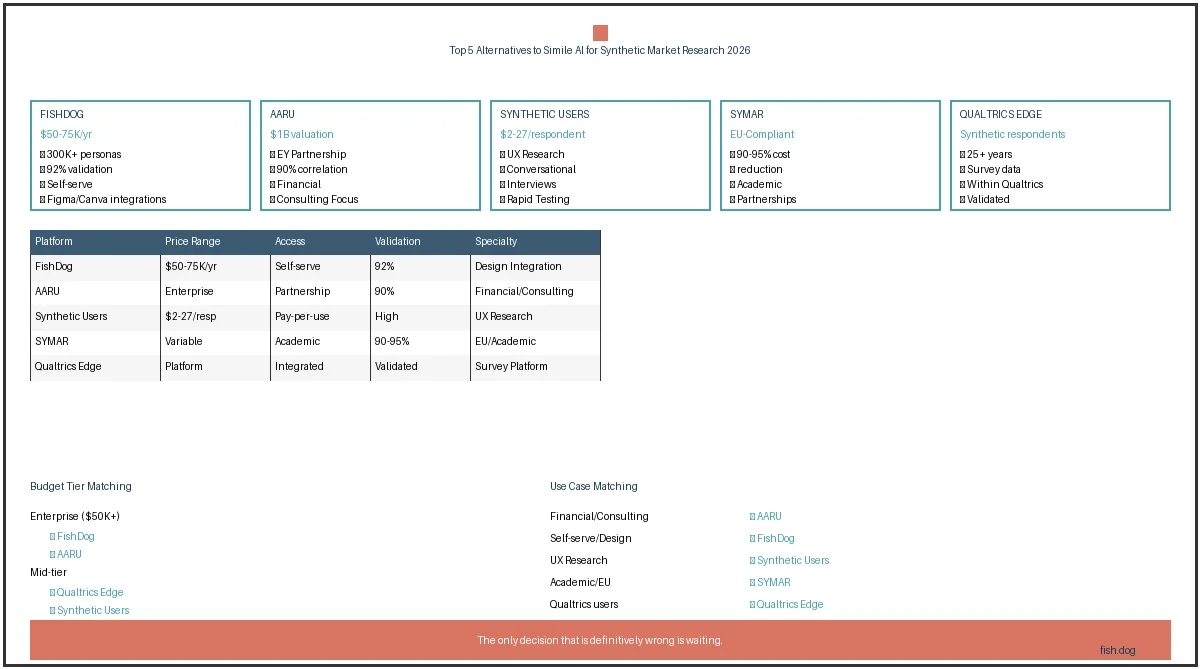
FishDog is a synthetic market research platform built for fast, self-serve studies with population-grounded synthetic personas.
Where Simile leans into enterprise behavior simulation, FishDog is built for repeatable research: concept and message tests, pricing exploration, positioning validation, audience comparisons, and shareable outputs that product teams, marketers, and agencies can run themselves. Pick it over Simile when you need to start quickly, want a transparent and repeatable workflow, and your job is closer to market research than behavior modeling. Simile earns the nod when you need deep behavioral simulation, a bespoke enterprise relationship, or the academic and Gallup-linked validation that some stakeholders will want to see.
2. Evidenza
Evidenza is strongest for B2B marketing and enterprise go-to-market questions. Its public positioning centers on hard-to-reach B2B buyers, synthetic customer copies, and faster strategic planning.
Best for:
B2B buyer research,
enterprise marketing strategy,
category entry point analysis,
campaign planning,
full-service synthetic research.
Why choose it over Simile:
your primary audience is B2B,
you want marketing-science expertise packaged with the research,
you prefer a full-service model.
When Simile may be better:
the question is less about B2B marketing and more about broader behavior simulation.
3. Artificial Societies
Artificial Societies takes a network-simulation approach. Its product is designed to test content and messages with artificial societies where personas interact and influence one another.
Best for:
social media strategy,
public opinion dynamics,
message propagation,
communications testing,
stakeholder reaction modeling.
Why choose it over Simile:
your question is about spread, influence, or network reaction,
you want to understand how a message may move through a group,
your use case is communications-heavy rather than general market research.
When Simile may be better:
you care more about individual behavior simulation than social-network effects.
4. Synthetic Users
Synthetic Users focuses on product and UX discovery with AI-generated participants. It is closer to a discovery co-pilot than a general market research platform.
Best for:
UX research,
prototype feedback,
product discovery,
early user journey exploration.
Why choose it over Simile:
your problem is product experience rather than market behavior,
you need early UX feedback,
you want to explore issues before recruiting real users.
When Simile may be better:
your question involves broad behavioral prediction rather than product-specific discovery.
5. Qualtrics Edge Audiences
Qualtrics Edge Audiences combines human and synthetic audience capabilities inside the Qualtrics ecosystem.
Best for:
enterprise research teams,
organizations already using Qualtrics,
teams that want human and synthetic panel options together,
stakeholders who trust established research infrastructure.
Why choose it over Simile:
your research operations already live in Qualtrics,
you need human and synthetic panel workflows,
enterprise procurement wants a familiar vendor.
When Simile may be better:
you are specifically exploring generative-agent behavior simulation outside a traditional research platform.
How to choose
Ask what you are actually buying.
If you want behavior simulation
Simile belongs on the shortlist.
If you want fast market research
FishDog is likely the better fit.
If you want B2B marketing strategy
Evidenza is likely the better fit.
If you want message-spread prediction
Artificial Societies is likely the better fit.
If you want UX discovery
Synthetic Users is likely the better fit.
If you want enterprise research infrastructure
Qualtrics Edge Audiences is likely the better fit.
Questions to ask before choosing a Simile alternative
Do we need self-serve research or enterprise service?
Are we simulating survey response, behavior, or social influence?
What validation evidence exists for our use case?
How quickly can we run our first study?
Can our team inspect, repeat, and share results?
What are the limits of the model?
When should findings be validated with real humans?
Bottom line
Simile is a serious company, but it is not the only serious synthetic research option.
For enterprise behavior simulation, evaluate Simile. For self-serve research, evaluate FishDog. For B2B marketing, evaluate Evidenza. For social influence, evaluate Artificial Societies. For UX discovery, evaluate Synthetic Users. For enterprise human-and-synthetic workflows, evaluate Qualtrics.
The right alternative depends less on which company has the most attention and more on what kind of evidence your decision needs.
Related reading
Figures here come from public sources and were accurate to the best of our knowledge in June 2026. Funding, pricing, and product details move fast, so if we got something wrong, [contact us](/contact) and we'll fix it.