
As of November 2026, Artificial Societies publishes no prices. Its pricing page offers a demo booking and nothing else: no free tier, no $40-a-month Pro plan and no named enterprise tier, so cost is set in a sales conversation. Here is what changed since we first wrote this piece, what buyers get now, and how it compares with the rest of the market.
Key takeaways
- As of November 2026, Artificial Societies (now societies.ai) publishes no prices; its pricing page offers only a demo booking
- The free tier, $40/month Pro tier and 'Radiant' enterprise tier described in March 2026 no longer appear on the site
- The product suits social media message testing, narrative tracking and strategic communications, now with surveys, focus groups and conjoint alongside simulation
- Its headline accuracy claim is 86% distribution accuracy across 1,000 surveys (company figure, 2026), self-reported rather than independently audited
- The company has raised $5.35M (Point72 Ventures seed plus pre-seed, 2025), lists a team of 18 and names Teneo and Pulsar as customers
From Forty Dollars a Month to Book a Demo
When we first wrote this analysis in March 2026, the headline was forty dollars a month for unlimited synthetic research. It came from Artificial Societies, the London startup with Cambridge roots and Y Combinator backing that simulates social networks to predict how ideas spread and opinions form. In a market where Evidenza's engagements run, by our estimate, $50,000-$100,000 a year and Simile's likely $100,000-$250,000+, that price cost less than most teams spend on coffee.
That headline no longer holds. The company has moved from societies.io to societies.ai, and the site now pitches simulations for strategic communications, crisis and issues, market expansion, investor relations and government affairs. Its only call to action is "Book demo". The question for buyers is what you get, and what you do not, now that the price is private.
Full disclosure: I am co-founder at FishDog, which competes in the synthetic research space. I have tried to be fair and thorough. The reader can judge.
What Happened to the Three Tiers
In March 2026 we described three published tiers: a free tier, a Pro tier at $40 a month and an enterprise tier branded "Radiant". As of November 2026 none of them appears on the company's site, and Artificial Societies quotes prices privately, as most of its competitors do.
Free Tier: No Longer Advertised
The free tier was a demonstration tool with limited study creation and basic social network simulation. The site now offers no free plan or trial. In its place, as of November 2026:
A demo form that asks about the size of the decision at stake, in bands from under $10k to $100m+
A free "data quality check", mentioned on its research page
Societies of 12 to 3,500 personas, drawn from a pool the company puts at more than 3 million
Losing the free tier removes what made Artificial Societies unusual in this market: the chance to try social network simulation without a sales conversation. Sceptical buyers now go through the same demo process they would at Evidenza, Simile or Aaru.
Pro Tier: Previously $40/month
The Pro tier was the centre of the original offer. As we described it in March 2026, it included:
Unlimited studies, with no per-study or per-respondent fees
Full social network simulation: personas that influence each other within a graph, not isolated individual responses
Fast turnaround, with results in minutes
Self-serve access: no sales calls, no account managers, no waiting
At $480 a year, that was roughly 100 times below our Evidenza estimate and 200 times below our Simile estimate. As of November 2026 no Pro plan is listed, and we found no current source for a self-serve price. Anyone who subscribed at $40 should confirm with the company what happens to that plan at renewal.
Enterprise Engagements
The "Radiant" name no longer appears on the site. What remains looks like the enterprise tier became the whole business:
Custom pricing, set after a demo
Methods beyond simulation: mixed-method surveys, interactive focus groups, follow-up interviews, multiverse experiments, conjoint analysis and scenario cascades
Societies of 12 to 3,500 personas per simulation
GDPR and SOC 2 compliance, with EU hosting
API access: not mentioned on the current site
Named customers have grown slightly. The homepage carries testimonials from Teneo's Global Head of Research and Pulsar's CEO, plus unnamed clients described as a global consumer goods conglomerate and a global consulting leader. The company says it works with Fortune 100 organisations.
What the Product Delivers
Whatever the quote, the value depends on what Artificial Societies' simulations measure. This is where precision matters.
The Social Network Approach
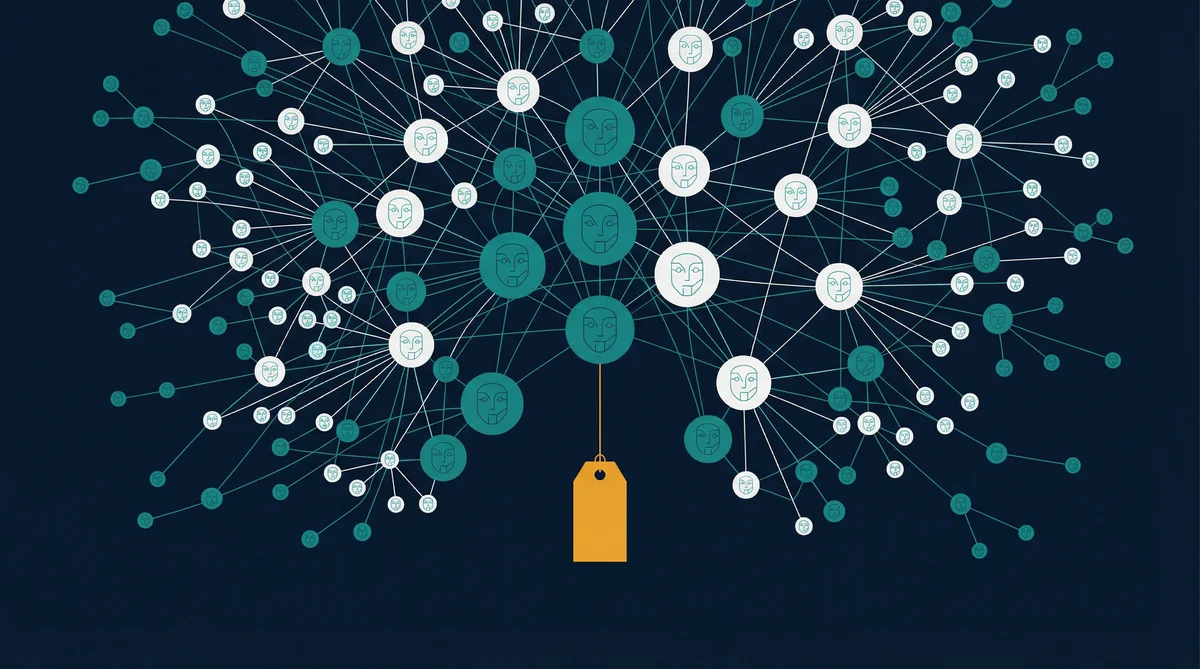
Artificial Societies' core innovation is social graph simulation. Rather than asking individual synthetic personas to respond in isolation (as FishDog, Evidenza, and most competitors do), Artificial Societies creates a network of personas who influence each other. An idea, message, or policy position enters the network, and the platform simulates how it spreads, mutates, and is received as it passes through social connections.
The approach is novel. CEO James He studied behavioural science at Cambridge, and two academics he met there advise the company (University of Cambridge, 2026). The method draws on network theory, social contagion models and agent-based simulation. He is lead author of a 2024 British Journal of Psychology paper showing that groups of AI chatbots mimic homophily, a key part of human collective behaviour. The paper studies chatbot groups; it is not a validation of the commercial product.
Where This Approach Excels
For specific use cases, the approach is strong:
Social media message testing: predicting how a campaign message, tweet, or political position will spread and be received across a social network
Narrative tracking: understanding how stories evolve as they pass through communities
Strategic communications: testing whether a corporate announcement will be amplified, contested, or ignored
Virality prediction: estimating the probability that content achieves organic reach
If your primary research question is "How will this message travel through a social network?", Artificial Societies remains one of the most specialised options in synthetic research. Whether it is still good value depends on the quote you receive.
Where It Falls Short
The limitations emerge when buyers expect Artificial Societies to work as a general-purpose consumer research platform:
Thinner on deep consumer research. The site now lists surveys, focus groups, interviews and conjoint analysis alongside simulation, but the product is built around message spread and opinion formation. If you need to understand why a consumer prefers one product over another, how they react to a specific price point, or what drives their purchasing behaviour, the social network model provides a different and often thinner signal.
Self-reported validation only. Artificial Societies' headline claim is now 86% distribution accuracy: the overlap between simulated and human opinion distributions across 1,000 surveys, against 91% for human self-replication and 67% for biography-prompted LLMs (company figures, 2026). The 95% figure we cited earlier appears only as one worked example. These numbers come from the company's own reports, not an independent audit. For comparison, FishDog's population is checked against several hundred Gallup and Pew polls and real-money prediction markets, Simile's Stanford paper reports 83% for interview-based agents and 86% combined in its June 2026 revision, and Gallup is testing Simile agents against its own Panel. Self-reported validation is not necessarily wrong, but it carries less evidentiary weight than third-party checks. For more, see our piece on self-reported versus independently audited validation.
Few named customers. As of November 2026, Teneo and Pulsar are the publicly named customers. Y Combinator lists a team of 18, and the company has raised $5.35 million (Unite.AI, 2025). Undisclosed customers may well exist, but the public evidence base is thin compared to Evidenza's roster (BlackRock, Microsoft, JP Morgan, Salesforce, Dentsu).
Integrations not documented. The current site does not mention an API, webhooks or integrations with product tools such as Figma, Canva or Framer. Teams that want to embed research in their design or development workflow should ask during the demo how findings leave the platform.
Self-serve access has gone. Teams that valued running studies themselves, without an account manager, now face the same opaque, contact-us pricing as the enterprise platforms.
How Artificial Societies Pricing Compares
Positioning Artificial Societies within the broader market reveals the full pricing landscape:
Tier | Platform | Approximate Cost (November 2026) | Model |
|---|---|---|---|
Budget | SYMAR | From €99/month (published) | Self-serve |
Mid-Market | Synthetic Users | From $12,500/year (published) | Annual plan, Research Tokens |
Premium | From US$1,500 per trailer screening | Founder-led | |
Undisclosed | Artificial Societies | No published price | Demo, then quote |
Ultra-Premium | Est. $100,000-$250,000+/year (our estimate) | Enterprise-only |
Several patterns emerge:
Artificial Societies has left the budget end. At $40 a month it undercut SYMAR (now €99 a month) and Conjointly (now $2,895 a year for Professional). As of November 2026 it publishes no price at all, which puts it alongside Evidenza, Simile and Aaru for buyers, whatever its eventual cost. Its demo form, which asks about decisions worth from under $10k to $100m+, suggests the bet has moved from volume to high-stakes decisions.
Pricing should reflect product scope. Artificial Societies sells social network simulation, now with surveys, focus groups and conjoint alongside. FishDog's pricing reflects a broader research platform (film and TV test screenings, clinician and patient panels, questions to workers, managers and buyers) checked against several hundred Gallup and Pew polls and real-money prediction markets. Evidenza's reflects consultant-led delivery, with results in 72 hours. The prices are different because the products are different.
Free tiers are rarer now. With Artificial Societies' free tier gone, Conjointly's free Basic plan is one of the few ways to try a research platform without a sales call, and it uses human respondents. In synthetic research, most buyers now start with a demo.
The Hidden Economics
The YC + Point72 Equation
Artificial Societies went through Y Combinator's Winter 2025 batch and has raised $5.35 million in total: a $2 million pre-seed and a $3.35 million seed round with Point72 Ventures (Steve Cohen's venture arm), announced in August 2025 (Unite.AI). At $40 a month per Pro user, reaching $6 million in annual recurring revenue would have taken about 12,500 paying subscribers (our arithmetic), a hard target for a niche B2B product.
In March 2026 we set out three possible trajectories:
Enterprise upsell is the real business. The $40/month tier drives adoption; the Radiant enterprise tier drives revenue. This is the classic SaaS land-and-expand model, and it is the most likely explanation.
Volume at scale. If Artificial Societies can achieve tens of thousands of Pro subscribers, the $40/month tier becomes a viable standalone business. This requires significant market expansion beyond the current base.
Pricing increases are coming. The $40/month is an introductory price designed to build market share. Once adoption reaches critical mass, prices rise. Early adopters benefit; late entrants pay more.
The first, or a version of it, appears to have happened: the self-serve tier has gone from the site, and the company now sells through demos. As we warned in March, the $40 price was not permanent.
What the Price Doesn't Include
Whatever the quoted price, several costs sit outside it:
Time investment: learning the social network simulation paradigm requires a conceptual shift for researchers used to traditional survey or focus group methods
Interpretation cost: social graph outputs (influence maps, spread patterns, opinion clusters) need different analytical skills than individual persona responses
Complementary research: organisations that need both social network insights and deep individual consumer research may find Artificial Societies is an addition to the research stack rather than a replacement
Who Should Book a Demo (And Who Should Not)
Artificial Societies is worth a conversation if:
Your primary research need is social media message testing, narrative prediction, or communications strategy
You are preparing a major announcement, crisis response or investor message and want to test reactions first
You can commit to an enterprise sales process and a private quote
Your questions centre on how ideas spread rather than why individuals hold specific preferences
You need fast iteration on messaging variants
It is likely a poor fit if:
You need deep consumer insights for product development, pricing, or packaging decisions
You require independently validated accuracy for high-stakes business decisions
You want a published price or a self-serve trial before talking to sales
Your use case is film and TV test screening, or research with clinicians, patients, workers, managers or buyers
You need census-grounded personas of the US population
For many organisations, Artificial Societies and a platform like FishDog serve complementary purposes. Use Artificial Societies to test how a message will spread. Use FishDog to understand whether the message resonates with the individuals who receive it. Together they cover breadth (social simulation) and depth (individual persona research); compare both quotes against the cost of traditional research.
The Broader Pricing Question
Artificial Societies' $40 price once posed an uncomfortable question for the rest of the synthetic research market: is enterprise pricing sustainable when a YC-backed competitor offers unlimited access for $40? Its own move to demo-only sales is part of the answer.
The answer, most likely, is yes, but only for platforms that offer meaningfully different capabilities. Evidenza's engagements (by our estimate $50,000-$100,000 a year) rest on consultant-led delivery with results in 72 hours. Simile's pricing (by our estimate $100,000+) rests on its Stanford generative agent research and a $200 million Series B at a $2 billion valuation in July 2026. FishDog's pricing rests on a population checked against several hundred Gallup and Pew polls and real-money prediction markets, and on TestScreen and its Medical and Financial panels being run with the founding team.
A $40 price point threatened the viability of mid-market platforms charging thousands a year for basic synthetic survey tools. With Artificial Societies no longer publishing a price, that pressure now comes from elsewhere: SYMAR sells from €99 a month, while Synthetic Users' annual plans start at $12,500.
The synthetic research market is repricing in real time, and in both directions. Artificial Societies started at the bottom and moved toward enterprise sales. For buyers, the lesson is to ask for a written quote, check what it covers, and compare the value delivered at each price point. Competition drives transparency, transparency drives value, and value drives adoption of a technology that, until very recently, did not exist at all.
Phillip Gales is co-founder at FishDog, a synthetic research platform that competes with Artificial Societies. This article was first written in March 2026 and updated to reflect publicly available pricing as of November 2026. Artificial Societies' pricing and features may change.