For studios, networks & advertisers

TestScreen

Find out how it plays while you can still change it

You lock the cut, book the media and commit the production money before anyone outside the building has reacted to it. TestScreen gives you the playability read first, the same afternoon, at a price that lets you test the decisions you currently make on taste.

  • See where you lose them and what they say at that moment.
  • Test every cut, title and hook without waiting for a screening budget.
  • Get it back the same day while the edit is still open.
Vintage Super 8 film camera

Ad testing costs too much to do more than once

01 / WHY NOW

A traditional dial-tested screening is estimated at $30,000 to $50,000 and takes weeks to arrange. So it happens once, near the end, on the title big enough to carry the cost. Every other call, the trailer cut, the title, the hook, the promo, gets made in the room by the people who made it.

The cost Testing is rationed

At an estimated $30–50K a screening and $20–40K a trailer test, most decisions never clear the bar. They get made on instinct rather than data.

The timing You find out too late

By the time the audience reacts, the edit is locked and the media is booked.

The room It isn't your audience

You screen for whoever turned up locally on a Tuesday night, rather than the viewers the title was made for.

Second-by-second audience reaction, and the reason behind it

02 / WHAT YOU GET BACK

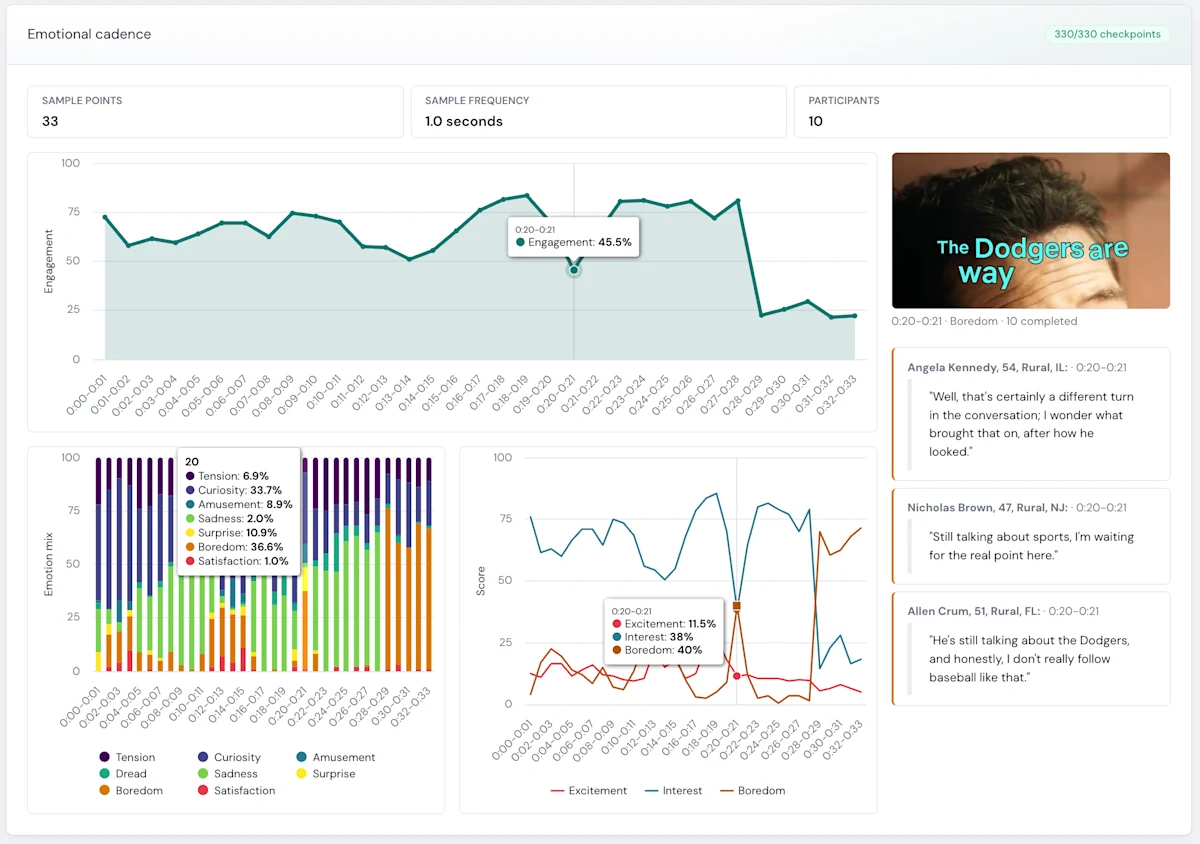
The dial-test read, without the dial or the recruited room. An attention curve across the whole audience, sampled every second, with the verbatim reaction attached to the frame that caused it. It measures ad effectiveness down to the moment, and tells you why.

Screening Room emotional cadence dashboard: an engagement curve, an emotion mix, and per-moment viewer verbatims tracked second by second across a clip
A real TestScreen read. Engagement holds in the low 70s, then falls into the low 20s as the dialogue runs past 0:20. Boredom climbs to 40%. One viewer: "Still talking about sports, I'm waiting for the real point here."
Where attention sags

The dips are your cuts. If fourteen seconds have to come out of the middle, this tells you which fourteen.

Who it holds

Split the same read by quadrant, or by whichever audience you actually sell to. A cut that works for 18–34 and dies for 45+ is a scheduling decision, not an edit note.

Why they went

Every reaction carries a timestamp and a named viewer, so you get the sentence behind the score.

Concept testing, ad testing, and everything before the final cut

03 / WHAT YOU CAN TEST
Concept testing & titles

Six title options, a franchise name, a positioning line. Settle it with the audience instead of the room.

Trailers & teasers

Find the sag before the media buy, not after the impressions are paid for.

Pilots & full cuts

Run it past the demographic you made it for, scene by scene, while the edit is still open.

Ad testing & promos

Read attention and fit across every audience you're buying, not just the one you researched.

What they understood

Comprehension in their own words. What they think it is, what genre, who the antagonist is, and who it was made for. A cut that loses the premise is a fixable defect, and you find it here.

What it promised

The expectation the cut sets, and what would disappoint them if the finished thing turns out to be something else. The mismatch is expensive after release and cheap before it.

Where it blurs

Whether the audience can tell which film this is. Tonal ambiguity reads as choice in the room and as confusion outside it.

Screen a cut you care about with the audience you're making it for.

Book a Demo

Why a synthetic audience read holds up

04 / WHY TRUST IT

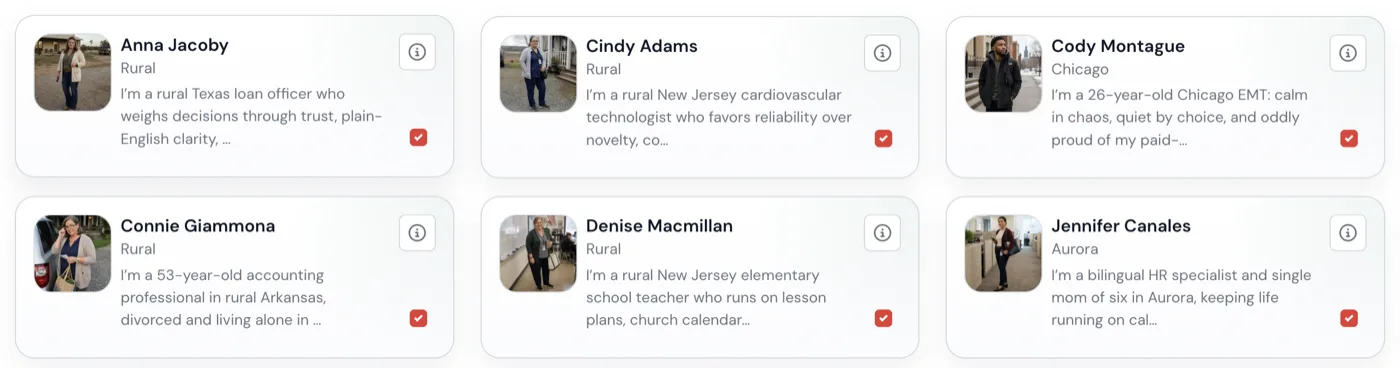
The audience is drawn from a population built to match real US demographics to within about 1% on the census margins, then checked against several hundred published human survey results. It's built to mirror the viewers you're targeting rather than a general panel.

A grid of synthetic audience members, each a named, located person with a photo and a short first-person bio
A slice of the audience. Each viewer is a specific, located person with a job and a life, drawn from the calibrated population.
Built from the real populationUS Census + ACS microdata

Calibrated to real US demographics to roughly 1% marginal error, so a 'women 25 to 44, suburban' audience actually looks like that group, not whoever filled the room.

Checked against human studiesGallup / Pew public surveys

Reactions are benchmarked against several hundred published human survey results, keeping attitudes and tastes anchored to the real public.

TestScreen vs. traditional ad testing and test screenings

05 / WHY IT WINS
Traditional testing
FishDog
What it costs
An estimated $30–50K a screening, $20–40K a trailer test
A fraction of one screening
When you find out
Weeks later, with the edit locked
The same afternoon
How often
Once, on the title that justified it
Every cut, every revision
Who reacts
Whoever filled the room
The audience you're actually selling to
What comes back
A score and a top-line
The moment, the reason, the verbatim

Ad testing and concept testing, explained

06 / FAQ

What is ad testing?

Ad testing puts a commercial, promo or campaign in front of a sample of the audience before it runs, to see whether it lands and with whom. It has traditionally meant recruited panels and a wait of several weeks, so most advertisers test the flagship spot and nothing else. TestScreen returns the same read the same afternoon, which covers the cutdowns and the promos too.

What is concept and ad testing?

Concept testing checks the idea before it is made: the title, the premise, the positioning line, the format. Ad testing checks the execution once it exists. TestScreen does both against the same audience, so the read from the concept stage and the read from the finished cut are comparable rather than two disconnected studies.

What is the difference between copy testing and concept testing?

Copy testing evaluates the specific words and creative execution. Concept testing evaluates the underlying idea, before any of that is settled. Concept testing catches the cheaper mistake, and it pays to run it more than once.

How long should you test an ad for?

Traditional panel testing takes two to six weeks, so in practice you test once, late, and live with it. A TestScreen run comes back in an afternoon whatever the length of the asset, which makes the practical answer as often as the creative changes.

What is the alternative to Kantar, System1 and traditional ad testing?

The incumbents recruit human panels, which is why they cost tens of thousands per asset and take weeks. TestScreen runs against a standing audience calibrated to the real population, and the economics change enough that you can test every cut rather than the one you can afford. Run it alongside a traditional test and compare the two reads.

How do you test a film, pilot or trailer before release?

Traditionally, by renting a theatre, recruiting a room and waiting weeks for one night of reaction. TestScreen screens against a calibrated audience as often as you like, from concept through final cut, with a second-by-second read of attention tied to the frame that earned it.

Know before you lock it.

Bring a cut, a trailer, or six title options. We'll show you how it plays.

Stay in the loop.

Signal from our synthetic populations, product updates, and the occasional hot take. No spam.