
Disclosure: FishDog is a synthetic market research platform and may compete with Simile in some buyer evaluations. The analysis below draws on public sources and separates documented fact from FishDog's interpretation.
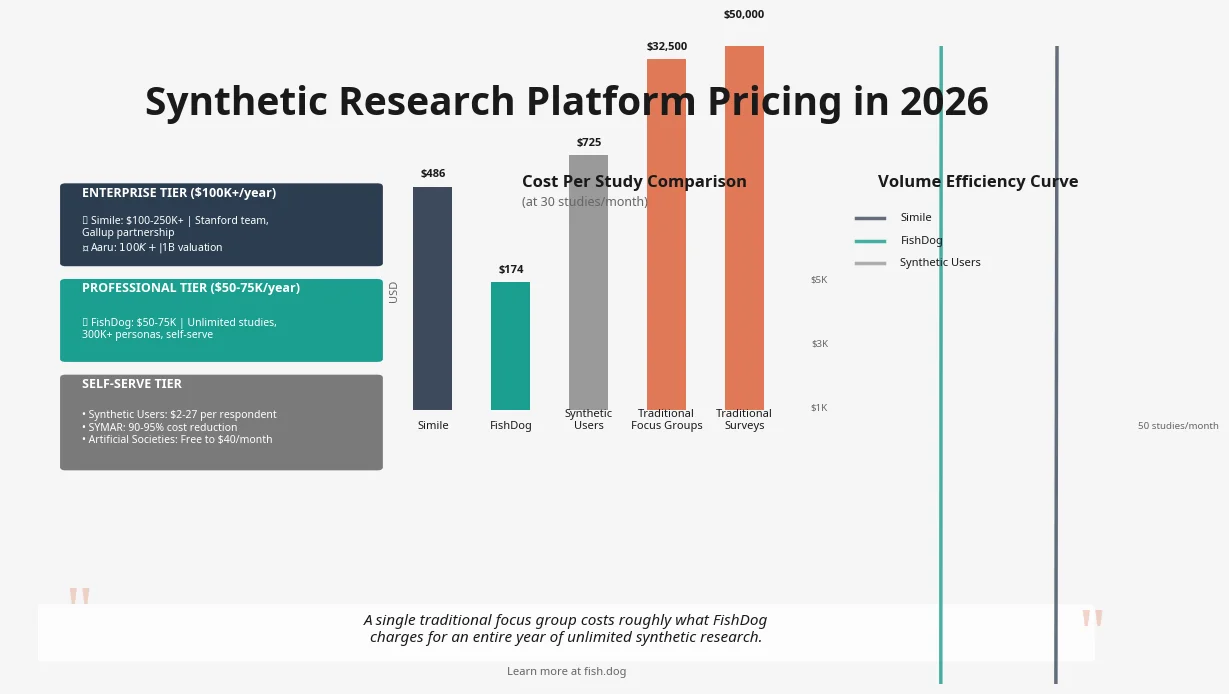
Simile does not publish pricing publicly.
That is the fact that should anchor your evaluation. If you are trying to compare Simile with other synthetic research platforms, there is no plan page, no self-serve checkout, and no published per-study or annual rate to benchmark against.
That says nothing about whether Simile is overpriced. It tells you the buying process is enterprise-led. Given the company's public positioning, funding, and customer profile, expect a sales conversation rather than a swipe-card research tool.
What is publicly known
Public sources indicate Simile is building AI simulations of human behavior using generative agents. Reports in February 2026 described a $100 million Series A led by Index Ventures, with participation from Bain Capital Ventures and prominent AI figures.
Simile's public site positions the company around behavior simulation rather than lightweight survey replacement. Gallup has also described research exploring synthetic responses through a partnership with Simile, independently validating where AI-generated agents perform well or fall short.
For pricing, those facts point to three things:
Simile is selling to enterprise buyers.
Setup and use-case scoping matter.
The price will not resemble a low-cost self-serve tool.
What buyers should expect
Expect custom pricing. The likely variables are:
number of use cases,
size and complexity of simulated populations,
whether agents need to be trained or grounded on proprietary data,
enterprise support requirements,
data security and compliance needs,
contract length,
integration or implementation work.
If your team wants a public monthly plan, Simile will not match that buying motion.
How to think about Simile pricing
The wrong comparison is "$X per synthetic respondent."
Weigh Simile against enterprise decision-support, research, forecasting, and strategy budgets instead. If the product helps a company avoid a bad product launch, improve a store-layout decision, or forecast stakeholder reactions, the value case can be large.
That also means you should demand clarity. Before entering procurement, ask:
What is included in the base contract?
How many studies, simulations, or scenarios are included?
Are synthetic agents reusable across studies?
Is proprietary data required?
Who designs the research?
How long does setup take?
Are outputs exportable and auditable?
What validation evidence applies to this specific use case?
What happens if results conflict with human research?
Are there limits on users, audiences, markets, or simulations?
Simile compared with alternatives
FishDog
FishDog fits better when the buyer wants self-serve synthetic research, repeatable studies, and faster concept, message, pricing, or product testing. The pricing conversation should center on research volume: run frequent studies and the value comes from a lower marginal study cost and shorter iteration cycles.
Evidenza
Evidenza fits better for B2B marketing research and enterprise go-to-market planning. Its model looks more service-led, though it has described self-service as a direction. The pricing conversation should center on the value of replacing slow B2B research and strategic-planning cycles.
Artificial Societies
Artificial Societies fits better for message or social-network simulation, and its public positioning includes more accessible self-serve options than Simile. The pricing conversation should center on communications testing and message-spread prediction.
Qualtrics Edge Audiences
Qualtrics Edge fits better when a buyer already runs on Qualtrics and wants synthetic audience capabilities alongside human panels. The pricing conversation should center on enterprise research operations, not synthetic respondents alone.
When Simile pricing may make sense
Simile may be worth enterprise pricing when:
the decision is high stakes,
behavior simulation is central to the use case,
your team has proprietary data to ground the simulation,
the expected business value is large,
stakeholders care about Stanford and Gallup-linked credibility,
procurement expects a custom enterprise process.
When to consider a lower-friction alternative
Consider alternatives when:
you need to run research today,
you need transparent pricing before a sales call,
you want a self-serve workflow,
your main use case is concept or message testing,
your budget is closer to research software than enterprise AI transformation,
you need many small studies rather than one bespoke simulation program.
Bottom line
Simile pricing is not public, so assume an enterprise sales process.
That can be the right call for large organizations evaluating behavior simulation, and the wrong one for teams that want fast, self-serve synthetic market research.
The practical advice is simple: ask Simile for a use-case-specific proposal, then compare it against the alternatives on the decision you need to support. Do not compare Simile on price alone. Compare it on speed, evidence, setup burden, validation, and whether behavior simulation is truly necessary for the call you are making.
Related reading
Figures here come from public sources and were accurate to the best of our knowledge in June 2026. Funding, pricing, and product details move fast, so if we got something wrong, [contact us](/contact) and we'll fix it.