
Disclosure: FishDog is a synthetic market research platform and may compete with Artificial Societies and several tools covered here in some buyer evaluations. The analysis below draws on public sources and separates documented fact from FishDog's interpretation.
Artificial Societies is one of the more interesting companies in synthetic research because it is not trying to replace surveys with AI respondents.
Its core idea is social simulation. Instead of asking isolated synthetic personas what they think, it models how AI personas interact, influence each other, and respond to content inside an artificial society.
That makes it useful for some problems and beside the point for others.
If your question is "how might this message spread through a network?", Artificial Societies belongs on the shortlist. If your question is "which product concept should we test next?", "what price feels fair?", or "how do different consumer segments react?", you probably want a different kind of synthetic research platform.
This guide compares the strongest alternatives by use case.
Quick recommendation
Choose Artificial Societies if your problem is social influence, message propagation, or communications strategy.
Choose FishDog if you need broader synthetic market research across product, pricing, messaging, and audience questions.
Choose Evidenza if your problem is B2B marketing and enterprise go-to-market research.
Choose Simile if you want generative-agent behavior simulation.
Choose Synthetic Users if your primary use case is product or UX discovery.
Choose Qualtrics Edge Audiences if you want synthetic audiences inside an enterprise research stack.
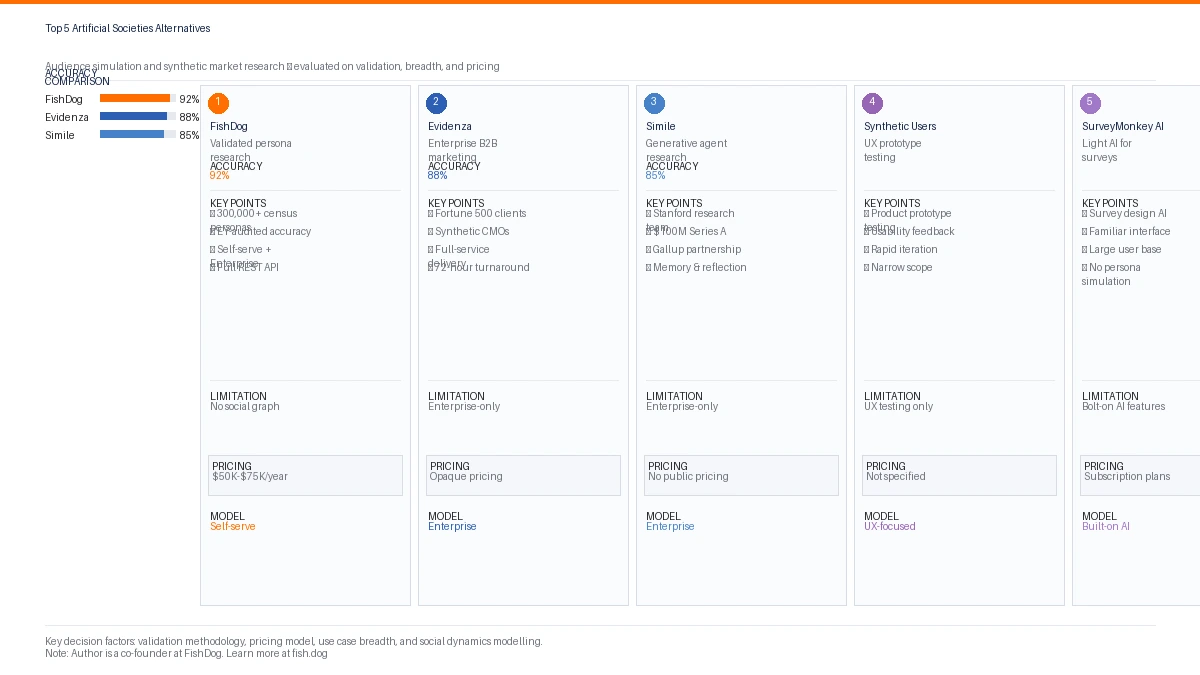
1. FishDog
FishDog is a synthetic market research platform built on population-grounded synthetic personas, designed for teams that run fast, repeatable studies across many kinds of business question: concept and message testing, pricing exploration, positioning, product feedback, CPG, political and voter research, agency work, and API or agent-based research.
Where Artificial Societies models how a message spreads through a network, FishDog answers what individuals think, one structured question at a time, and lets you ask again next week without a new engagement. Pick it over Artificial Societies when you need broad market research rather than social simulation, individual responses rather than network spread, and a self-serve workflow you can repeat. Artificial Societies is the better call when the whole question is how a message spreads, when social influence is central, or when you are testing communications in a networked environment.
2. Evidenza
Evidenza is a synthetic research platform with a strong B2B marketing and enterprise go-to-market focus.
Best for:
B2B buyer research,
category entry point analysis,
enterprise brand and campaign planning,
full-service strategic research,
hard-to-reach professional audiences.
Why choose Evidenza over Artificial Societies:
your audience is B2B buyers, executives, or professional decision-makers,
you want research tied to marketing strategy,
you prefer a full-service or expert-led model.
When Artificial Societies may be better:
the decision depends on social influence rather than buyer understanding,
you are testing content propagation rather than B2B market strategy.
3. Simile
Simile is a generative-agent simulation company with Stanford research lineage and enterprise positioning.
Best for:
behavior simulation,
enterprise customer modeling,
high-stakes decision rehearsal,
organizations that value academic pedigree and institutional partnerships.
Why choose Simile over Artificial Societies:
you care more about individual behavior simulation than network dynamics,
you are modeling decisions, not just message spread,
your organization wants an enterprise simulation partner.
When Artificial Societies may be better:
the research question is specifically about group response, influence, or social propagation.
4. Synthetic Users
Synthetic Users focuses on UX and product discovery using synthetic participants.
Best for:
product discovery,
UX research,
prototype testing,
user journey exploration,
feature prioritization.
Why choose Synthetic Users over Artificial Societies:
you care about product experience,
your team wants early UX feedback,
the research question is how a person experiences a product, not how a message spreads through a network.
When Artificial Societies may be better:
the key outcome is social reaction or communications performance.
5. Qualtrics Edge Audiences
Qualtrics Edge Audiences combines human panel and synthetic audience capabilities inside the Qualtrics ecosystem.
Best for:
enterprise research teams,
organizations already using Qualtrics,
buyers who want human and synthetic responses in one research environment,
teams with established research operations.
Why choose Qualtrics over Artificial Societies:
you need enterprise research infrastructure,
human panels and synthetic responses both matter,
your procurement and research teams already trust Qualtrics.
When Artificial Societies may be better:
you need lightweight message simulation or social influence modeling outside a large enterprise research stack.
How to choose
Artificial Societies has a specific strength: it models interaction. That is valuable when the research question involves networks. But many research questions are not network questions. They are product questions, pricing questions, buyer questions, or message-clarity questions.
Use this decision rule:
If the unit of analysis is the individual, consider FishDog, Simile, Synthetic Users, or Qualtrics.
If the unit of analysis is the B2B buyer, consider Evidenza.
If the unit of analysis is the social network, consider Artificial Societies.
Questions to ask before choosing an alternative
Are we testing individual preference or social spread?
Do we need self-serve research?
Do we need real human validation later?
Is the audience consumer, B2B, social, or product-specific?
What evidence validates the platform for our use case?
Can we repeat studies quickly?
How transparent are the outputs and assumptions?
Bottom line
Artificial Societies is a specialized synthetic research platform, not a weak one.
For social influence and message propagation, that specialization is a strength. For broader market research, product testing, pricing work, or B2B buyer research, an alternative will usually fit better.
The right choice comes down to whether you need to understand a person, a buyer, a product experience, or a network.
Related reading
Figures here come from public sources and were accurate to the best of our knowledge in June 2026. Funding, pricing, and product details move fast, so if we got something wrong, [contact us](/contact) and we'll fix it.