
Disclosure: FishDog is a synthetic-population platform and may compete with Aaru in some buyer evaluations. This review draws on public sources and separates documented fact from FishDog's interpretation.
Aaru is one of the most talked-about names in synthetic populations, and most of the talk is about the story: founded by teenagers in March 2024, valued at roughly a billion dollars inside two years, and built around an unusually bold thesis, that you can simulate human behaviour well enough to predict outcomes before they happen.
The useful question for a buyer is narrower than the headlines. What does Aaru actually do, what evidence stands behind it, and when is a prediction engine the right tool versus a synthetic population you can question?
Quick verdict
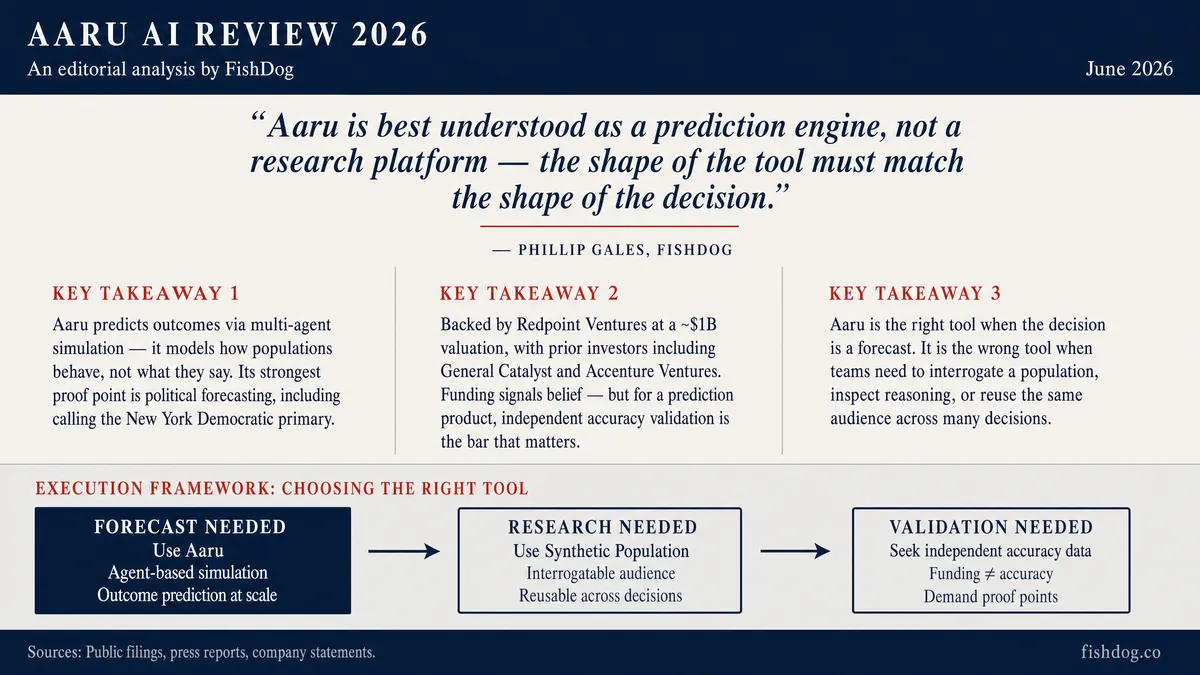
Aaru is best understood as an agent-based prediction company, not a research platform. Its strength is forecasting outcomes, especially elections and group behaviour, by simulating interactions between AI agents rather than asking people questions. For organizations whose decision genuinely is a forecast, and who can work through a high-end enterprise engagement, Aaru belongs on the shortlist. For teams that need to interrogate a population, inspect the reasoning, and reuse the same audience across many decisions, it is the wrong shape of tool.
What Aaru does
Aaru builds multi-agent simulations to predict human behaviour and outcomes. Its founders, Cameron Fink (CEO), Ned Koh, and John Kessler, describe software that models the decisions and behaviours of individuals, groups, and entire populations, then uses those agents to predict how specific demographics or geographies will respond to future events, products, or messages. The pitch is a prediction, not a survey you run or an evidence layer you take apart.
The most concrete public proof point is political: Aaru's method has been credited with calling the New York Democratic primary. Its named clients include Accenture, EY, and Interpublic Group, alongside political campaigns.
Funding and standing
Aaru raised a Series A in December 2025 of more than $50 million, led by Redpoint Ventures, at a roughly $1 billion headline valuation. Earlier pre-seed and seed capital came from investors including General Catalyst, Accenture Ventures, Felicis, and Abstract Ventures. The valuation and the founder story have drawn heavy press (WSJ, TechCrunch, CNBC), which is part of why buyers keep encountering the name.
Funding is a signal of belief, not of accuracy. For a product whose entire promise is prediction, the bar that matters is independent validation, and that is harder to find from the outside than the funding headlines.
Where Aaru looks strong
Outcome prediction at scale. When the decision genuinely is a forecast, an agent-interaction model is a legitimately different approach from polling or surveys.
High-stakes, time-sensitive calls. Elections are unforgiving, fast-moving domains, and a system built for them is built for pressure.
Narrative and access. The valuation and coverage open doors, and for some buyers institutional confidence is part of the purchase.
Where buyers should be careful
A prediction is an endpoint, not evidence. You get an outcome, not the deliberation behind it. If your decision needs the why, the objections, the segments, the distribution of views, a forecast alone will not give it to you.
Validate for your domain. Calling an election does not automatically transfer to your category, your market, or your audience. Ask for accuracy evidence on the specific kind of outcome you care about.
Transparency and access. From the outside, methodology, pricing, and study setup are hard to inspect. Expect a sales-led, enterprise engagement.
Aaru compared with FishDog
Aaru and FishDog are both synthetic-population approaches, and they do different jobs.
Aaru simulates agents to predict an outcome. FishDog builds a population-true synthetic population you can question, across research, financial-services behavioural modelling, media-audience decisions, and policy work, and inspect the reasoning behind every answer.
In plain terms:
choose Aaru when you need a forecast and an outcome is enough,
choose FishDog when you need a population you can interrogate, segment, and reuse across many decisions.
Questions to ask before buying Aaru
What validation exists for my exact outcome type, not just the headline election cases?
How is uncertainty in a prediction expressed and bounded?
Can I inspect the agent assumptions, or only the final forecast?
How are private data and proprietary scenarios handled?
What is the implementation timeline and commercial model?
What decisions should not be made with Aaru?
Bottom line
Aaru is a credible, well-funded company with a genuinely distinct thesis: simulate to predict. That is one valuable job, and where the decision is a forecast, Aaru is worth serious evaluation.
But most teams searching the synthetic-population space do not need a single number. They need a population they can question and reuse. For that, the better starting point is a platform built to be interrogated across research, finance, and media, with validation you can inspect for your own decisions.
Related reading:
Figures here come from public sources and were accurate to the best of our knowledge in June 2026. Funding, pricing, and product details move fast, so if we got something wrong, [contact us](/contact) and we'll fix it.