

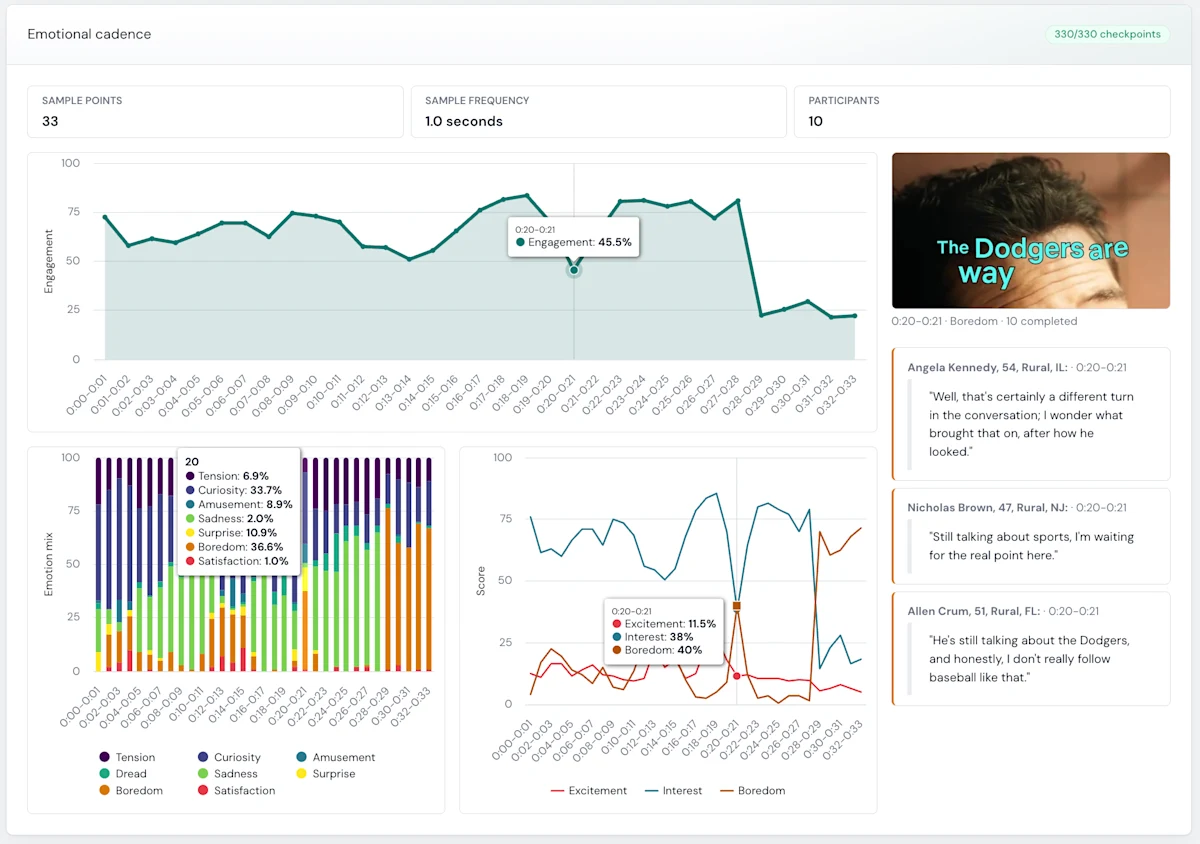
Screening Room now gives you Emotional Cadence: a moment-by-moment read of how your audience feels across the entire runtime of a video. Instead of a single score for the whole piece, you get a timeline. You can see the beat where attention peaks, the stretch where it sags, and the exact second a reaction turns, with the audience's own words attached to each moment.
It works on anything you can screen, from a 15-second pre-roll to a two-hour feature. This is the part we are most excited about: you can now run a full-length movie past a population-true synthetic audience and watch their engagement, excitement, and emotional state move scene by scene across the whole film.
Why we built it
A single overall score tells you whether something worked. It does not tell you where it worked, and that is usually the question that matters. A commercial can test well on average and still lose half its viewers in the first five seconds. A film can hold attention for ninety minutes and lose the room in the third act. The overall number hides exactly the moment you need to find.
Emotional Cadence makes the runtime legible. Every beat is measured, so the conversation moves from "did it land" to "it lands here, drags here, and recovers here, and this is what people said when it did."
What's new
A timeline, not a number. The top chart tracks engagement across the runtime. Below it, three views of the same timeline let you read the emotional shape of the piece beat by beat.
Excitement, interest, and boredom over time. A second chart traces three core attention signals together, so you can see exactly where interest climbs, where excitement spikes, and where boredom takes over. In the example below, interest holds high through the opening and then collapses at a single beat as the scene stalls.
The full emotion mix. A stacked view breaks down what the audience is actually feeling at each moment across eight emotions: tension, curiosity, amusement, dread, sadness, surprise, boredom, and satisfaction. You can watch dread build, curiosity give way to boredom, or satisfaction arrive at the close.
Reactions tied to the beat. Every moment carries the audience's own words. Scrub to any point and you see who reacted and what they said. At a slow beat in our example film, three participants are visibly checked out, talking about the Dodgers instead of the scene, which is the kind of signal a single score would never surface.
What you can do with it
Review commercials. See whether the spot earns attention in its first seconds and holds it to the call to action. Find the exact frame where viewers disengage and fix it before the media buy.
Screen pilots. Watch where a pilot grips and where it sags, scene by scene, so you know which act needs work before you commit to the series.
Optimise ad breaks in existing media. Place breaks at the beats where engagement is naturally high and emotional investment is strong, instead of guessing, and avoid cutting away at the moment the audience is most hooked.
Screen films during editing and production. Run a rough cut past an audience and get a beat-by-beat reaction across the whole runtime. Find the slow third act, the joke that does not land, the scene that drags, while there is still time in the edit to change it.
See it on a real film
We ran the full 1959 feature House on Haunted Hill through Screening Room with a panel of twelve viewers. You can read the complete Emotional Cadence report, beat by beat, here: House on Haunted Hill (1959) Screening Room report.
As with everything in Screening Room, the read is synthetic, directional, and human-validated, built to complement your existing measurement rather than replace it. What it gives you is a fast, structured view of how a piece moves an audience across its whole runtime, early enough to act on.
If your organization is enabled for Screening Room, Emotional Cadence is in your reports now. If you would like access for your team, get in touch.