
Political polling has operated on essentially the same model since George Gallup correctly predicted FDR's 1936 landslide. Gallup's innovation was methodological: replace the Literary Digest's 2.4-million-ballot straw poll with a scientifically selected sample of 50,000, and you get a more accurate result at a fraction of the cost. The insight was that representativeness matters more than raw numbers. Ninety years later, the polling industry still runs on Gallup's basic architecture -- recruit a sample, ask questions, tabulate responses, publish findings. The methodology is overdue for disruption. Not because it is wrong, but because the world it was designed to measure has changed in ways that make it progressively less effective.
The Decline of Traditional Polling (and Why It Matters)
The American polling industry generates roughly $20 billion in annual revenue. A substantial portion of that figure flows through political campaigns, party committees, super PACs, and the constellation of consultancies that orbit the electoral process. The economics are instructive. A single statewide poll from a reputable firm costs between $20,000 and $50,000. A comprehensive tracking programme for a competitive Senate race -- weekly polls from July through November -- runs into the hundreds of thousands. For presidential campaigns, the figure enters the millions. These are not vanity expenditures. They are the navigational instruments that campaigns use to allocate resources, craft messages, and decide which voters to target in the final weeks.
The problem is that these instruments are becoming less reliable precisely as they become more expensive.
The headline statistic is response rates. In 1997, the Pew Research Centre achieved a 36% response rate on telephone surveys. By 2018, that figure had fallen to 6%. By 2023, it was hovering around 4%. This is not a minor calibration issue. When 96% of the people you call refuse to participate, the 4% who do are, almost by definition, unusual. They are more likely to be older, more likely to be retired, more likely to be politically engaged, and more likely to hold strong opinions they wish to express. The resulting sample is not representative of the electorate. It is representative of the kind of person who answers unknown numbers and agrees to spend fifteen minutes discussing their political preferences with a stranger.
The industry has adapted, of course. Online panels, text-to-web surveys, probability-based sampling, post-stratification weighting, and multi-mode fielding have all been deployed to address the declining reliability of phone-based polling. Some of these methods work well. Many introduce new biases while correcting old ones. All of them take time -- typically two to four weeks from questionnaire design to final results -- and money that might otherwise be spent on voter contact, advertising, or field operations.
The cost constraint is particularly acute for down-ballot races. A candidate running for a state legislature seat or a competitive US House district does not have $50,000 for a single poll. They might have $50,000 for the entire campaign. These campaigns make decisions about messaging, issue emphasis, and voter targeting based on a combination of national polling trends (which may not reflect local conditions), canvasser anecdotes (which are vivid but unrepresentative), and the candidate's personal intuition (which is, by definition, biased). The result is a two-tier system: well-funded campaigns navigate by data, and everyone else navigates by instinct.
This is not a satisfactory state of affairs for anyone who believes that democratic elections benefit from informed decision-making at every level.
What Voter Research Actually Needs to Accomplish
Before discussing methodology, it is worth being precise about what political and voter research is supposed to do. The term "polling" is used loosely to describe several quite different activities, each with its own requirements and success criteria.
Sentiment tracking is the ongoing measurement of how voters feel about candidates, parties, and issues over time. This is the horse-race polling that dominates media coverage -- who is ahead, who is behind, and by how much. It is useful for fundraising, media strategy, and resource allocation, but it is the least actionable form of voter research for campaign strategists because it describes the current state without explaining why it exists or how to change it.
Message testing is the evaluation of specific campaign communications -- advertisements, talking points, debate responses, direct mail copy -- against target voter segments before those communications are deployed at scale. This is where campaigns discover that the healthcare message that tests brilliantly with suburban women falls flat with rural independents, or that the economic message they assumed would be their strongest performer is actually less compelling than the education message they had been treating as secondary. Message testing is, by a considerable margin, the highest-ROI form of voter research. The cost of testing five message variants against synthetic voters is trivial. The cost of running the wrong message in $2 million worth of television advertising is not.
Issue prioritisation determines which policy areas and voter concerns should receive the most emphasis in campaign communications. Candidates arrive with a platform of twenty policy positions. Voters care, meaningfully, about three or four. The campaign's job is to identify the overlap between what the candidate wants to say and what voters want to hear, and then to build the communications strategy around that overlap. This requires understanding not just which issues voters care about, but how they rank them relative to each other, and how those rankings vary across demographic and geographic segments.
Candidate perception research explores how voters perceive the candidate as a person -- their character, competence, relatability, and trustworthiness. Elections are, at a fundamental level, hiring decisions, and voters evaluate candidates the way they evaluate job applicants: partly on qualifications, partly on experience, and substantially on gut-level assessments of character. Understanding how voters perceive your candidate (and the opposition) is essential for deciding which personal qualities to emphasise, which vulnerabilities to address, and which attacks to prepare for.
Opposition research -- the voter-facing kind, not the investigative kind -- tests how voters react to negative information about the opposing candidate. This is the research that determines whether a particular line of attack will be effective, counterproductive, or irrelevant. Running a negative advertisement that voters find distasteful costs money twice: once for the media buy and once for the reputational damage to the attacking campaign. Testing the attack beforehand costs a fraction of either.
Get-out-the-vote (GOTV) strategy testing evaluates which mobilisation messages and tactics are most likely to motivate specific voter segments to actually cast a ballot. Persuasion is only half the battle. The other half is ensuring that persuaded voters show up. GOTV research identifies the most effective appeals for different segments -- whether they respond to civic duty framing, peer pressure framing, convenience messaging, or issue urgency -- and informs the targeting strategy for the final push.
Traditional polling can, in theory, address all six of these functions. In practice, the cost and time constraints mean that most campaigns can afford to do one or two well, and the rest not at all.
Synthetic Voter Research: What It Is and What It Is Not
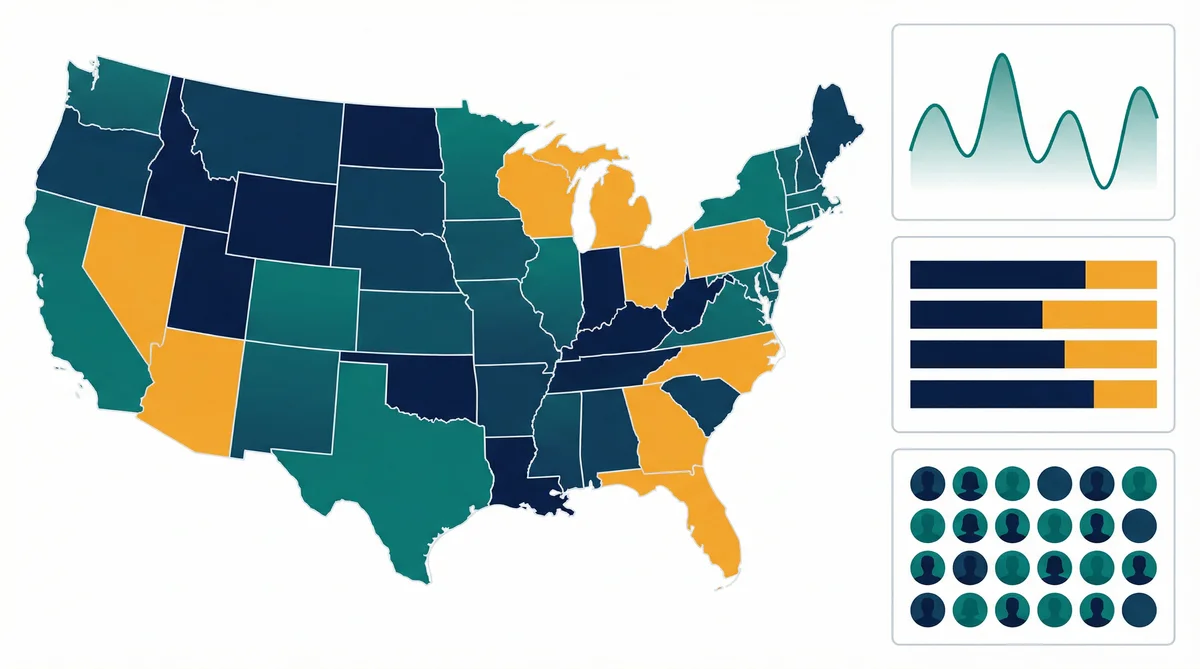
FishDog maintains a panel of over 300,000 AI-generated personas grounded in census data, consumer behaviour patterns, and demographic distributions. For political research, the critical capability is state-level filtering. You can create a research group of synthetic voters filtered to a specific state -- Michigan, Texas, Pennsylvania, Arizona -- and the resulting personas will reflect the demographic composition, political leanings, cultural attitudes, and issue priorities of that state's actual electorate.
This is not a parlour trick. The personas are calibrated against census data and behavioural surveys. A synthetic Michigan voter is not a generic American voter with a Michigan label. They carry the economic concerns of a state with a manufacturing heritage, the environmental attitudes of a Great Lakes population, the political sensibilities of a purple state with distinct urban-rural divides, and the cultural reference points of the upper Midwest. When you ask this persona about healthcare policy, they respond in the context of Michigan's specific Medicaid expansion history. When you ask about trade, they respond in the context of a state where automotive supply chain disruption is not an abstract policy discussion but a lived economic reality.
The state filtering uses two-letter postal codes -- MI, TX, PA, AZ, OH, GA, WI, NV -- which is worth mentioning because full state names do not work with the API and will return zero results. This is one of those small technical details that saves considerable frustration on the first attempt.
A few honest caveats are in order.
Synthetic voter research does not replace large-scale probability-based polling for the purpose of predicting election outcomes. If you need to know, with statistical confidence, that your candidate leads by 3.2 points with a margin of error of plus or minus 2.1, you need a traditional poll with a properly constructed sample. Synthetic personas do not produce that kind of quantitative precision, and anyone who claims otherwise is either confused or selling something.
What synthetic research does, and does exceptionally well, is the qualitative and semi-quantitative work that campaigns need most but can least afford: understanding why voters feel as they do, which messages resonate and with whom, how candidate perceptions are constructed, which issues drive voting behaviour in specific geographies, and how all of these factors interact. This is the research that informs strategy. The horse-race number tells you the score. The qualitative research tells you how to change it.
The speed advantage is not incremental. A synthetic voter study returns results in minutes. Not days, not weeks -- minutes. A campaign can test a debate response at 9pm, receive voter reactions by 9:15pm, refine the message, and have the optimised talking points in the candidate's hands before the morning shows. This is not a hypothetical workflow. It is the practical reality of synthetic research applied to the tempo of modern campaigns.
The Seven-Question Voter Study Framework
The study design below has been refined through dozens of voter research engagements. The seven questions are designed to produce a comprehensive picture of voter sentiment, issue priorities, candidate perception, and message receptivity for a specific race in a specific state.
Question 1: Issue Salience
"What are the most important issues facing [state] right now? What should elected officials be focused on?"
This question establishes the voter's priority stack before any candidate-specific priming. Responses reveal what voters actually care about, in their own language, without the framing effects that come from mentioning specific candidates or parties. The gap between what voters say here and what the campaign assumes they care about is frequently the most valuable finding in the entire study.
Question 2: Candidate Awareness and First Impressions
"What do you know about [candidate name], who is running for [office] in [state]? What is your impression of them?"
This measures both awareness (does the voter know who the candidate is?) and perception (what do they think?). For well-known candidates, the question reveals the dominant narrative. For lesser-known ones, it reveals how much work remains in building name recognition and defining the candidate before the opposition does it for them.
Question 3: Candidate Strengths and Weaknesses
"What do you see as [candidate name]'s biggest strengths? What concerns you most about them?"
A direct assessment of perceived strengths and vulnerabilities. The qualitative detail matters more than the summary -- a voter who says the candidate "seems smart but doesn't understand people like me" is providing actionable intelligence about a relatability gap that no amount of policy expertise will close. The concern responses are particularly valuable for debate preparation and opposition defence planning.
Question 4: Message Testing
"[Candidate] says: '[Campaign message or key talking point].' How does this make you feel? Does it change how you think about them?"
The core message testing question. Present a specific campaign message -- a stump speech excerpt, a proposed advertisement line, a policy framing -- and measure its impact on voter perception. Run this question with multiple message variants across different voter segments to identify which messages resonate where. The qualitative reasoning ("this makes me trust them more because...") is more useful than the directional response alone.
Question 5: Opposition Contrast
"If you had to choose between [candidate] and [opponent], what would be the deciding factor for you? What would make you lean one way or the other?"
This question maps the competitive dynamics of the race. It reveals which dimensions voters use to distinguish between candidates, which factors are deal-breakers, and where the race is being decided. If voters say the deciding factor is "who I trust more on the economy," that tells the campaign where to focus. If they say "who seems more honest," that is a different strategic imperative entirely.
Question 6: Persuadable Voter Identification
"Is there anything [candidate] could say or do that would make you more likely to support them? What would change your mind?"
This is the question that identifies persuadable voters and maps the persuasion pathways. Responses fall into three categories: voters who are effectively locked in (nothing would change their mind), voters who are genuinely undecided and can articulate what would persuade them, and voters who are leaning away but reachable under specific conditions. The middle category is the campaign's target audience, and their articulated conditions for persuasion are the campaign's roadmap.
Question 7: Turnout Motivation
"How important is this election to you personally? What would motivate you to make sure you vote?"
The closing question addresses the GOTV dimension. It reveals both the intensity of voter engagement (an unenthusiastic supporter who might not vote is less valuable than a moderately enthusiastic one who definitely will) and the specific motivational triggers that the campaign's mobilisation operation should leverage. If voters say they will "definitely vote because abortion rights are on the ballot," that is a mobilisation message. If they say they "probably will if the weather is good and the lines are short," that is a logistics problem.
State-Specific Research Groups: The Precision Advantage
The most consequential design decision in political voter research is geographic filtering. National polling tells you how the country feels. State-level research tells you how the voters who will actually decide a specific race feel. The difference is not subtle.
Consider a Senate race in Michigan. National polling might show that healthcare ranks as the third most important issue for American voters. But Michigan voters, who experienced the Flint water crisis and have above-average rates of chronic illness in post-industrial communities, may rank healthcare first -- and may care about specific aspects of healthcare (prescription drug costs, rural hospital closures, environmental health) that differ markedly from the national aggregate.
FishDog's state-level filtering produces research groups that reflect these local realities. When you create a group of "MI State Voters," the personas embody Michigan's demographic composition: the racial diversity of Detroit and its suburbs, the rural conservatism of the Upper Peninsula, the college-town liberalism of Ann Arbor, the working-class pragmatism of Grand Rapids. The resulting study captures the full spectrum of voter sentiment within the state, not a nationalised average that obscures local variation.
For campaigns operating in swing states, where margins are measured in thousands of votes, this precision is not a luxury. It is the difference between a message strategy calibrated to your actual electorate and one calibrated to a notional average that may not describe any real voter in your district.
The practical implementation is straightforward. When creating a research group in FishDog, you specify the state filter using the two-letter postal code. A group of "PA Swing Voters" is created by filtering to PA and specifying demographic criteria that capture the persuadable middle -- moderate-income suburban voters, independent-leaning professionals, soft partisans who vote for candidates rather than parties. You can create separate groups for different segments -- "TX Latino Voters," "GA Suburban Women," "WI Rural Independents" -- and run the same study against each to understand how sentiment and message receptivity vary across the coalition you need to build.
This segmentation capability is where synthetic research offers its starkest advantage over traditional polling. Running a traditional poll with enough sample in each of five voter segments, in each of three battleground states, would require a sample size of several thousand and a budget in the six figures. Running the same segmented analysis through FishDog takes an afternoon and costs less than a restaurant dinner.
Real-Time Tracking: The Weekly Pulse
Campaign seasons are not static. Voter sentiment shifts in response to debates, news cycles, advertising, endorsements, scandals, economic data, and the accumulated weight of campaign contact. A poll that was accurate in June may be meaningless by September. The campaigns that win are, disproportionately, the ones that detect shifts early and respond before the opposition can capitalise.
Traditional tracking polls attempt to capture these shifts through weekly or bi-weekly fielding. The problem is the delay. A tracking poll fielded on Monday typically delivers results on Thursday or Friday. If the shift was triggered by a Tuesday event, you are receiving confirmation of something you already suspected, two to three days too late to respond optimally.
Synthetic voter research collapses this timeline. You can run a full seven-question voter study on Tuesday evening and have results before midnight. If a debate performance shifted voter perception, you know by morning. If an opposition attack is landing, you know within hours. If your new advertising buy is moving the needle on candidate perception, you can measure the shift before the second flight airs.
The operational advantage compounds across the campaign calendar. Consider a twelve-week general election sprint from Labour Day to Election Day. A campaign running weekly synthetic tracking studies accumulates twelve data points -- a high-resolution film of voter sentiment rather than a series of blurry snapshots. They can track which messages gained traction and which lost it, how candidate perception evolved in response to specific events, and whether the coalition they need is consolidating or fragmenting. This granularity of insight is currently available only to presidential campaigns with multi-million-dollar research budgets. Synthetic research makes it accessible to every competitive race.
The weekly tracking cadence also supports rapid-cycle message optimisation. Test five message variants in Week 1. Identify the two strongest performers. Refine them and test the refinements in Week 2. By Week 3, the campaign is running messages that have been iteratively optimised against actual (synthetic) voter reactions. This is the political equivalent of A/B testing in digital marketing -- except that the "audience" is a census-grounded panel of state-level voters, and the turnaround is measured in minutes rather than statistical significance thresholds reached over days.
The Claude Code Workflow for Political Research
For campaign teams using Claude Code, the voter research study can be executed as a single conversational workflow. The sequence is designed for speed, because campaigns do not have the luxury of contemplative timelines.
Step 1: Create a state-specific research group. Specify the state using its two-letter code (MI, TX, PA, AZ), along with any additional demographic filters that define the voter segment of interest. Claude Code translates these specifications into FishDog API parameters and recruits a group of 10 synthetic voters matching the profile. The group name should be descriptive -- "MI State Voters," "PA Suburban Independents," "GA Black Voters" -- so that subsequent studies using the same group are easily identifiable.
Step 2: Create the voter study. Provide the candidate name, the office being sought, the opponent's name, and any specific messages to be tested. Claude Code generates the full seven-question study, customised to the race and the state, and submits it to FishDog.
Step 3: Run the study. FishDog's synthetic voters answer all seven questions. The study typically completes in under five minutes. Claude Code monitors progress and notifies you when results are ready.
Step 4: Extract insights. Claude Code processes the raw responses and generates a voter research report covering: issue priority rankings, candidate perception summary, message effectiveness analysis (with per-segment breakdowns), opposition vulnerability assessment, persuadable voter profile, and GOTV recommendation. Each finding is sourced to specific voter responses.
Step 5: Inform campaign strategy. The report is structured to be immediately actionable. Issue priorities inform advertising buys and talking points. Message testing results inform creative development. Candidate perception findings inform earned media strategy and debate preparation. Persuadable voter profiles inform targeting. GOTV insights inform the field operation.
The entire workflow, from group creation to completed report, takes approximately 15 to 20 minutes for the initial study. Subsequent tracking waves using the same group specification take under 10 minutes.
For campaigns already familiar with FishDog's commercial research capabilities -- brand perception tracking, cross-market research -- the political workflow will feel familiar. The methodology is identical. The questions are different. The stakes, one might argue, are higher.
What Changes When Voter Research Becomes Fast and Cheap
The consequences of accessible voter research extend beyond individual campaign advantage. They are structural.
When only well-funded campaigns can afford research, the political system develops an information asymmetry that correlates with money. Candidates with large war chests make data-driven decisions. Candidates without them make intuition-driven decisions. This is not a partisan observation. It is a mechanical one: the candidate who knows which messages work, which issues matter, and which voters are persuadable has a systematic advantage over the one who is guessing. Reducing the cost of voter research by two orders of magnitude does not eliminate every inequality in campaign resources, but it removes one of the most consequential ones.
There is a second-order effect worth noting. Campaigns that understand their voters are, on balance, more responsive to those voters. A candidate who knows that her constituents rank prescription drug costs above every other healthcare concern is more likely to emphasise prescription drug costs in her platform and, if elected, in her legislative priorities. This is not idealism. It is the straightforward consequence of better information flowing into the political process. Voter research, when accessible, functions as a feedback loop between the electorate and the candidates seeking to represent them.
The temporal dimension matters as well. Traditional polling, with its multi-week turnaround, creates a political discourse in which campaigns respond to voter sentiment as it existed three weeks ago. Synthetic research, with its same-day turnaround, allows campaigns to respond to voter sentiment as it exists now. In a news environment where the narrative can shift overnight -- and in an electorate whose attention is increasingly fragmented -- the difference between "three weeks ago" and "today" is the difference between relevance and obsolescence.
None of this makes traditional polling unnecessary. Election forecasting, media reporting, and public accountability all require the kind of rigorous, transparent, probability-based polling that has been the industry standard for decades. What synthetic research does is fill the vast operational space that traditional polling cannot reach: the daily message decisions, the segment-level targeting choices, the rapid-response assessments, and the continuous feedback loops that determine how campaigns are actually run.
George Gallup's insight in 1936 was that you do not need to survey everyone to understand what the electorate thinks. You need a representative sample and good methodology. That insight still holds. The methodology, however, no longer requires a telephone, a clipboard, and four weeks of patience.
Getting Started
A voter research study requires three inputs: the state where the race is being contested, the candidate whose prospects are being evaluated, and the willingness to discover what voters actually think rather than what the campaign assumes they think. The third requirement is, as in all research, the most demanding.
The seven-question framework described in this article is available through FishDog and can be executed via Claude Code in a single session. For campaign teams facing their first competitive race, the initial study provides a baseline understanding of voter sentiment that informs every subsequent strategic decision. For experienced operations looking to add rapid-cycle research to their toolkit, the weekly tracking programme builds the kind of longitudinal insight that was previously available only to presidential campaigns.
The midterm cycle rewards preparation. The campaigns that begin voter research early -- understanding their electorate before the opposition defines it for them -- enter the final months with a strategic advantage that no amount of late spending can replicate. The first study takes twenty minutes. Everything else follows from there.
Phillip Gales is co-founder at [FishDog](https://fish.dog). He has financial interests that the reader should weigh accordingly.
The Claude Code and FishDog for Product Marketing Series
This is part of a series exploring how AI agents handle the core disciplines of product marketing. Each article covers one function of the PMM stack, explains the methodology, and links to a companion Claude Code guide you can run yourself.
Part 1: How to Develop Product Positioning (guide)
Part 2: How to Build Competitive Battlecards (guide)
Part 3: How to Research Pricing (guide)
Part 4: How to Test Product Messaging (guide)
Part 5: How to Run Voice of Customer Research (guide)
Part 6: How to Segment Customers (guide)
Part 7: How to Validate GTM Strategy (guide)
Part 8: How to Build a Content Marketing Engine (guide)
Part 9: How to Build Sales Enablement Materials (guide)
Part 10: How to Research a Product Launch (guide)
Part 19: How to Run Political and Voter Research with Claude Code and FishDog -- this article