A commodities quant named Mario stood on the Alt Data London stage last week and said something I have not stopped thinking about.
"Batteries are coming in. They are changing the structure of the market, the resilience of the grid. And you cannot backtest something when there was no past."
Backtesting is the move every quant makes before risking a dollar. You run your strategy against historical data and see if it would have made money. No past, no backtest. No backtest, no trade. Mario was talking about grid-scale batteries entering the energy market, but the same logic catches every structural shock a fund will face this decade: tariff regimes, AI in the labour market, the next pandemic.
That is a massive gap. Every alt-data product in the room, credit card spend, satellite imagery, foot traffic, container shipments, only works when the future looks structurally like the past. When something genuinely new shows up, those signals are blind.
That is the whole reason FishDog exists.
Why we went
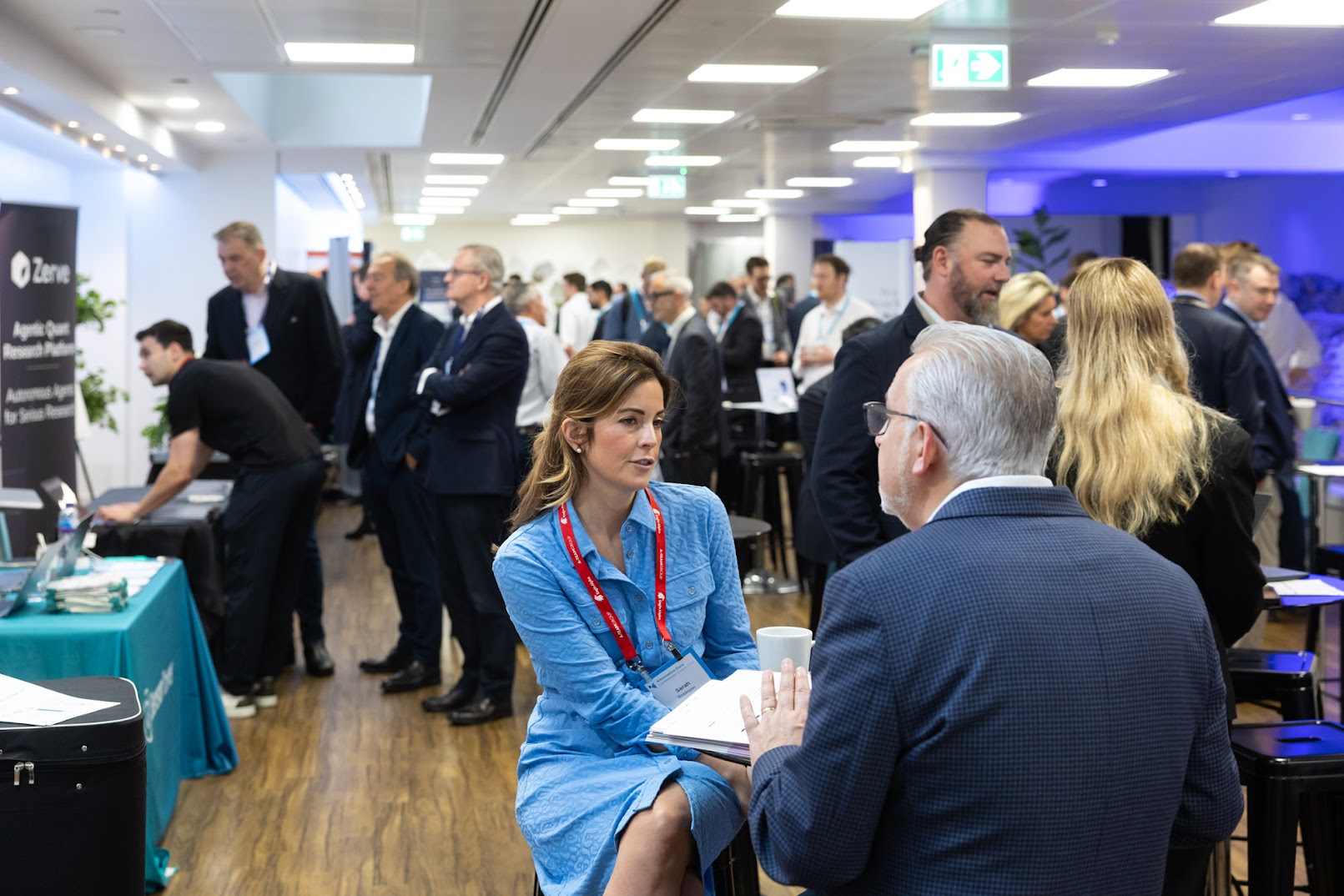
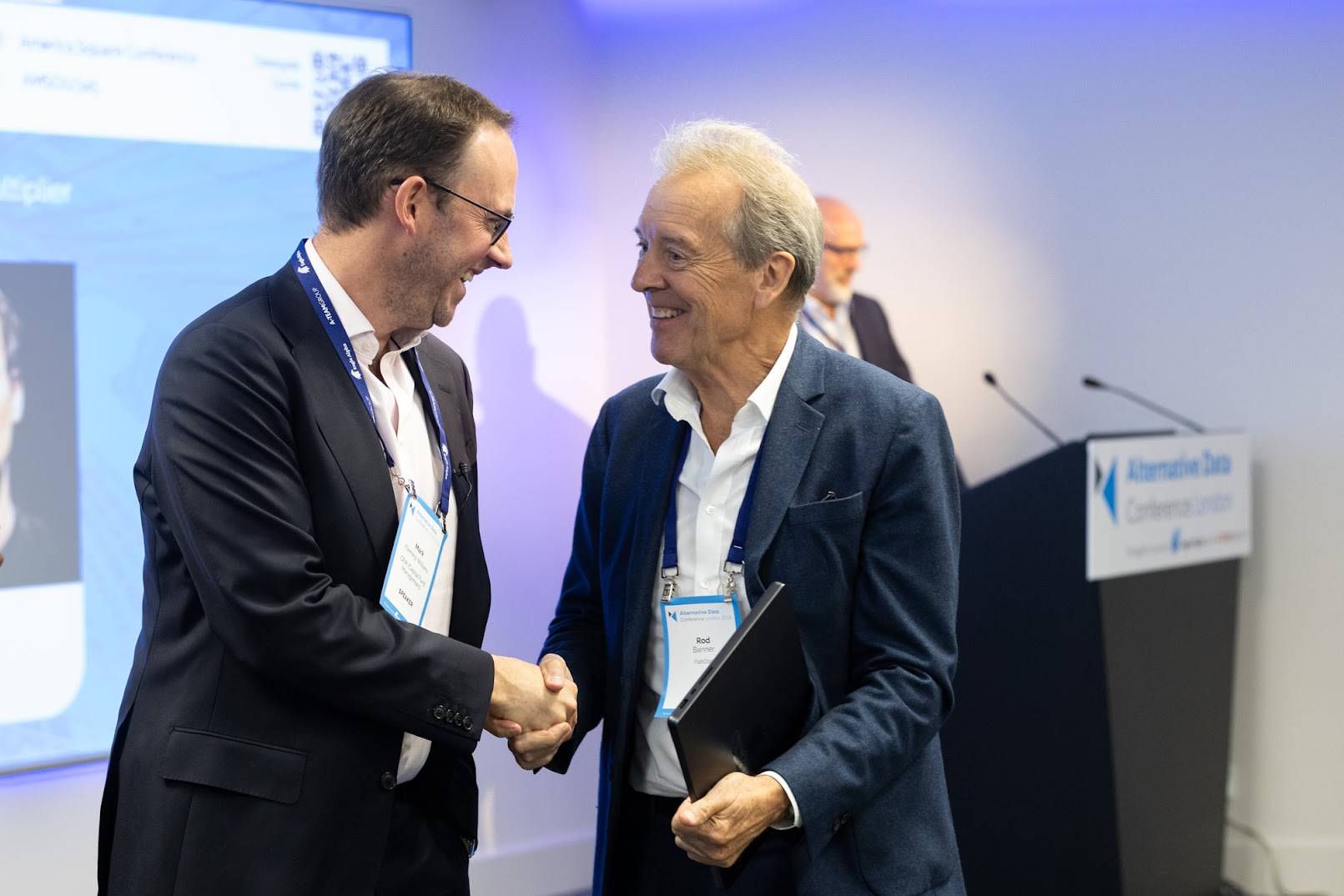
Rod Banner, FishDog chairman, four-decade brand strategist, the patient counterweight on our hyper-active founding team, and I met at the Alternative Data Conference, organised by A-Team Group to collaborate with our channel partner Eagle Alpha. About 500 people in a room in the City of London: heads of data sourcing at the biggest funds in the world, alt-data vendors of every shape, a few academics, and the quants who actually use the stuff to make money.
We had a booth, we had a three-minute Fresh Features slot on stage, we had a list of people we wanted to meet. And we had a thesis to test: that synthetic research is the next layer of alternative data, not a replacement for the existing one.
Three minutes on stage
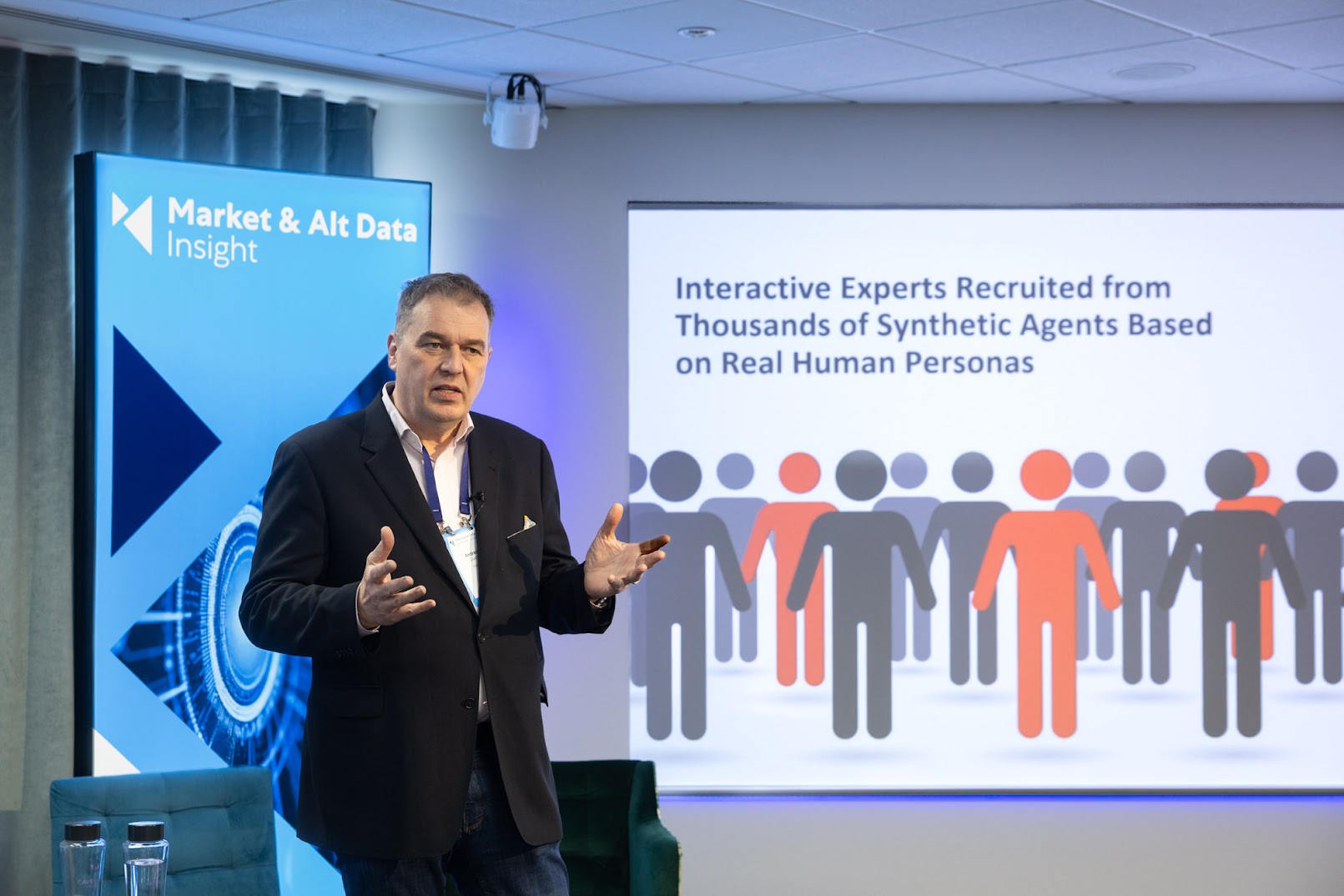
The Fresh Features format, where newcomers get to present their wares, is fun. Three minutes, no demo, no slides past a holding card, no recovery if you fumble. Rod opened with the brand build, fishing for alpha, the dog that brings it home. Then he handed it to me.
My job: explain how we build synthetic populations of entire countries without putting the room to sleep.
I used the analogy I had been refining at the booth all morning. We take 340 million Americans, based on census data, consumption data, political data, health data, voting data, and we compress them into 340,000 personas.
Like turning a raw camera image into a JPEG. A thousand-to-one compression that keeps the information that matters. You can still recruit a cab driver in New York City, a cancer researcher in Seattle, an unemployed truck driver in Austin, Texas, an airline pilot from St. Louis. They are not made up. They are statistically real.
A sales playbook, drawn on paper
The single most valuable 25 minutes of my conference happened at our booth on the Tuesday afternoon. A senior quant at a major asset manager, machine learning engineer by background, sat down at the booth, drew a Sharpe-ratio curve on a piece of paper, and gave us a sales playbook for the hedge fund world.
The line I wrote down word for word:
"The information I will never have is how the consumer is going to react to this new product. Synthetic data doesn't have this problem."
Read that twice. A sophisticated machine learning quant, never met us before, articulated the category gap better than any deck I have ever written. Historical alt-data, things like credit card spend, satellite imagery, container shipments and foot traffic, tells you what people did. It cannot tell you what they would do in a scenario that has not happened yet.
He gave us the rule for selling into this world too: "80 percent of vendors here are selling different formats of the same information." Every new dataset has to add information that is mathematically distinct from what the buyer already has. Pitch FishDog as another dataset, and we lose. Pitch FishDog as out-of-distribution information, the kind of questions no existing dataset can answer, and we win.
He also sharpened my view of the buyer. The big funds (Millennium, Citadel, BlackRock-shape) will come to you. They have data science teams whose job is to test new things. The small funds (sub-300-million in assets, about 5,000 of them on Morningstar) cannot afford that. They are mostly salespeople. They need infrastructure, not another vendor.
That is two products from one platform. And one of them is a category we had not been seriously building toward.

How funds actually buy alt data
The most useful single insight of the whole conference came from a data vendor panellist on the AI and Alt Data session. He described, in detail, the internal process for getting a new dataset into a hedge fund.
It is four steps. One: a dedicated data-sourcing lead is the single entry point. The title varies. "Head of Data Sourcing," "Head of Market Data Strategy," "Senior Data Scientist with sourcing remit." Two: it goes to a quantitative researcher who tests it in isolation against the firm's Sharpe-ratio gate. Three: if it passes, it goes to a deeper quant dive. Four: it lands with a portfolio manager (in pod-based firms) or a committee (in corporate-outcome firms).
That is the map. If you are pitching alt-data into a hedge fund and you don't have a name for step one, you are not selling, you are guessing.
He also explained why data subscriptions die. "When it comes time to unwind, usually it's because the group left, and the group that was using the data left." Single-champion adoption is fragile. Retention requires planting a multi-stakeholder root system before the pitch goes deep.
The same panel gave me the line I will be borrowing for the next deck: "Alternative data is really becoming table stakes data. You've got to have it, otherwise you're looking at PE ratios and earnings estimates. Good luck."
What the room agreed on
A few things I heard repeated in different rooms by different people:
Augment, do not replace. Every credible buyer voice said the same thing. The panellists. The data-sourcing leads. The quant at our booth. The funds that buy alt-data are not looking to fire their researchers. They are looking to make their researchers ten times faster. The pitch that lands is the one that respects the existing workflow.
Schema stability matters more than freshness. Buyers worry less about whether your data is six hours old or six days old, and more about whether the structure of the data set is going to change underneath them next quarter. Silent structural change is the thing that breaks trading strategies.
Price by use case, not by vendor ego. The panel was unanimous on this. You do not get to charge what you think your data is worth. You charge what it is worth to the buyer's specific use case, and you align your commercials to that.
And then Mario again, on the regime-change panel: alt-data has already replaced traditional fundamental signals in most quant workflows. PE ratios and analyst estimates are quarterly. Alt-data is daily. By the time a sell-side analyst revises an estimate, the alt-data signal is priced in. The traditional factor stack is structurally lagged.
What this changes for us
I left London with three things sharper than when I arrived.
The category is real, and the buyer behaviour is no longer a guess. The funds that win this decade will be the ones that can interrogate behaviour with no historical precedent. Mario's gap. Historical alt-data cannot answer that question. Synthetic populations can.
The buyer has a name and a title. Head of Data Sourcing. Head of Market Data Strategy. Senior Data Scientist with sourcing remit. We met five of them in two days. They are real people with budgets, and they have a 4-step internal process that any serious vendor can navigate if they understand it.
The product is two products. Managed-service for the tier-one funds with internal research benches. Self-service infrastructure for the 5,000 small funds without them. Same FishDog underneath. Different deployments and price points. Different sales motion.
We came home with sixteen new contacts, one consulting offer from a buyer who became an unexpected ally, and a clearer view of the category than I have had in two years of building it.
We also came home convinced of something simpler. The market is not waiting for synthetic research to prove itself. The market is waiting for someone to build it properly and show up where the buyers are.
That is the work now.
FishDog builds synthetic research populations for hedge funds, asset managers, and the consultancies and research firms that serve them. If you are responsible for data sourcing or alternative data evaluation at your firm, the conversation is open. Find me at [email protected].