
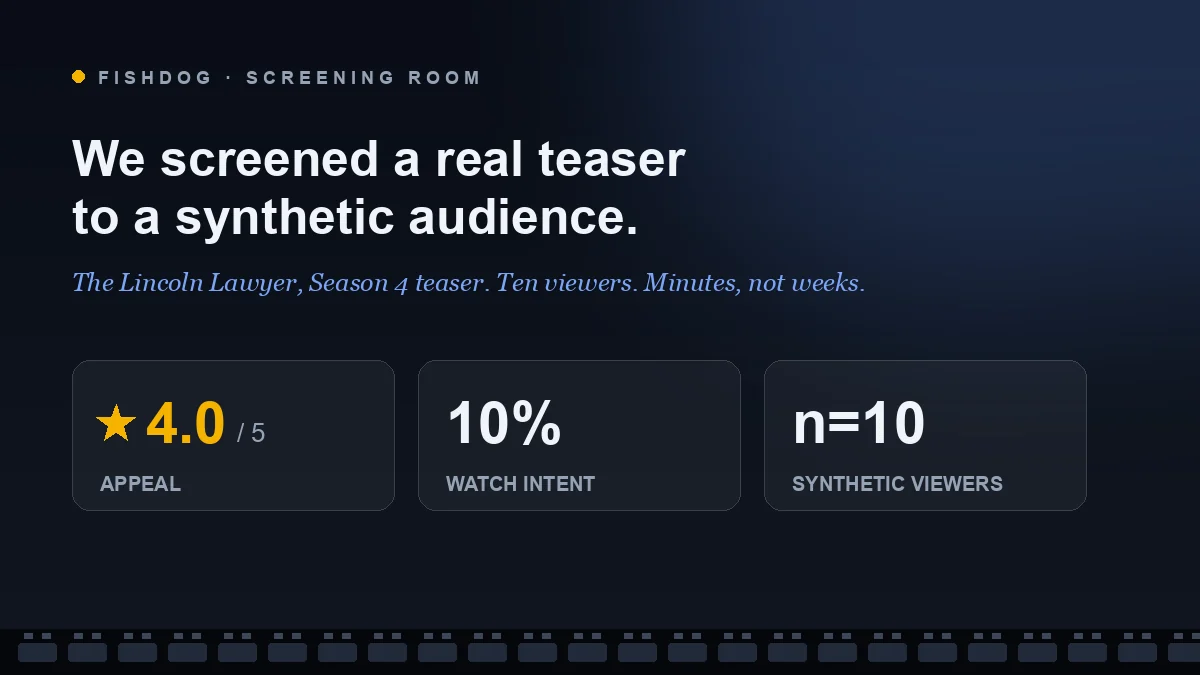
In June we pointed our own product at a real piece of creative: the teaser trailer for Season 4 of The Lincoln Lawyer. Ten synthetic viewers, each with a defined demographic and psychographic profile, watched the cut and told us what they made of it. The headline read was a contradiction worth sitting with.
The teaser scored 4.0 out of 5 for appeal and 10 percent for watch intent. The audience admired the craft. Almost none of them said they would actually press play. That gap, between what an audience respects and what it will do, is the whole reason pre-testing exists. It normally costs weeks and a five-figure budget to surface. We surfaced it in minutes, for the price of a coffee, and then did the thing a focus group cannot: we asked the viewers why.
You can open the screening yourself. The full report is live and public here.
A disclosure, first
I run Screening Room as a co-founder of FishDog, the company that built it, so read me as an interested party. I have tried to make that caveat unnecessary by being exact about what the tool does, what it does not do, and where its output should and should not be trusted. The numbers in this piece are not illustrations. They come from an actual screening, and I have linked it so you can check my working.
What Screening Room actually is
Screening Room is a way to put any ad, trailer, pilot, or feature film in front of a population-true synthetic audience and get a structured report back: an emotional-response score, watch or purchase intent, message clarity, the segments that diverged, and the audience's own words. It sits beside Research Studies in the FishDog workspace and runs through a short, guided flow: create the screening, choose and size the audience, connect the media, set the questions, run it, read the responses, then read the report.
The first step is the one everything hangs on: connect the media. Drag in a video file or paste a link, and the system measures the clip and prepares it as the stimulus the panel reacts to. One task, two ways in, no setup ceremony.
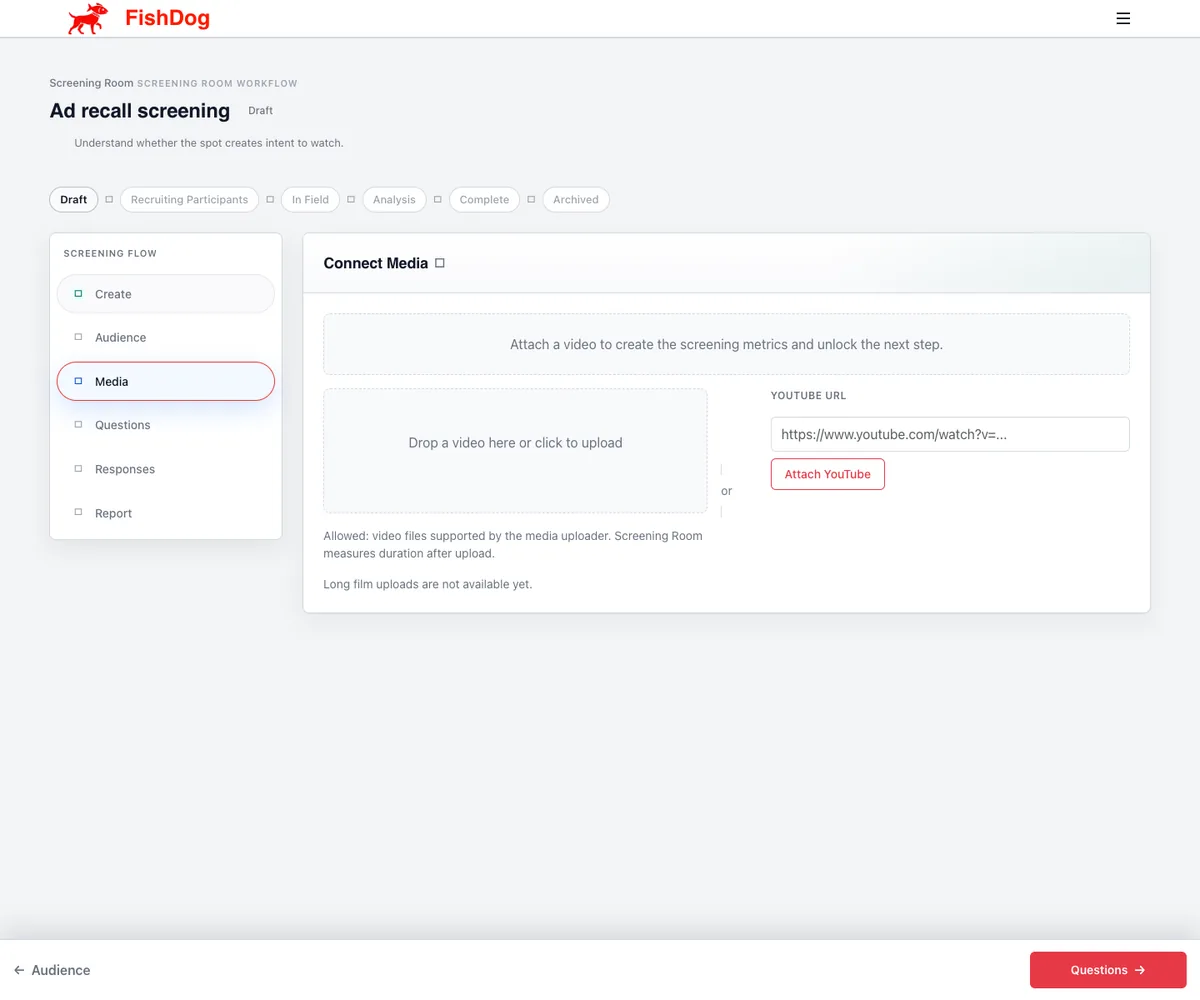
Connecting the media: drag in a video file or paste a link. The clip becomes the stimulus the synthetic panel reacts to.
Who was in the room
The audience for the Lincoln Lawyer screening was ten US adults, aged 47 to 63, drawn largely from rural areas across Illinois, New Jersey, Florida, Ohio, the Carolinas, Oregon, California and Georgia. Among them were registered nurses, a civil engineer, an HVAC technician, retail and corrections supervisors, and an operations-research analyst, on incomes ranging from under 24,000 dollars to roughly 150,000. Screening Room shows you exactly who is in the room before you run anything: the faces, and the full demographic breakdown.
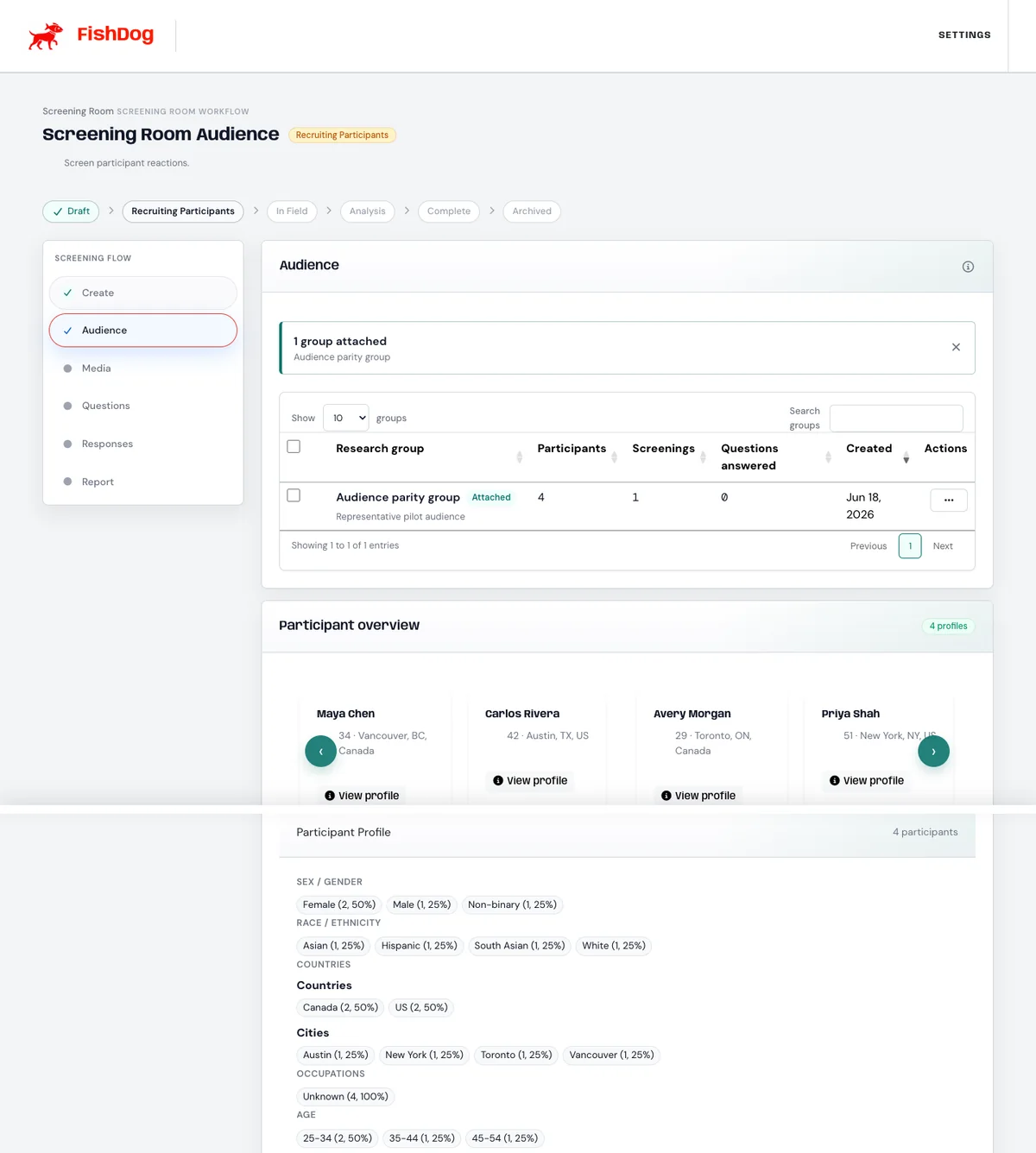
The Audience step: a population-true panel with a full demographic breakdown, so you know precisely who you are testing with before a single reaction comes in.
This matters because the read you get is the read for that audience, not a generic average. A teaser that plays as taut and intelligent to a 30-year-old streaming-native crowd is not guaranteed the same reception from viewers in their fifties at the end of a long shift. The panel you pick is the argument you are testing.
What the numbers said, and what they hid
On the surface the teaser did well. A 4.0 appeal score is a respectable read on craft, and the central mystery landed cleanly: the idea that Mickey Haller is framed for murder and fighting to prove his own innocence came back almost verbatim in the open responses. One viewer summarised it without prompting as “a lawyer framed for murder trying to prove his innocence.” When the audience can restate your premise unaided, the hook is doing its job.
And yet watch intent sat at 10 percent. The craft was admired; the click was not promised. A single overall score would have flattered the cut and hidden the problem. The interesting signal was the distance between the two numbers, and the only way to understand that distance is to read what people actually wrote and, better still, to ask them.
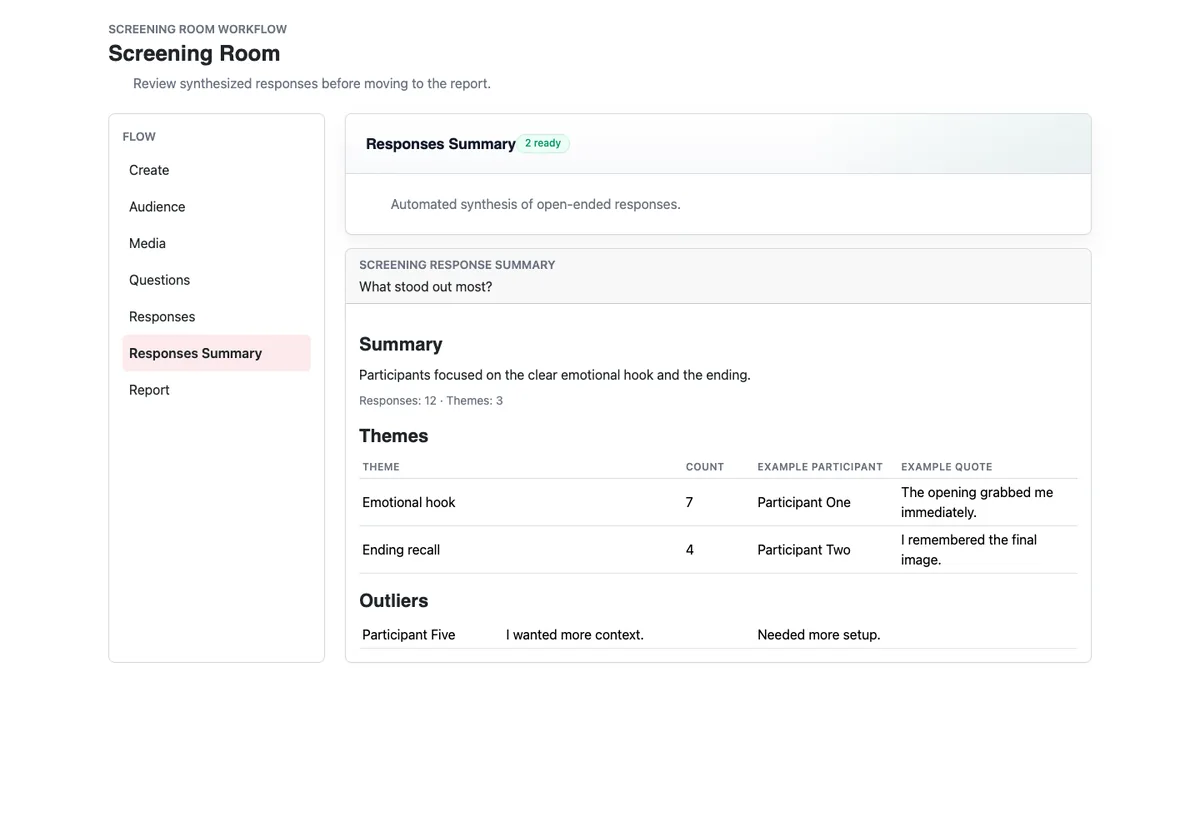
The Responses Summary synthesises every open-ended reaction into themes, with counts, an example participant and a representative quote, before you reach the formal report.
Then we asked them why
This is the part that separates a synthetic screening from a survey. Click into any reaction and you can hold a conversation with that participant, seeded with what they already said, and push on the trade-off the way a moderator would in a live session, except instantly and with anyone in the room.
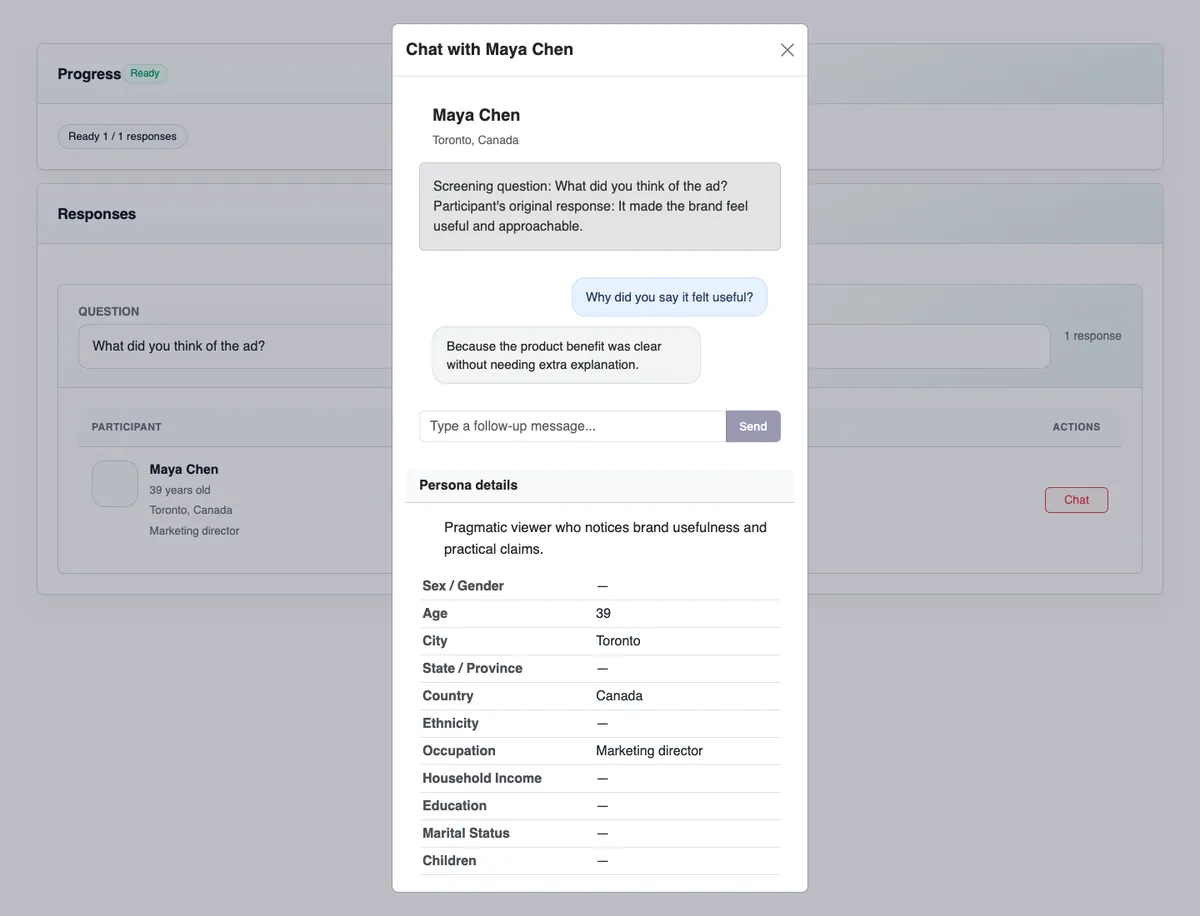
Talk to your audience: open a chat with any participant, seeded with their original reaction, and probe the why behind the number.
The why, here, was consistent. The pacing was the sticking point. Several viewers found the rapid courtroom cuts “too much”, particularly as something to choose after a long working day. The ones who leaned in were the problem-solvers: “problem-solving keeps my interest,” as one put it, with another wanting the show to make its case “without trying to pull any fast ones.” The memorable image, an axe and a tree, stuck, but the procedural promise, the how of the legal fight, did not come through. The family stakes were unclear.
From that, the report assembled recommendations a cutting room can act on:
Add a premise card by the five-second mark so the framed-for-murder setup is explicit, not inferred.
Insert a three to five second procedural beat, a non-spoiler evidence or strategy cue, to pay off the problem-solvers.
Slow one or two clarity shots and duck the music under dialogue, so the intensity stops drowning the plot.
Produce two fifteen-second cutdowns, one built for intensity and one for strategy, and let the data choose.
A/B test the thumbnail: the axe-and-tree image against a straight evidence still.
None of that is a verdict on the show. It is a verdict on this cut, for this audience, produced in the time it takes to make a coffee. That is the unlock: not a grade, but a list of specific, testable moves.
What it changes
Audience testing has always been slow, expensive and small, so most creative gets tested rarely, late, or not at all, and the gut call wins by default. A traditional panel means recruiting, scheduling, moderating and waiting days or weeks for a deck, usually once, when the cut is nearly locked and there is little room left to change course.
A synthetic, population-true panel changes the economics, and the economics change the behaviour. When a screening costs a few dollars and finishes in minutes, you can test early (a rough cut, a concept, a storyboard read), test often (two versions of the hook, head to head), and test broadly (the whole funnel of questions you actually care about). Audience feedback stops being a one-time gate at the end of the line and becomes a normal part of the work.
What it is not
I would rather state the limits plainly than have you discover them. The panel is synthetic and directional. It is built to give a fast, repeatable, defensible read, and it is human-validated, but it is not a census of the real world and it does not replace your in-market measurement or your qualitative research. Treat it as the instrument you reach for constantly, the one that tells you where to point the expensive instruments you reach for occasionally.
Used that way, the synthetic read and the real-world read are complements, not rivals. Used as a replacement for either, it will let you down, and so would any tool sold as doing everything. The honest framing is the whole pitch: directional, synthetic, validated against humans, and fast enough to use before every decision rather than after the important one has been made.
The verdict
If you make or buy media and you currently test it once, late, or never, Screening Room earns its place the first time it catches a problem while you can still fix it, as it did with a teaser that everyone admired and almost nobody said they would play. If you need population-true ground truth for a regulatory claim or a nine-figure media commitment, keep your real-world research, and use this to decide which questions are worth asking it.
The dividing line is simple. Use the synthetic panel to iterate, to compare, to find the gap between appeal and intent before the money is spent. Use human research to confirm the calls that cannot be wrong. The mistake is treating a fast, cheap, constant signal and a slow, expensive, occasional one as substitutes. They are a system. Screening Room is the half of that system the industry has never been able to afford to run often, until now.
Open the Lincoln Lawyer Season 4 screening report to see the full read, or visit fish.dog to screen something of your own.
Phillip Gales is a co-founder of FishDog, which builds Screening Room and synthetic-audience research on the FishDog platform.