How do Netflix, Disney and the rest decide a show will work before they spend nine figures making it? Strip away the data-science mystique and the honest answer is the one the screenwriter William Goldman gave decades ago: nobody knows anything. What the industry has instead is a handful of backward-looking signals, dressed up as foresight, and a testing business that arrives too late to change the decision that matters. In 2026, with fewer and bigger bets, that gap costs more than it used to.
Prediction happens in three stages, and only one of them works
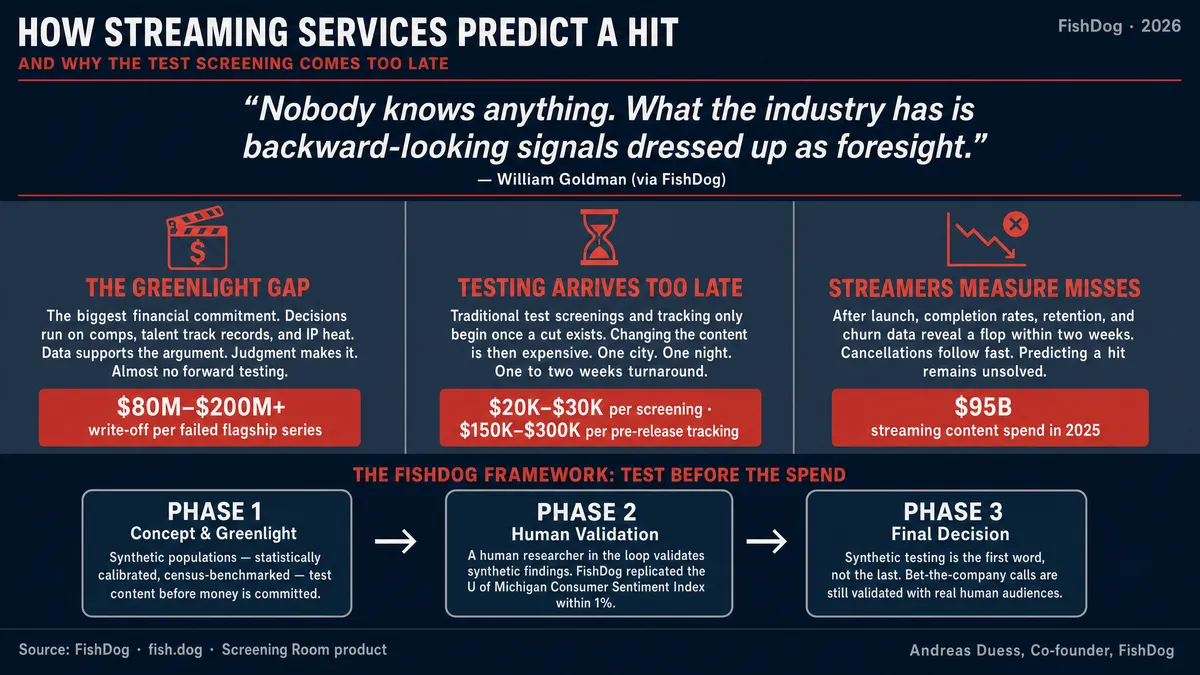
At greenlight, where the real money gets committed, there is almost no forward test. The decision to make a series runs on comparisons ("it's Ozark meets Yellowstone"), the track record of the talent, and how hot the underlying IP is. Data supports the argument. Judgment makes it. Netflix's real edge is that it owns the viewing history behind its comparisons, so its guesses are sharper than a studio guessing from Nielsen. They are still guesses.
Once there is a cut to show, the testing begins, and here the work is real but structurally late. Recruited test screenings, dial testing where the audience twists a handheld dial moment to moment, trailer and concept testing, pre-release tracking. It is a decades-old industry with two dominant firms, National Research Group and Screen Engine/ASI. The problem is not the method. The problem is timing. You can only test something once it exists, by which point changing it is expensive, and the recruited test audience is whoever a firm could get into a room in one city on one night. Turnaround runs one to two weeks.
After launch, the industry is good at one thing: measuring a miss. Completion rates, retention, the effect on subscriber churn, thumbnail tests. This is why streamers cancel so fast. They can measure a flop in two weeks. Predicting a hit is the part nobody has solved.
So the one decision that commits the most money, the greenlight, gets the least testing.
What a test screening costs
The audience testing business is large and concentrated. The Los Angeles Times reported that the two leading firms held "a virtual lock on the $100 million that studios spend annually to test their movies and costly promotional campaigns." That is a near-monopoly on a nine-figure budget line.
Neither firm publishes a rate card, so treat these as reliable industry estimates:
Test screening: about $20,000 to $30,000 for a single showing in one city, more for complex multi-cut tests.
Trailer or TV-spot test: roughly $10,000 to $20,000 per asset.
Concept or positioning study: about $30,000 to $75,000 for a batch of titles, loglines or art.
Pre-release tracking: a full programme for a wide release runs $150,000 to $300,000 per title.
None of that is cheap, and all of it lands after the expensive decision is already made.
Why the gap is getting more dangerous
The economics changed. The industry has left the land-grab behind and entered what analysts now call "streaming market repair." Global content spend was about $248 billion in 2025, up a flat 0.4%, with streaming crossing $95 billion and projected to pass $100 billion in 2026. The dollars are still enormous, but they are being spent on fewer, bigger bets: shorter episode orders, more tentpoles, faster cancellations.
Fewer bets, each one larger, means the cost of getting a greenlight wrong has never been higher. A failed flagship series is an $80 million to $200 million-plus write-off. And the tolerance for letting a weak show find its audience over three seasons is gone. Year one, increasingly week one, decides renewal. So more money than ever now rides on the one decision that still gets almost no forward test.
A synthetic alternative to the test screening
There is a better way, and it does not require a theatre. A synthetic population is an audience built to mirror the real one: statistically calibrated against census data, given the demographics, occupations and life circumstances of the people you are trying to reach, and updated continuously so it knows about the world it is supposed to be living in. You screen a concept, a trailer, a title, or a full cut against it, and you get how it plays, in an afternoon, before the money goes out.
The obvious objection is accuracy, and it deserves a real answer rather than a slogan. The test is replication against a known human benchmark. In June 2026 we re-ran the University of Michigan Index of Consumer Sentiment questions, unchanged, against a FishDog synthetic panel, and the result landed within 1% of the published index. The audience is recruited from a population that existed before your question, not generated on demand to fit your brief, which is the difference between a representative sample and a machine telling you what you want to hear.
Two things make this fit the greenlight problem specifically. It works at concept stage, when there is nothing physical to screen and a traditional test is impossible. And it is repeatable, so you can test every revision instead of betting on one audience on one night. This is the job our Screening Room product does for studios, networks and advertisers.
The honest caveats
Synthetic testing is the first word in a decision, not the last. It is exceptional for exploration, concept screening and fast iteration, and a bet-the-company call should still be validated with human research before the cheque clears. And niche audiences remain genuinely hard. The smaller and stranger the group, the more sceptical you should be of any vendor's coverage claim, ours included.
What I would actually do
If I ran a slate, I would stop treating the greenlight as the one decision I make blind. The testing industry is not wrong, it is just late, and late is the expensive part. Move a version of the test to the front, when the work is still cheap to change and the audience is a keystroke away. Keep the human researchers for the decision that ends a career if it goes wrong. Judgment still makes the call. It just should not be the only thing in the room when $100 million rides on it, and right now, at greenlight, it usually is.
Andreas Duess is a co-founder of FishDog. Figures reflect the market as of July 2026.