

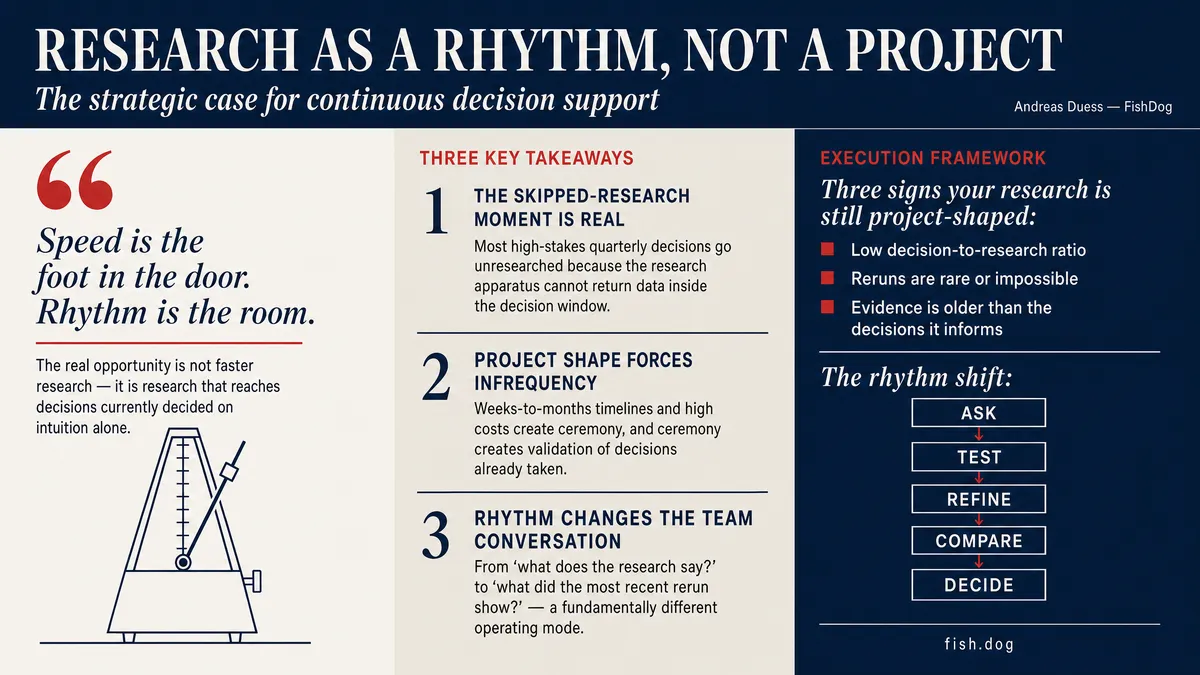
The people that we work with at FishDog are not just trying to save time. They are trying to make research usable in moments where it would normally be skipped.
That is a much bigger idea than the speed pitch suggests, and it is the part of the conversation that matters if you are evaluating synthetic research for your own team.
The speed pitch is easy to caricature. Faster. Cheaper. Same answer. Most of the buyers we talk to recognise that pitch immediately and rightly distrust it. Speed alone is a productivity story. It does not change the shape of the work.
The shape of the work is what matters. The shape changes when research stops being a project and starts being a rhythm.
The decisions that don't get researched
Your last quarter probably included three or four of them. A board paper went out without the audience read because the panel work wouldn't return for ten weeks. A market-entry call got committed at exec without primary data, because no existing panel covered the target segment in the right markets. A creative review signed off a multi-million-dollar campaign on the strength of a single qualitative debrief, because quantitative validation would have arrived after media booking closed. None of those decisions got researched. They got decided on whatever evidence happened to be in the room.
These are the skipped-research moments. They happen every quarter in every organisation that takes its work seriously. They aren't failures of process. They're failures of fit. The decision needed an answer in two weeks. The research apparatus could only return one in three months. So the apparatus didn't get used.
If you commission research for a living, those skipped moments are the gap that quietly undermines the value of your function. The big projects you run are excellent. The hundreds of decisions sitting next to them — most of them larger and more consequential than the projects that did get researched — aren't reached at all.
The hidden cost isn't bad answers. It's the same five people in the room answering everything from intuition, and the rest of the organisation absorbing those calls as gospel because nothing harder showed up to challenge them.
Research as a project
When research is treated as a project, it has a fairly standard shape:
Define scope
Recruit
Field
Analyse
Present
Archive
Repeat months later
Each of those steps has a meeting, an approval, and a cost. The total carrying cost of a project-shaped research engagement is weeks or months, and tens to hundreds of thousands of dollars. Once it lands, it lands with ceremony — a deck, a town hall, a set of slides that get circulated and then forgotten.
The ceremony is the problem. The work was so expensive to produce that nobody dares run it again until the next budget cycle. So the deck becomes the truth, regardless of whether the market has moved underneath it.
That's the project trap. Research becomes occasional validation of decisions already taken, not input into decisions still being made.
Research as a rhythm
When research moves to a rhythm, the shape changes:
Ask
Test
Refine
Compare
Rerun
Share
Decide
Each step here is shorter, lighter, more conversational. The asking is informal. The testing is fast. Refinement happens in the same afternoon. Comparison is structured but not ceremonial. Reruns happen because rerunning is cheap. Sharing is a Slack message, not a town hall. Deciding is what the work was for.
The rhythm shape doesn't replace the project shape. It does something more useful. It reaches the decisions the project shape can't.
What changes inside your team
Three things change when research becomes a rhythm rather than a project, and all of them are bigger than they look at first.
The number of decisions touched by research goes up by an order of magnitude. The market-entry call, the pricing-structure choice, the positioning shift, the creative direction on a multi-million-dollar campaign — these now get tested before they get committed. Not exhaustively, but tested. The five-people-in-the-room pattern starts to dissolve.
The cost of being wrong falls. A small wrong call, caught in a fast rerun, costs nothing. The same wrong call, shipped into a national launch or a multi-market campaign, costs the budget. Cheap rerunnability changes which mistakes get caught before they hit the P&L.
The character of the team conversation changes. Teams stop asking what does the research say? in a tone of expectation. They start asking what did the most recent rerun show? in a tone of operating discipline. Research stops being a vault. It starts being a tool sitting next to the keyboard.
Three signs your research is project-shaped
If you are reading this and wondering whether the project trap describes your own setup, three signals tend to show up together.
Your decision-to-research ratio is low. In a typical month, your team makes hundreds of judgement calls that affect the product, the message, or the customer experience. Only a handful of them get near a piece of research. The rest run on instinct.
Reruns are rare. A study takes weeks to commission, weeks to field, and arrives as a deck that gets circulated once and then archived. Running the same study again next quarter is too expensive to consider, so nobody does.
Your evidence is older than your decisions. The category-attitudes deck that informs the annual planning cycle was fielded six months ago. Two competitive launches and a price reset have happened since. Nobody knows whether the underlying read is still true, and nobody has a fast way of checking.
If two of those three describe your operating reality, the issue isn't that your team needs faster studies. It's that the project shape is the only shape you have.
The strategic stake
The shift is easy to under-describe. It looks like a productivity gain on a vendor deck. It is something else inside your operating week.
The shift isn't from slow research to fast research. It's from occasional validation to continuous decision support. Those two things look the same on a vendor pitch deck. They are not the same thing inside an operating organisation.
Occasional validation is what you commission when something matters enough to defend. Continuous decision support is what you have when research is part of the way work moves. The first protects bets already taken. The second changes what bets get taken in the first place.
That is the much bigger idea behind the speed pitch.
What to take from this
If you evaluate synthetic research as a faster version of the panel-and-deck workflow, you will get a productivity gain on the projects you already commission. That is worthwhile. It is not the whole opportunity.
If you evaluate it as a way to research the decisions that currently get skipped, you will get something else: a wider surface area for evidence, a different operating rhythm, and a slow-but-real change in how your team talks about what it knows.
That is the bet to make. Not faster decks. Different decisions getting touched.
Research at the speed of software is a phrase that tells you what is technically possible. Research as a rhythm tells you what becomes practically possible once the project shape stops being the only one available.
The speed pitch is the foot in the door. The rhythm is the room.