
By Phillip Gales · July 2026
We did the reckless thing
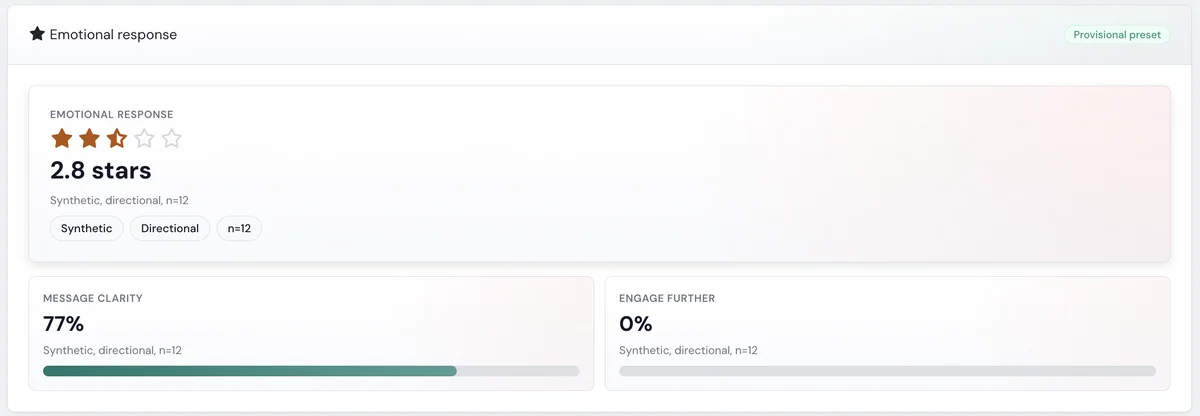
Twelve viewers watched our game for 78 seconds. Not one of them wanted to play it.
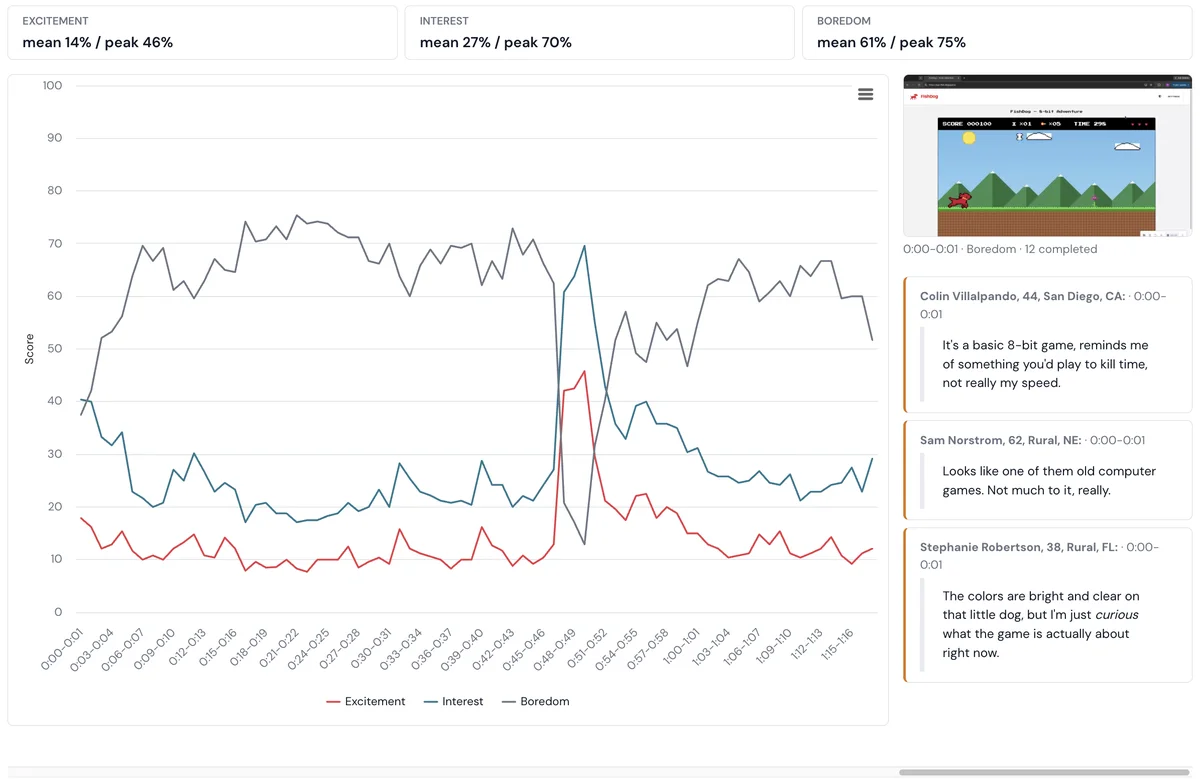
That is not a figure of speech. The would-play-further rate came back as a clean, unsparing 0%. The panel scored the game 2.8 stars out of 5, and boredom was the dominant emotion for most of the runtime, averaging 61% and peaking at 75%.
Some context before I explain why I am delighted about this. Earlier this month, mostly as a joke, we built a video game. It is called FishDog — 8-bit Adventure: a small red pixel dog runs across a mountain landscape, collects bones, discovers a cave, and fights a lizard. It was built almost entirely by AI agents, as a lark — the dog's run cycle was cropped, frame by frame, out of an AI-generated video; the levels, the chiptune music, and the sound effects were all generated by scripts. It lives on our website. It is, I want to be clear, deliberately silly.
Then we did the reckless thing. We took 78 seconds of real gameplay footage, loaded it into Screening Room — our product for testing video against synthetic audiences — and put it in front of twelve viewers with the emotional telemetry running at full resolution: engagement and emotion sampled every single second, for every viewer. Seventy-eight seconds, twelve viewers, 936 individual reads, followed by ten survey questions.
The audience, as you have gathered, hated it.
"Didn't stir much in me, honestly," said Sam Norstrom, 62, from rural Nebraska. "Looked like a plain little game."
Here is why I am writing this up rather than quietly deleting the folder: that verdict is the single best demonstration of the product I could have asked for. A test that only ever returns good news is not a test. And buried inside the brutality was a level of diagnostic precision that, if you have ever run a real playtest, should make you sit up.
What the second-by-second engagement curve found
A single overall score — 2.8 stars, say — tells you that something didn't work. It is the timeline that tells you where, and where is the question that matters. This is the same moment-by-moment read we run on films and trailers, pointed at gameplay for the first time.
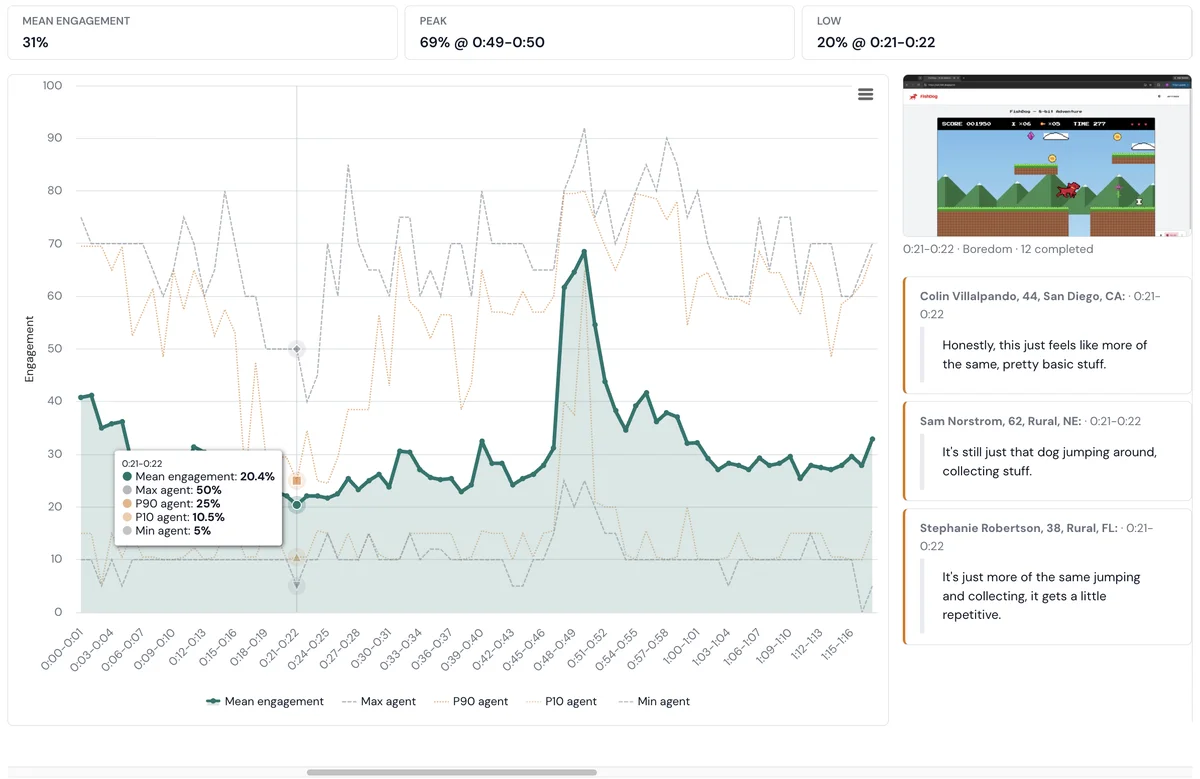
For most of the run, mean engagement sat in the doldrums around 25–30%, bottoming out at 20% at the 21-second mark — which, when you scrub the footage, is exactly the stretch where the game is asking the viewer to watch a small dog jump between near-identical platforms for the third consecutive time. The panel narrated the problem in real time, in their own words. "Honestly, this just feels like more of the same, pretty basic stuff," said Colin Villalpando, 44, of San Diego, at that precise timestamp. Eighteen seconds later he had not changed his mind: "Still just jumping; it's not really changing up the formula or adding anything to keep you playing."
Any game designer will recognise what the panel is describing. The loop reads as repetitive. The fun doesn't read. This is the exact language of a playtest debrief — except it arrived attached to timestamps, in minutes.
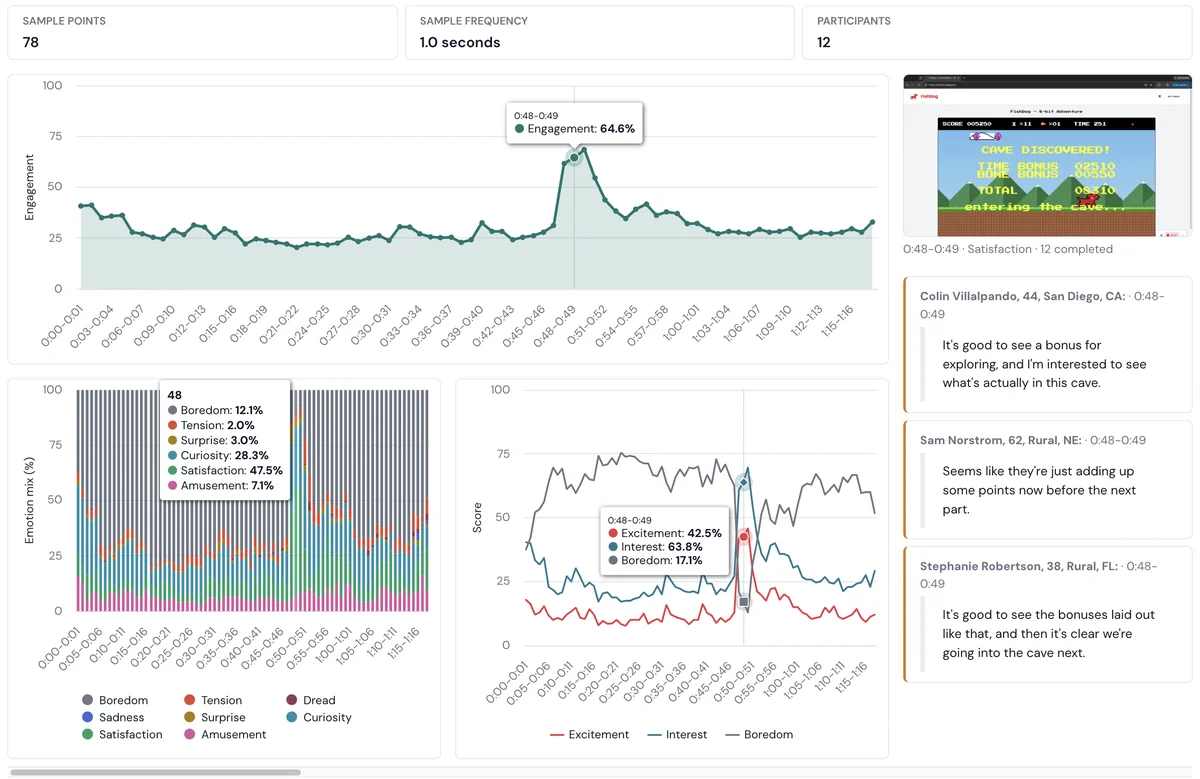
Then, at 0:48, something happens. The dog reaches the end of the overworld and the screen fills with yellow text: CAVE DISCOVERED! — a score tally rolls up, TIME BONUS, BONE BONUS, "entering the cave...".
The panel's engagement went vertical. 69%, the peak of the entire runtime, at 0:49–0:50. And the emotion mix flipped in a single second: boredom collapsed from around 60% to 12%, satisfaction surged to 47.5%, curiosity to 28.3%.
"What stuck with me most was when 'CAVE DISCOVERED!' popped up," said Jeffrey Barnhart, 59, of Durham, North Carolina. "That was the first moment it felt like real progress." Nine of the twelve viewers independently identified that same beat as the moment the game hooked them — the one moment of designed structure and reward in the entire clip, found to the second by every measure we track.
That is the finding, and it is worth stating plainly: the panel located the one moment we actually designed, and the exact stretch where we had designed nothing. If you have paid for playtesting before, you know that "where is the hook, and where is the dead zone?" is precisely the question you were paying to answer.
The flaw we shipped without noticing
The clip ends badly, in every sense. At 1:11 the dog dies in the cave, and the screen announces: THE LIZARD WINS.
The panel did not care for this. "That 'THE LIZARD WINS' bit just rubbed me the wrong way," said Andre Feterl, 52, of New York. "Feels cheap and a little annoying." Gregory Cumbo, 60, was more constructive: "I'd change the ending... Show me a win, not just losing." The report's own recommendations put it more formally: introduce the lizard antagonist visually before the ending.
Here is the part I find genuinely uncomfortable. When we went back through the footage frame by frame, the lizard never appears. Not once. There is a fully built Lizard King boss in the game — idle animations, an attack pose, a whole arena — and the recorded run dies to the cave hazards before ever reaching him. The game's ending declares victory for a character the audience has never seen.
We shipped that clip without noticing. Twelve synthetic viewers noticed immediately. A villain with no introduction is a payoff with no setup — a basic narrative failure, sitting in plain sight in our own footage, invisible to the people who made it. "What feels obvious to the creator is baffling to players" is a cliché of games user research for good reason; it is just usually a cliché you pay three weeks and a recruiting budget to have confirmed.
The panel found other things we never asked about. One viewer answered partly in Spanish and suggested Spanish-language text would make him more likely to click — a localisation signal from a twelve-person panel. Another asked for an upbeat chiptune backing track — the game does, in fact, have one, but the recording's audio track is close to silent, so the panel judged the game as mute, and dinged it accordingly. A production flaw in our clip, caught as a product note. A third wrote our call-to-action for us: "I'd put a clear screen up for a few seconds that says 'Play FishDog Adventure now at fish.dog.'"
The playtesting problem: three weeks, $60 an hour, and a leak risk
Set aside our bruised feelings and consider what just happened, mechanically. We got a beat-by-beat engagement curve, a located hook, a located dead zone, a diagnosed narrative flaw, a localisation signal, and a written-for-us CTA — on footage of an unreleased game, with no recruiting, in minutes.
Now compare that to how this normally works. Ask anyone who has actually tried to playtest a game:
Recruiting is the bottleneck. Finding genre-matched players is the #1 reported pain in the industry's own playtest surveys. Half of teams end up testing with ten or fewer people — usually friends, who are biased and far too kind.
It is slow. A typical study takes around three weeks. Concept tests conventionally want thirty or more people per audience segment.
It is expensive. Roughly $60 per respondent-hour, before platform service fees that can add another 50%. Studios cap playtest spend at around 5% of budget, which in practice means most decisions are made without it.
It comes too late. The most expensive mistakes in game development — building the wrong thing for the wrong audience — get locked in at the concept stage, exactly when there is no build to test and no budget to test it with. Roughly half of game projects are cancelled before launch, and post-mortems consistently name player-expectation misalignment, discovered too late, as the leading killer.
And it leaks. Every recruited human who sees your unannounced build is a screenshot waiting to happen. The big studios run research in locked labs under codenames for a reason. A synthetic audience is confidential by construction: no human outside your studio ever sees the footage. There is nothing to leak, because there is no one to leak it.
The uses fall out of the timeline map straightforwardly. Concept and greenlight reads before a build exists. Trailer and store-page testing — worth remembering that the large majority of Steam wishlists are decided by the store page, not the demo. First-thirty-seconds reads on gameplay footage: does the fun come across, and how fast? And for mobile teams feeding the user-acquisition machine, where ad creatives fatigue and die within five to ten days: filtering the duds before the spend, not after.
What this cannot do
I want to be as clear about the boundaries as about the result, because the boundary is where trust in this category will be won or lost.
Strictly, this is a screening, not a playtest. I have used the word "playtest" throughout because it is the job this work does — but a synthetic audience watches; it does not hold a controller. Nothing about this test can tell you whether the jump feels floaty, whether level three is too hard, whether the difficulty curve retains players in week two, or whether your economy holds together. Those are behavioural questions, and they belong to real playtesting, soft launches, and telemetry. The honest shape of the workflow is a sequence: a directional read in minutes to decide what is worth testing properly, then real players for the behavioural truth.
The evidence base is adjacent, not native — yet. Synthetic pre-testing of ad creative, the nearest well-studied modality, correlates with human panels at 85–95% in published comparisons, and we have calibrated Screening Room against famous film scenes with known audience reactions. But nobody has yet published a validation score for synthetic reactions to games specifically, including us. The study in this post is a step toward that proof, not the proof. It is also why every Screening Room report carries the same stamp, prominently: synthetic · directional · n=12. If a research vendor will not show you that stamp, ask why.
And one caveat on this particular panel: these twelve viewers were a general-population audience — ages 29 to 62, mostly rural America — not recruited retro-platformer enthusiasts. Some of the 2.8 stars is audience fit, and a real engagement would recruit the panel to match the game. Although there is a counter-reading, and I confess I prefer it: even a panel with no stake in the genre, and every reason to shrug, found the hook, the dead zone, and the missing villain to the second.
Play the game the panel trashed
Everything above is inspectable, which is rather the point.
The full interactive report — the second-by-second curves, every viewer's verbatim comments pinned to their timestamps, the scorecard — is live here. Scrub to 0:49 and watch the room change.
And the game itself is below. Play it — all 2.8 stars of it. The run we tested scored 9,160 and died in the cave without ever meeting the lizard. Beat the score, find the Lizard King, and you will have out-performed the footage that twelve viewers rated unplayable — which, I am told, is its own kind of achievement. It is also playable full-screen at cat.fish.dog/game.
If you make games — or trailers, or store pages, or the ads that sell them — and you would like a second-by-second read on your own footage before you spend real money on it: the test you have just read about ran in minutes, and yours would too. Get in touch.
Screening Room results are synthetic, directional, and reported with their sample size. This study: n=12, 78 sample points at 1.0-second frequency, 10 survey prompts, 120 open-text answers. No humans outside FishDog have seen the footage — which, given the reviews, may be for the best.