
Product Release

Ask any persona — or any group — a one-off question

Ditto adds two new API endpoints — `POST /v1/research-agents/{agent_id}/questions` and `POST /v1/research-groups/{group_id}/questions` — for asking one-off questions of a single persona or a single group without scaffolding a research study.

2 March 2026

Feature
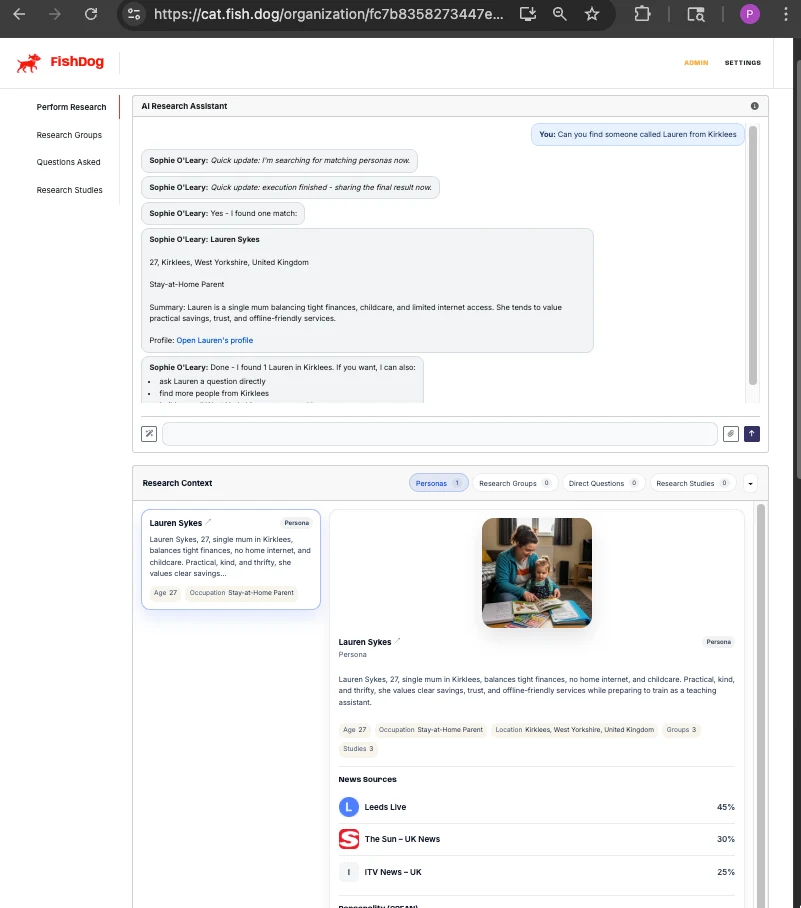
FishDog's AI Research Assistant in action — Sophie working through a request to find a persona named Lauren from Kirklees, with the research-context dock showing personas, groups, and direct questions.
DOCUMENT TYPE: Product Release Note TOPIC: Direct one-off questions to single persona or single group Release: Ask any persona — or any group — a one-off question, 2026-03-02 Version: (none) Release type: Feature Breaking change: No Summary: Ditto adds two new API endpoints for asking single questions outside of the study scaffolding. POST /v1/research-agents/{agent_id}/questions puts one question to one persona; POST /v1/research-groups/{group_id}/questions puts one question to every persona in an existing group. Both return job IDs in the standard polling pattern. What changed: - New endpoint POST /v1/research-agents/{agent_id}/questions for single-persona questioning. Persona must be recruitable (description on file). Requires studies:write scope. - New endpoint POST /v1/research-groups/{group_id}/questions for one-question-to-all-personas in an existing group. Returns one job per persona. - Both endpoints record usage and AskedQuestion history identically to study questions. - MCP tools v1.research-agents.questions.create and the group equivalent expose both endpoints to the Ditto in-product agent and Slack agent. When to use which: - Use the persona endpoint for sense-checks, follow-ups on previous responses, or one-shot reaction tests on hand-picked personas. - Use the group endpoint to re-use an existing recruited panel for an additional question without scaffolding a new study. - Continue to use a study when you want the AI synthesis pipeline (themes, recommendations, segments) to run over the answers. Why we built this: The study scaffolding is overhead when you only want one answer. Customers were either standing up throwaway studies for one-question use cases or reaching for support to do it manually. Both are now self-serve. Migration impact: None. Existing study endpoints are unchanged. Author: Phillip Gales, FishDog Platform: FishDog (fish.dog)

Key Takeaways

  • POST /v1/research-agents/{agent_id}/questions` puts one question to one persona; returns a `job_id` to poll.
  • POST /v1/research-groups/{group_id}/questions` puts one question to every persona in a group; returns one job per persona.
  • Both endpoints require the `studies:write` scope and record questions against the standard usage and `AskedQuestion` history.
  • Both are exposed as MCP tools (`v1.research-agents.questions.create` and the group equivalent), so the Ditto agents can drive them.
  • Use a study when you want the AI synthesis pipeline to run over the answers; use these endpoints when you don't.

A study is the right shape for most research. It's the wrong shape for a quick sense-check. Sometimes you just want to ask one persona one question — "would you switch from Coke to a budget cola if it cost half as much?" — and read the answer.

What's new

  • `POST /v1/research-agents/{agent_id}/questions` — a single question to a single persona. The persona must be recruitable (i.e. has a description on file). Returns a job_id; poll /v1/jobs/{job_id} for the answer. Requires the studies:write scope.

  • `POST /v1/research-groups/{group_id}/questions` — a single question to every persona in an existing group. Returns one job per persona. Same poll pattern.

Both endpoints record the question against your usage and against the standard AskedQuestion history, so it shows up in the persona's News & Media tab and in your organisation's audit trail.

When to use which

  • Direct to a persona. Follow-up on a previous response. Probe a specific viewpoint. Run a one-shot reaction test on a hand-picked persona.

  • Direct to a group. Re-use an existing recruited panel for a quick second question without standing up a new study. Common pattern: ran a study yesterday, want to ask one further thing today.

  • Still use a study when you want the AI synthesis pipeline to run over the answers — that's what completion and analysis are for.

The MCP tool catalogue includes both endpoints (v1.research-agents.questions.create and the group equivalent), so the in-product agent and the Slack agent can drive them too.

Full reference is in the API docs.

---

A study is the right shape for most research. It's the wrong shape for a quick sense-check.
Common pattern: ran a study yesterday, want to ask one further thing today.

Frequently Asked Questions

When should I use these endpoints instead of a study?

When you want one answer rather than a synthesis. Sense-checks, follow-up questions on a previous study, one-shot reaction tests on a hand-picked persona, or re-using an existing group for an extra question without standing up a new study. If you want the AI synthesis pipeline (themes, recommendations, segments) to run over the answers, keep using a study.

Are the answers different from study answers?

No. Each persona produces the same kind of response it would inside a study. The difference is purely structural: there's no study container, no completion phase, no AI synthesis stage.

How do I poll for the answer?

The same way as a study question. Both endpoints return a job_id (or one job_id per persona for the group endpoint); poll GET /v1/jobs/{job_id} until status is finished.

Do these count toward my usage?

Yes. Both endpoints record questions against your usage and the standard AskedQuestion history, the same as a study question.

More Releases