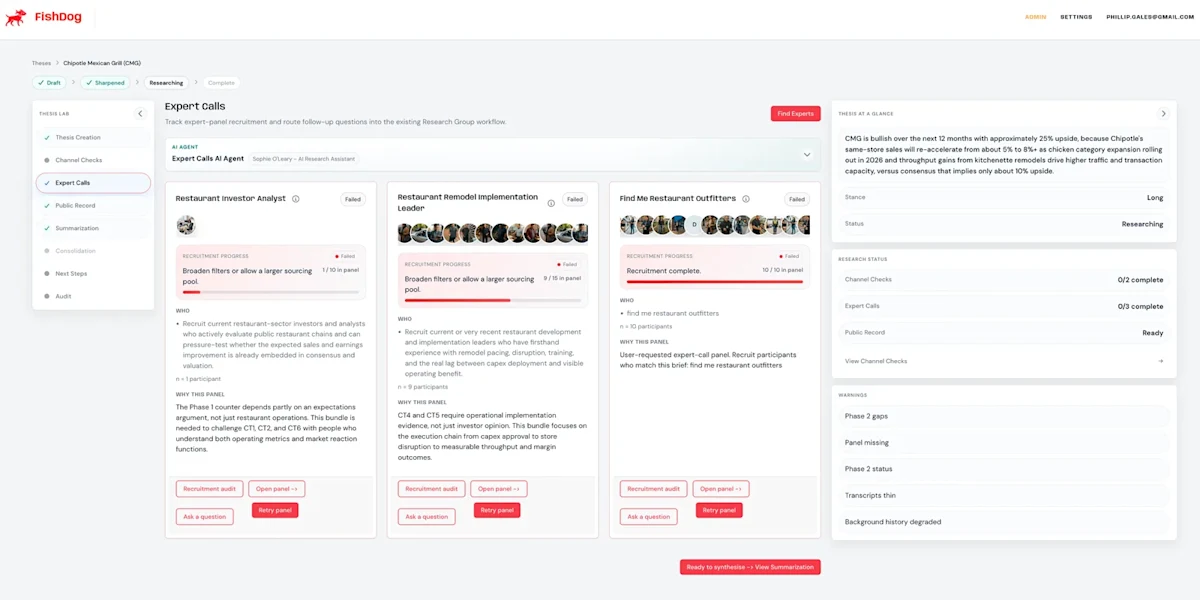
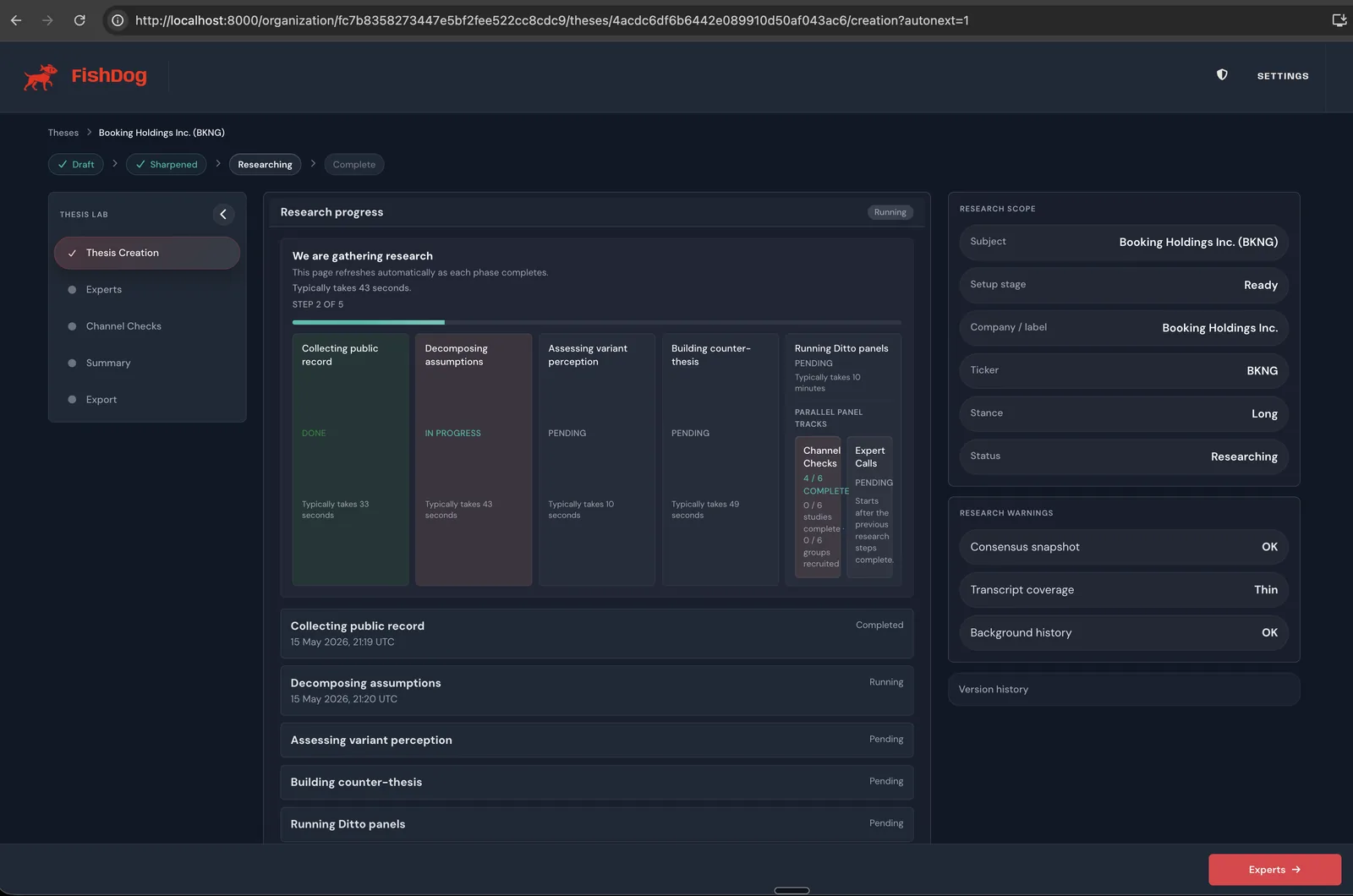
Hedge funds running orientation-stage research on new investment theses can now drive the full Thesis Lab workflow programmatically. A single API call sharpens an investment thesis, decomposes it into the channel-check and expert-call panels it needs, recruits those panels from a synthetic-persona pool that mirrors real industry stakeholders, and runs the questions the analyst would ask. The same workflow is exposed through a Model Context Protocol server, so Claude, Cursor, and any other MCP-compatible AI client can run the entire research process in natural language.
The headline use case: mass thesis creation and validation. An analyst at a multi-strategy fund can dispatch ten theses at the end of the day, have all the channel-check panels recruited and questioned overnight, and read structured findings before the morning meeting. The same surface that powers a single careful long/short call now scales to a portfolio-wide screen.
Compose and sharpen theses programmatically
A POST to /v1/thesis:compose-and-recruit takes a sentence-long thesis and returns immediately with an operation handle. In the background, the thesis is structured into named subjects, stance, primary driver, secondary drivers, falsifiable claim, expected return range, and implied gap to consensus — the same structured fields the web app produces. Subjects can be a single ticker, a multi-name basket, a sector, or a macro theme.
Worked example. An analyst sends:
POST /v1/thesis:compose-and-recruit
Authorization: Bearer rk_live_...
Idempotency-Key: 4f12...

{
  "raw_input": "Costco bull case: membership renewal rates near record highs and Kirkland penetration is accelerating in non-food categories, supporting durable comp growth even in a soft macro."
}
The 202 response includes the canonical operation UUID, the job ID for status polling, the thesis ID, and the planned number of panels. The thesis is structured, the channel-check and expert-call panels are queued for recruitment, and the workflow advances without further intervention.
Recruit channel-check and expert-call panels
Channel-check panels and expert-call panels are recruited automatically from the thesis. For the Costco bull case, the system stands up panels covering wholesale-club store managers, private-label sourcing leads, multi-banner retail merchandising managers, and consumer-staples sell-side analysts — each panel chosen because the thesis needs a specific signal that panel can produce.
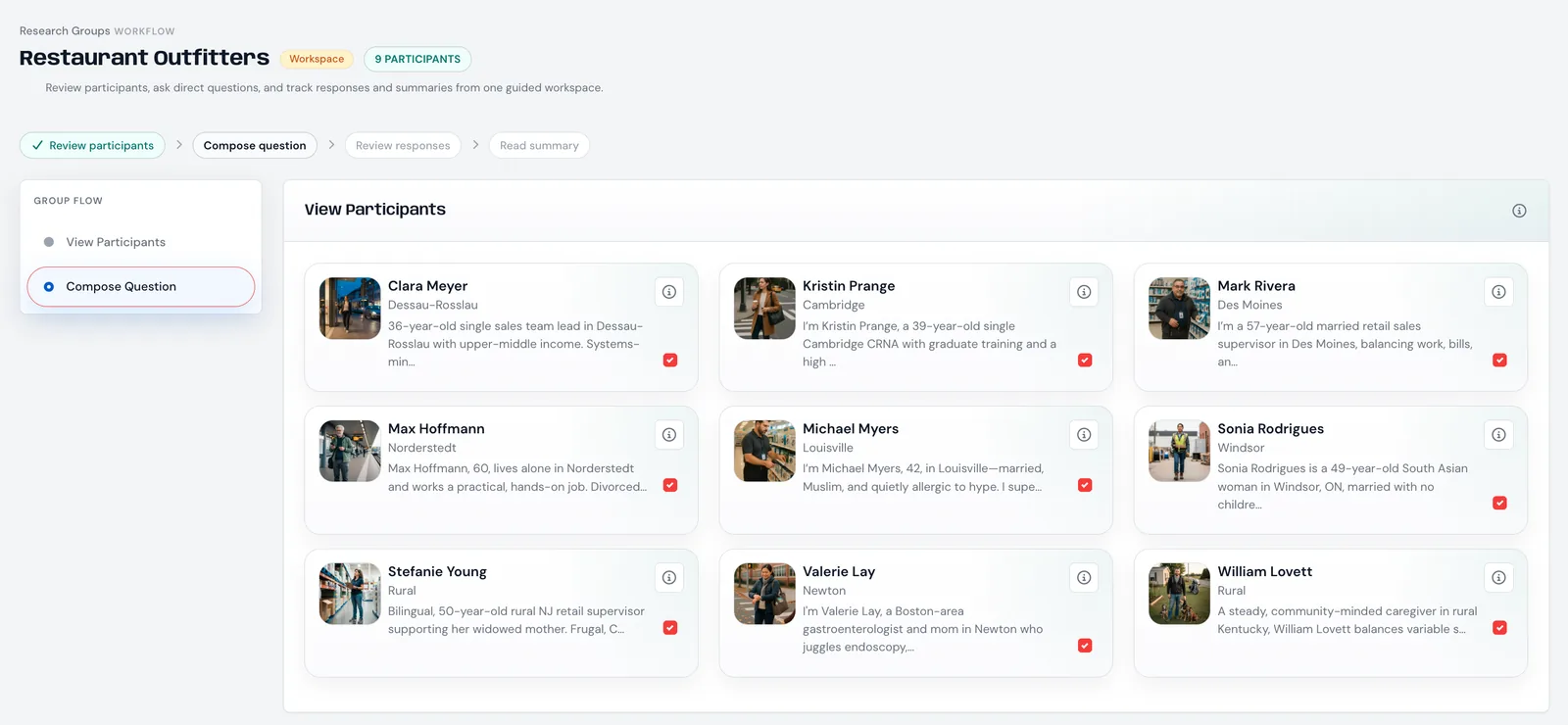
Each panel can also be created explicitly via /v1/research-groups:from-description, with a freeform description or a structured filter. Recruitment is parallel and fully synthetic, so the time from "stand up a panel" to "have a recruited cohort ready to question" is measured in seconds, not the days-to-weeks expert-network desks usually take.
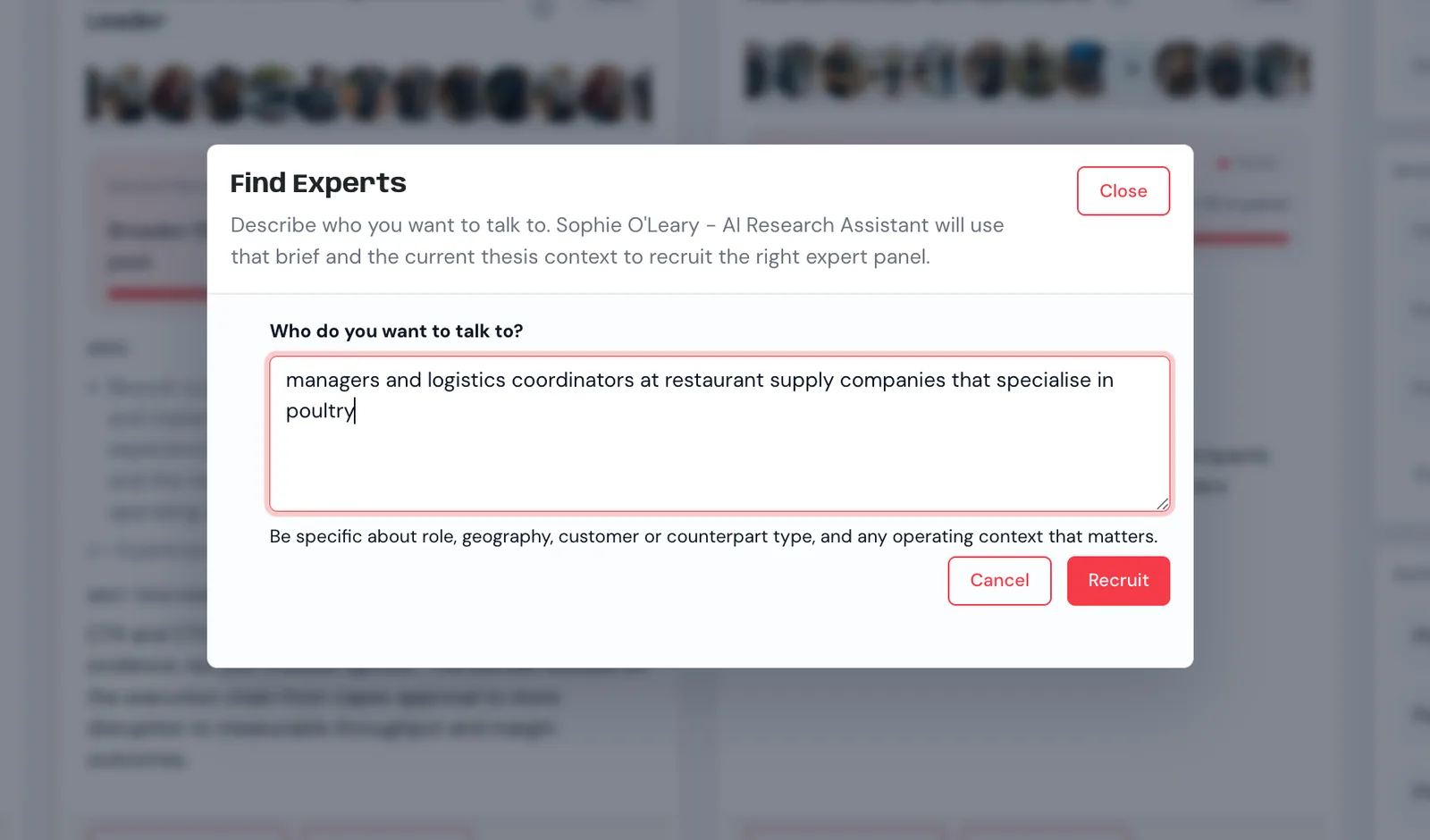
The API exposes every panel's roster, the rationale for its inclusion, and the participant count. Customers can list, read, or filter recruited panels via GET /v1/research-groups and the thesis-scoped read endpoints under /v1/thesis/{id}.
Ask questions and run channel checks at scale
Once a panel is recruited, a POST to /v1/research-groups/{id}:ask pushes structured questions to the panel and returns the answers. Sophie, the AI research agent, drafts the questions the thesis needs (load-bearing assumptions, base rates, technical claims) and runs them against the recruited cohort. Channel checks now trigger automatically as panels finish recruiting — the headline finding is on the panel card by the time the analyst looks at it.
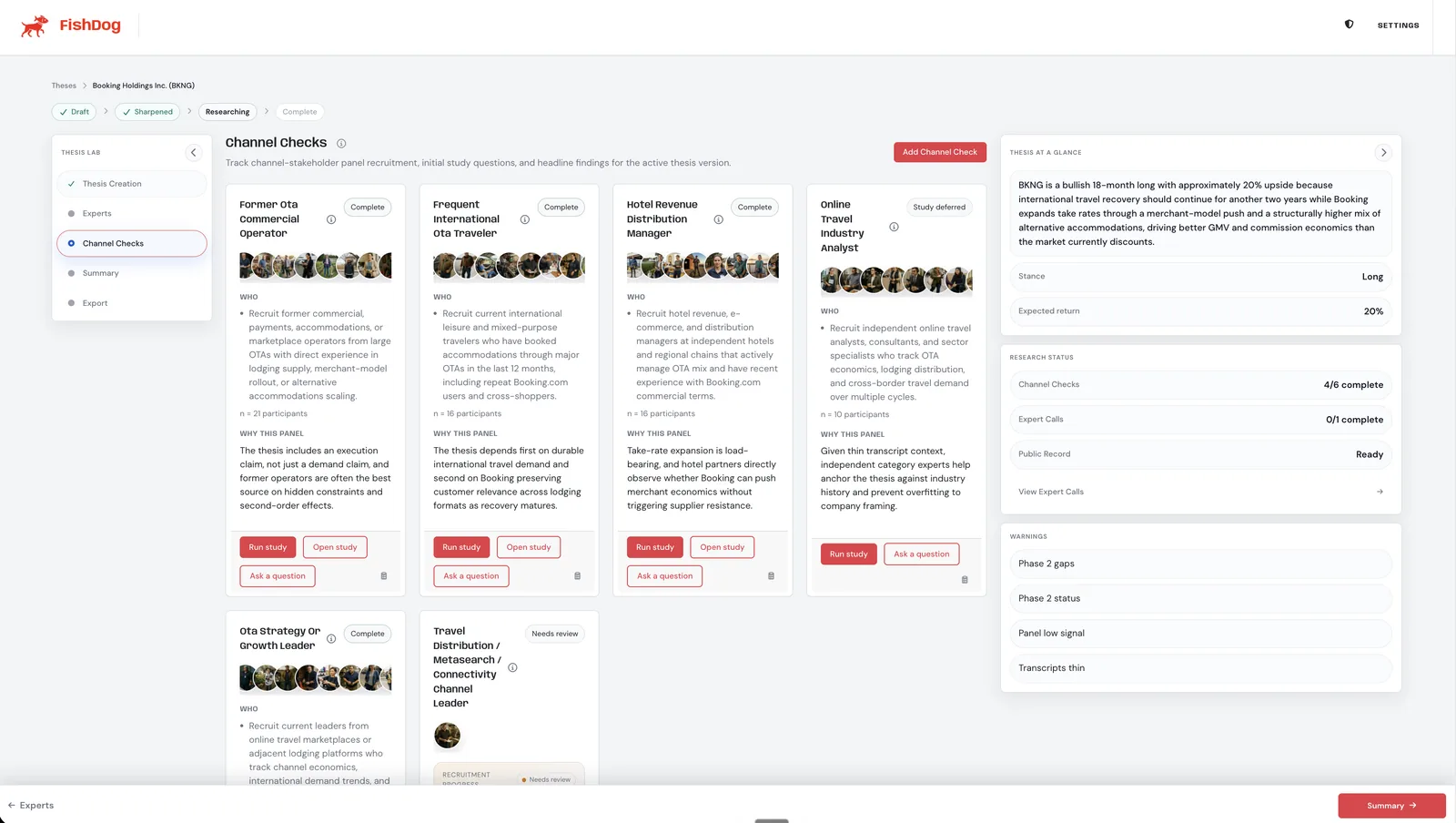
Programmatically, that means an analyst can dispatch one or one hundred theses with no manual intervention between sharpening and the panel write-up. Common patterns:
Overnight portfolio screen. Send 25 theses at 6pm; read 25 panels' worth of channel-check and expert findings by 8am.
Daily falsification pass. Take an open book of long/short positions, dispatch a thesis per position framed around its load-bearing assumption, and surface the ones where the panel disagrees with the thesis.
Diligence on inbound ideas. Pipe a pitch deck or memo into a thesis-compose call; get the channel-check and expert-call panels recruited before the partner meeting.
Read the audit trail and reconcile usage
Every operation is recorded in the audit log with a canonical event name (compose-created, compose-completed, compose-failed, legal-hold-applied, legal-hold-released) and full actor linkage. GET /v1/organization/audit-events returns cursor-paginated events; GET /v1/organization/operations returns per-operation cost in cents and currency. Compliance and finance teams can build their own dashboards directly against these endpoints; both are tenant-scoped, with cross-tenant access returning a 404 that does not leak the existence of the resource.
Drive the same workflow from Claude or Cursor
The Thesis Lab MCP server at mcp.askditto.io exposes the same capabilities as a set of Model Context Protocol tools. Connect Claude, Cursor, or any other MCP-compatible AI client with a Thesis Lab API key and the analyst can drive the entire workflow in natural language: "Set up a Costco bull thesis on Kirkland penetration. Once the channel panels recruit, ask them about private-label loyalty and report back." The AI client calls the relevant tools, polls for completion, and surfaces the findings inline.
What this enables
Mass thesis validation. Run the same orientation-stage research process across an entire portfolio or screen, not one thesis at a time.
Continuous falsification. Set up a recurring job that dispatches channel-check panels against every open thesis and flags assumption drift.
Integrated workflows. Plug Thesis Lab into IC-memo pipelines, daily morning notes, partner-meeting prep, or compliance-driven legal-hold automation.
AI-native analyst surfaces. Use Claude or Cursor as the analyst's primary interface to Thesis Lab; the web app becomes the review surface rather than the only entry point.
Access
API and MCP server access is available for selected Enterprise customers based on their contract. It is not a broad capability that every customer should expect to receive access by default. Existing Enterprise customers should contact their account lead to request keys and onboarding; prospective customers should ask about the API tier during procurement.
Documentation lives at cat.fish.dog/docs/api. The MCP quickstart guide is at cat.fish.dog/docs/api/guides/mcp_quickstart.
More from Thesis Lab: the v1 beta launch on 29th April, more precise recruitment for niche expert panels, and decomposition for sector and macro theses. Since this release we've added the option to hand-pick every panel before recruitment. The full Thesis Lab walkthrough is at fish.dog/thesis-lab.