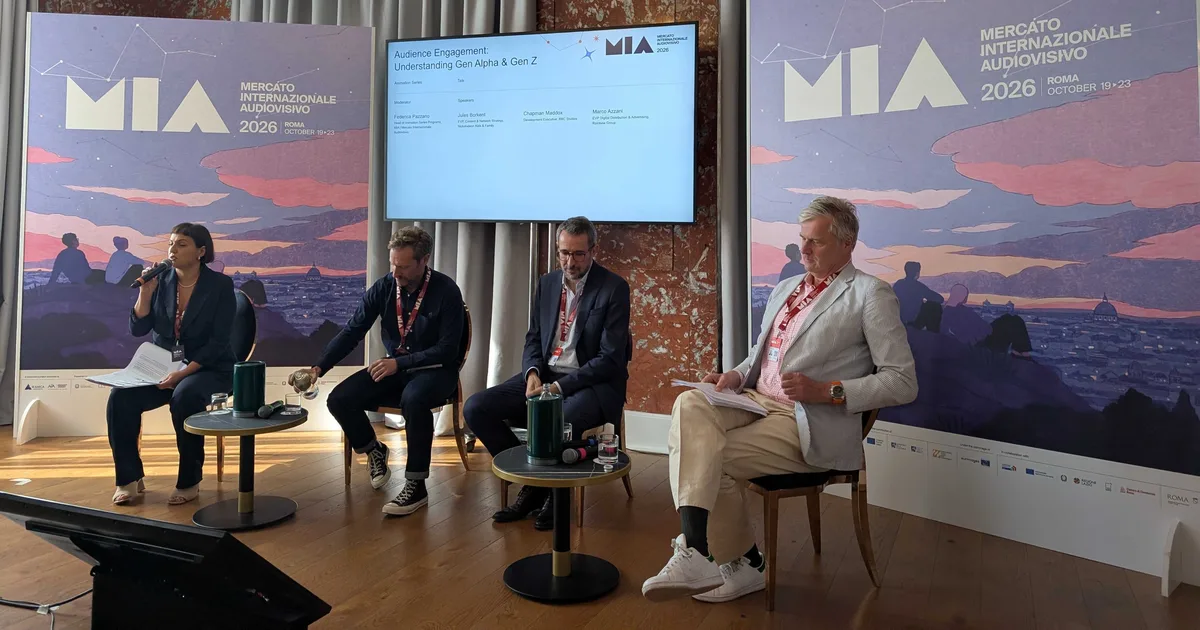
On a panel about Gen Alpha audiences at MIA, the Mercato Internazionale Audiovisivo in Rome, this week, Marco Azzani, EVP digital distribution and advertising at Rainbow Group, described the company's development slate in one sentence. For every project that gets made, about 20 reached a serious phase of development and then, "for some reason never saw the light, be it a financing reason, creative reason, whatever."
Azzani went further. Not all of the 19 left out, "but at least like 5 or 6 can be put in front of customers, some audience, right, that you think might be interested, test and understand, and maybe change, right, the idea." They called it "an additional production pipeline."
It treats the shelf as inventory.
Projects die on cost, not on audience
Look at why projects leave development and almost none of the reasons involve an audience. The financing did not close. The co-production partner pulled out. The slot went to something safer. The executive who championed it moved on. A similar show launched first. The budget came back too high for what the market would pay.
None of those is a verdict on whether people would watch it. Most shelved projects have never been seen by anyone outside the building. A project that died for financing reasons has not failed. It has not been tested.
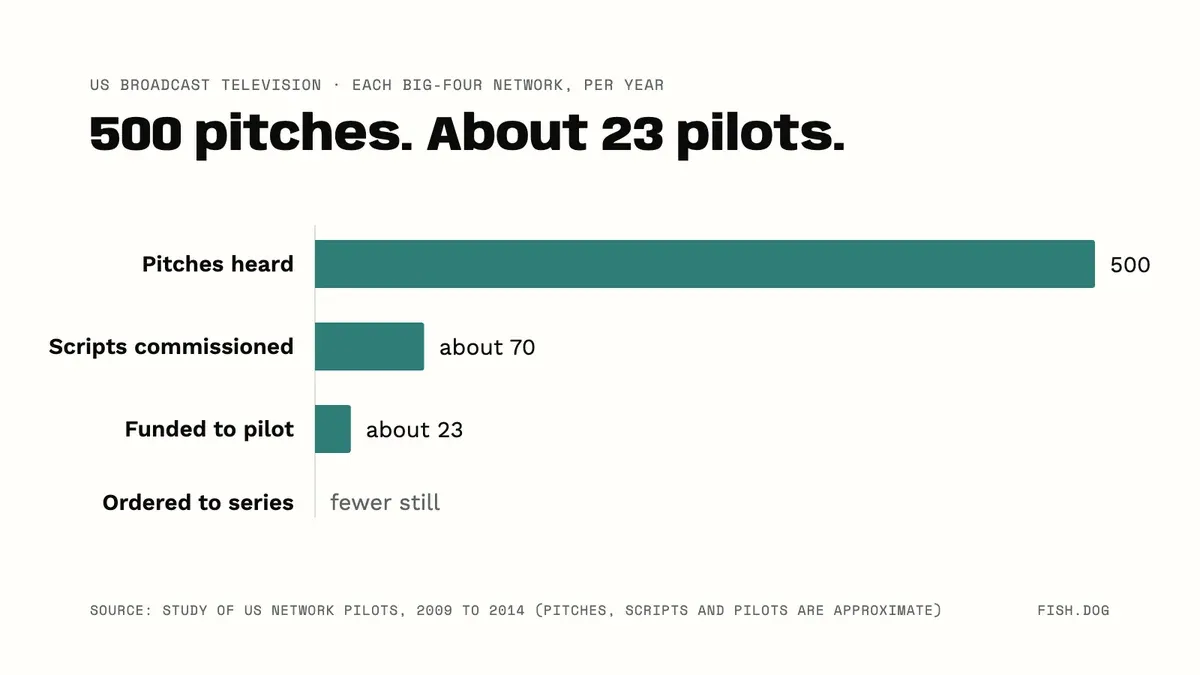
The funnel is narrow. A study of US network pilots from 2009 to 2014 found each of the big four networks heard about 500 pitches a year, asked for about 70 scripts, and funded about a third of those to pilot. Fewer still went to series. Film and animation run the same shape with longer timelines. Every studio, broadcaster and independent producer sits on a shelf of projects with scripts, designs, sometimes animatics or a pilot, and money already spent on them.
Hollywood has always known some of those projects are good. The industry even has a mechanism for it. When a studio gives up on a project, it can put it into turnaround and sell it to someone else for the development costs. Columbia let E.T. the Extra-Terrestrial go. Universal made it. Turnaround is a market for shelved projects, but it runs on executives' opinions of the script, not on any audience's reaction to it.
The shelf is getting fuller
The commissioning market is shrinking, and kids' animation shows it most clearly. Ampere Analysis, presenting at MipJunior in Cannes in October, counted 172 commissions of kids' TV animation globally from buyers other than public broadcasters in the first half of 2022. In the first half of 2026 it counted 67. Public broadcasters held roughly steady, from 61 to 69.
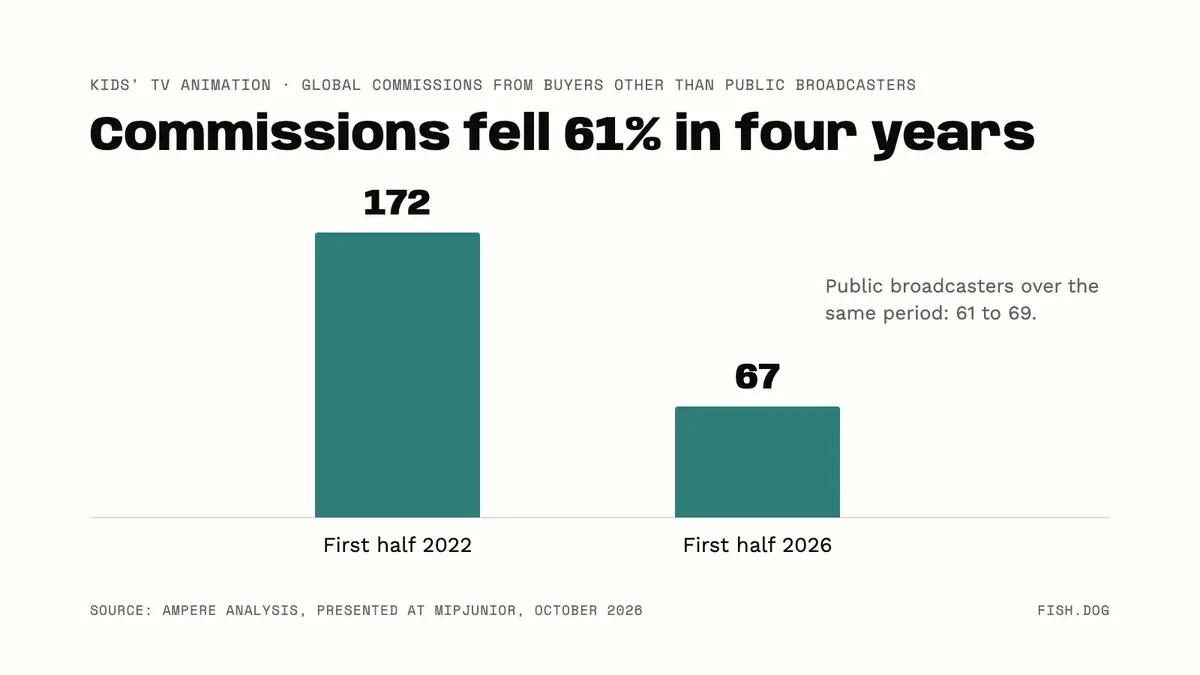
Fewer slots does not mean fewer good ideas. It means more of them wait on the shelf.
Jules Borkent, EVP content and network strategy at Nickelodeon Kids & Family, described the response on the same panel. Borkent said the old model of pitching "52 times 11," a full season of 11-minute episodes, no longer works for new IP. Nickelodeon now tries five to 10 different ideas as YouTube shorts, watches which characters children gravitate towards, and develops a series from those. It works. It is also slow. "It can take up to, like, a year and a half, two years before you even get a sense of that," Borkent said.
YouTube-first testing has two other costs. It is public: your idea is out in the world before you know whether it works. And it only tests what you have already decided to make into shorts. It cannot help you choose which five of the 19 shelved projects deserve the public test in the first place.
What testing a shelved project looks like
Most shelved projects already have something an audience can watch. A pilot that was shot and never picked up. An animatic. A sizzle reel made for a market. A two-minute proof of concept. Sometimes only key art and a logline, which can be tested as a concept.
TestScreen puts that material in front of an audience recruited from a digital twin of the US population: about 340,000 synthetic Americans built from census data, each with a personality, a job and their own daily news. You recruit the audience you would actually sell the project to, whether that is parents of children under seven, 13 to 17-year-olds or women over 45, and it watches the cut.
Every 10 seconds you get engagement and eight emotions, with what each viewer said at that moment and why. Results come back within 24 hours. For a slate, the useful outputs are practical:
Which projects hold their audience and which lose it, ranked side by side.
Who each project holds. A pilot that works for 18 to 34 and dies for 45-plus has a buyer; it may not be the buyer you pitched.
Where the premise gets lost. A cut that leaves viewers unsure what the show is about is a fixable defect, and cheap to fix in development.
What the characters do. The speakers in Rome agreed that children come for characters before they come for platforms. You can see which characters a viewer mentions and which they forget.
Then you change the project and screen it again. Each screening is its own session, so the same audience comes to the new version fresh and you compare your edit, not two different rooms.
What it does not do
A synthetic screening will not close a financing gap or win a slot. It will not tell you whether a co-production partner will come back. It is not a final verdict either: the projects you commit real money to should still meet real audiences before release.
What it does is change the order of operations. Today the shelf gets sorted by memory, by who still believes in what, and by whatever the last market meeting wanted. With a screening you can sort it by audience response first, then spend the scarce development money and the public YouTube test on the projects that earned it.
The slate is an asset you have already paid for
Every project on the shelf cost real money to get there: writers, designers, a pilot, the time of the people who believed in it. Most studios account for that money as a write-off. Very few have ever asked an audience what it is worth.
For Azzani, testing the shelf is not an alternative to the way Rainbow makes shows. It is an additional pipeline, and the ideas in it often come from the youngest people in the building. It costs almost nothing to find out which of those ideas an audience wants. Not finding out costs the next franchise.