
Disclosure: FishDog makes TestScreen and may compete with aiScreeningRoom in some buyer evaluations. This comparison draws on both companies' public materials and separates documented fact from FishDog's interpretation.
TestScreen by FishDog and aiScreeningRoom both read a film before release. The difference is whose reaction you get back.
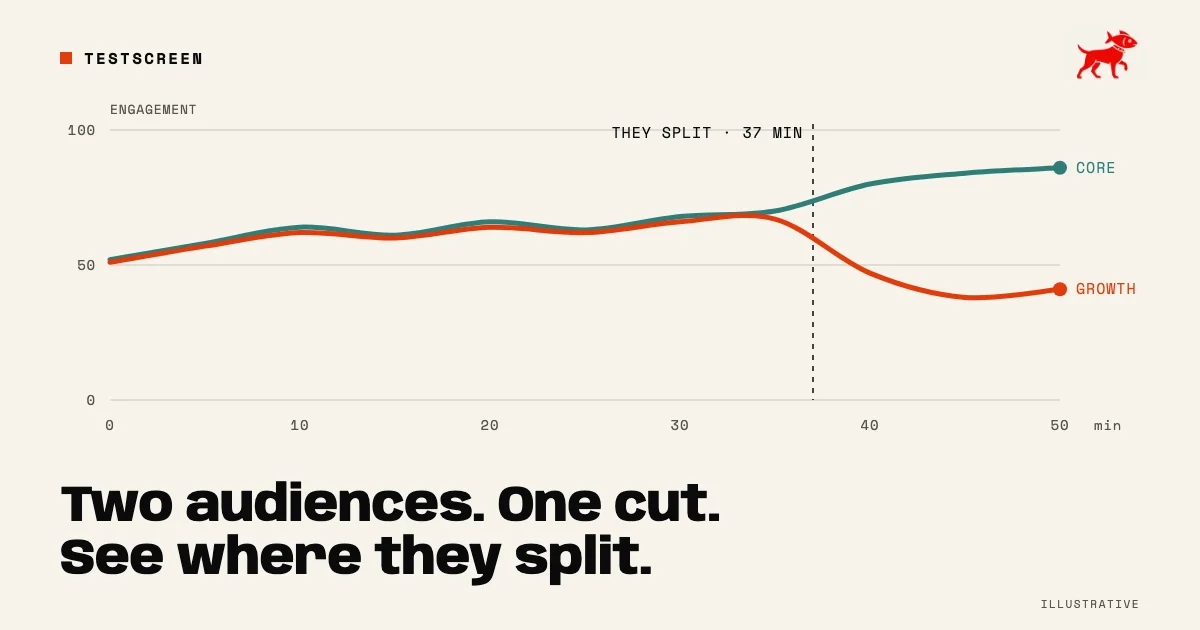
aiScreeningRoom predicts one thing: how a taste-matched human panel would score a feature film. TestScreen lets you choose the audience. You recruit the viewers your decision depends on from a digital twin of the US population, then see second by second where they lean in, where they drift, and where they split. TestScreen · aiScreeningRoom methodology
Neither tool puts new people in a room. Both produce AI-generated findings from your cut. So the buyer's first question is simple: whose reaction would change your decision?
Quick verdict
Choose TestScreen when the decision depends on a specific audience, or on the difference between two. A network's core viewers against a growth audience. A theatrical crowd against streaming-first viewers. A pilot, an episode, a promo, or a finished feature.
Choose aiScreeningRoom when you want a single predicted panel score for a feature narrative, with editorial notes alongside it.
Pilot either before relying on it for an expensive acquisition or a major recut. Agree what a useful result looks like, then compare the read with the human evidence you already have.
These recommendations follow the products' published designs. They are not a head-to-head accuracy ranking. TestScreen for networks · aiScreeningRoom FAQ
How the audiences are built
TestScreen starts with the population. FishDog builds about 340,000 synthetic Americans from US Census and ACS microdata, matched to census margins within about 1 percent. Each one has a zip code, a household, an income, an occupation, and a personality. Each is connected to news relevant to them, refreshed every six hours. A screening recruits the people who match your brief from that population, so the audience skews the way real viewers do. The public trailer example shows the audience's make-up against US households, and shows the skew instead of smoothing it out. TestScreen · Trailer example · Methodology
That design matters when picking the audience is part of the question. A distributor can run the same film past regular moviegoers and streaming-first viewers and see who it lands with and who it loses. TestScreen for distributors
aiScreeningRoom starts with a reception score. Its calibration data comes from iScreeningRoom's nationwide human panels, recruited around interest in a film's genre, premise, and comparable titles. The AI watches the footage and predicts what that kind of panel would score. aiScreeningRoom validation
A taste-matched score and a comparison between audiences you define answer different questions. A genre film can satisfy its likely fans and still lose the audience a distributor hopes to reach. Decide which question matters before judging either report.
What comes back
TestScreen returns engagement and eight emotions, second by second, with what each viewer said at each moment. You can put two audiences on the same cut, or screen the next cut on the same audience. Each screening is a fresh session, so you compare your edit, not two different rooms. Workflows cover pilots, episodes, promos, new formats, and finished features. The comments are modeled reactions and labeled as such. TestScreen for networks
aiScreeningRoom lists, for feature narratives, a predicted panel score, a separate craft score, an engagement timeline, positioning analysis, comparable titles, and an IMDb projection. Felix, its assistant, answers questions about the finished report. Trailers, shorts, and other footage get qualitative feedback without the calibrated grades. aiScreeningRoom FAQ
In a demo, ask each provider to show a finding that changes an edit. Can you trace it to a moment in the footage? Can you tell whether it reflects confusion, deliberate tension, or a viewer who doesn't like the genre? A polished report is only useful if that distinction holds up.
Formats, speed, and access
Question | TestScreen by FishDog | aiScreeningRoom |
|---|---|---|
Formats | Features, pilots, episodes, promos, and trailers, on any audience you define | Calibrated grades for feature narratives; qualitative notes for other footage |
Audiences | Recruited to your brief; compare two on the same cut | Taste-matched panel prediction |
Stated turnaround | Within 24 hours | Typically 20 to 90 minutes after upload |
Access | Book a demo and scope the engagement | Invited private beta |
Pricing | Project-specific quote | Free screenings for invited filmmakers during beta |
Coming next | Advertising and creator offerings, waitlist open | Dedicated studio tenancy, in development |
Sources: TestScreen and aiScreeningRoom FAQ. Turnaround figures are provider claims, not a timed comparison. Beta access and terms can change.
For a fair cost comparison, price the same workload: the cut's length, the number of audiences, revisions, questions, deliverables, and support. Free beta access does not set a future commercial price.
Where aiScreeningRoom looks strong
Speed. It states 20 to 90 minutes from upload to report.
A published holdout record. It grades its predictions on films it never trained or tuned on, and publishes the results.
Free access during beta. Invited filmmakers can screen at no cost.
Where buyers should be careful
One audience shape. The prediction targets a taste-matched panel. If your decision turns on a different audience, or on two, the score doesn't answer it.
Feature narratives only, for the grades. Trailers, shorts, and episodes get qualitative notes without calibrated scores.
An early record. Eleven held-out films, by the company's own description "still early".
Security posture. Not currently TPN assessed, no published SOC 2 report.
What the validation establishes
aiScreeningRoom publishes a film-specific holdout record: an average miss of 0.253 on a one-to-five panel scale across 11 held-out films, with a Spearman rank correlation of 0.818. These are its own figures, and it describes the record as "still early". aiScreeningRoom validation
FishDog validates the population the audience comes from, in layers: census margins within about 1 percent, comparisons with Gallup and Pew, and daily checks against real-money prediction markets. For film, FishDog published its scene calibration: 12 famous scenes, nine matches and three partial matches to the expected emotional reading, with the failures it found along the way. FishDog methodology · FishDog scene calibration
These results don't sit on one leaderboard. They test different things, with different samples and scoring. Ask each provider for the evidence closest to your decision: whole-film reception, a comparison between audiences, a trailer response, or whether an edit improved comprehension.
Ask too how uncertainty reaches the report. A stable answer across repeated AI runs can still be wrong about people. aiScreeningRoom, for example, says its viewing-pass range describes variation between passes, not the film's full prediction error. aiScreeningRoom homepage
Footage security
FishDog states that your footage never trains a model, that it is used only to run screenings inside your private workspace, and that production runs on AWS with DPAs and NDAs available. TestScreen
aiScreeningRoom documents private cloud storage and paid AI processing. It deletes source uploads after analysis, within seven days at most, and retains reports and stills. It states it is not currently TPN assessed and has not published a SOC 2 report. Security and footage · Studio deployment FAQ
For either provider, your security review should cover processors, staff access, retained derivatives, deletion, report-sharing links, and your rights to submit the footage. Confirm every provider statement in the agreement for your screening.
How to run a useful comparison
Start with one decision you can judge afterwards. For example: "Does the revised opening make the premise clearer to our intended audience without weakening the suspense?"
Fix the brief. Use the same cut, target audience, and questions wherever both products support them. Record where the audience definitions differ.
Keep the answer hidden. If human results exist, withhold them until each provider has delivered. Ask whether the title or its outcome was used in development.
Score the useful details. Check scene comprehension, audience relevance, specific edit suggestions, and uncertainty. Don't score fluency as accuracy.
Test a change. Screen the original and the revised cut under the same settings, and check whether the improvement shows up in a human read.
Keep the misses. Record wrong explanations and confident recommendations that point the wrong way.
If the two tools disagree, look at the audience and the measurement target first. Two AI products agreeing is not independent confirmation of human response.
Bottom line
If your decision turns on a specific audience, or on the gap between two, start with TestScreen: a network weighing a pilot for its core and growth viewers, a distributor deciding whom to release to, a filmmaker checking whether a recut lands with the people it was made for. If you want a single predicted panel score for a feature narrative, aiScreeningRoom is built for that.
To see TestScreen on your own material, book a demo with the cut, the audiences, and the decision you want to examine.
Related reading
Figures here come from public sources and were accurate to the best of our knowledge in October 2026. Product, pricing, and validation details move fast, so if we got something wrong, [contact us](/contact) and we'll fix it.