
Social Desirability Bias: Why Your Research Data Might Be Lying to You
Social desirability bias is one of the most stubborn problems in market research, social science, and consumer insights....
Read ArticleTag: Attention Economy
Consumer attention is the most cited and least understood resource in marketing. Brands spend more to reach less of their audience every year. Recall numbers fall. Click-through rates drop. The TikTok-ification of every other channel has produced a market in which everything is competing with everything else for the same scarce three seconds of attention. Most of the advice in this category is anecdotal. The articles below try to do better by running actual synthetic research on real attention dynamics.
These pieces are slightly more provocative than the typical FishDog editorial. The aim is to use synthetic methods to surface uncomfortable truths about why your content is not read, why your survey data is overstating your brand's resonance, and which interventions actually recover attention versus which ones simply waste budget. They are short, sharp, and meant to be useful within an hour of reading.
What you'll find
Test your attention assumptions at fish.dog
Social desirability bias is one of the most stubborn problems in market research, social science, and consumer insights....
Read Article
The attention economy has a problem: the pie isn't getting bigger, but everyone's trying to serve more slices....
Read Article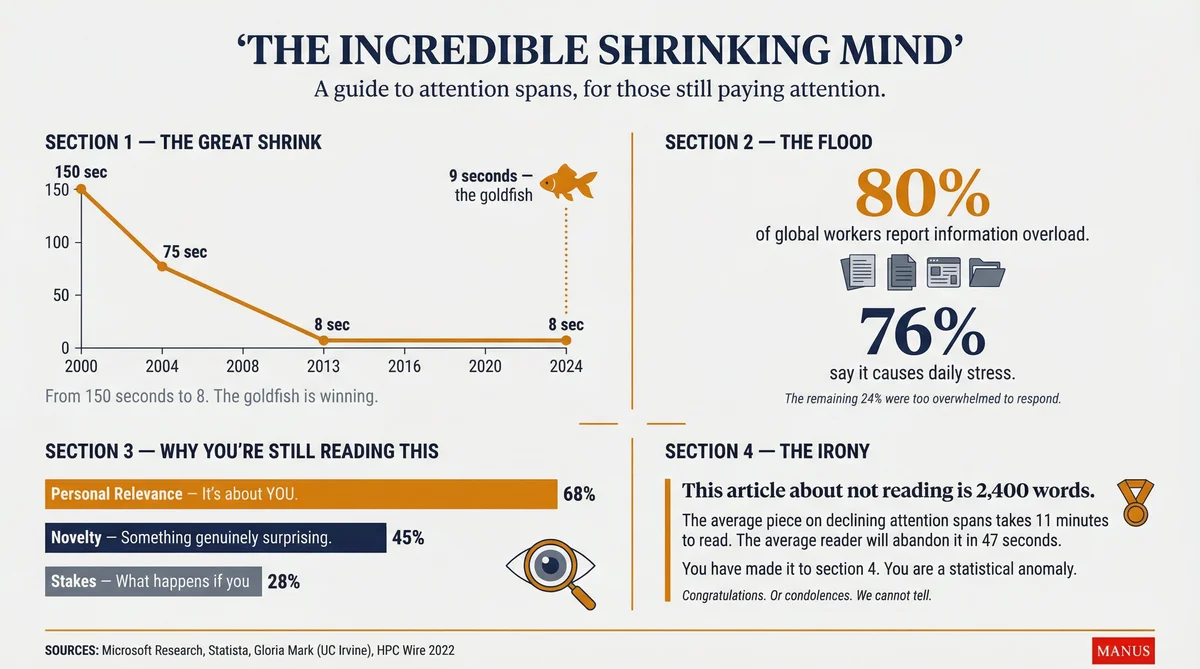
Every second, our digital ecosystem processes an extraordinary volume of content. 6,000 tweets, 272 TikTok videos, and t...
Read ArticleThe attention economy is the market in which consumer attention is the binding resource — scarce, increasingly fragmented, and increasingly expensive to capture. Every brand, platform, and content producer competes for the same shrinking blocks of attention, which is why average click-through rates and recall scores have steadily declined over the past decade.
Three structural reasons: the proliferation of platforms (each demanding their own engagement), algorithmic feed design (optimised for short-form retention), and the post-COVID normalisation of multitasking media consumption. The cumulative effect is that an average viewer's effective attention per piece of content is at an all-time low.
Self-reported attention measurement is corrupted by social desirability bias — respondents say they read more than they did, watched longer than they watched, paid more attention than they paid. Synthetic research and behavioural data triangulate better: synthetic personas don't lie about attention, and behavioural data (scroll depth, dwell time) is harder to game.
The interventions that consistently move attention metrics, by FishDog's research: specificity (concrete examples beat abstract claims), surprise (unexpected angles get longer dwell), brevity (shorter pieces have higher completion rates), and identity-relevant framing ("this matters to people like you"). The articles in this collection cover each in detail.