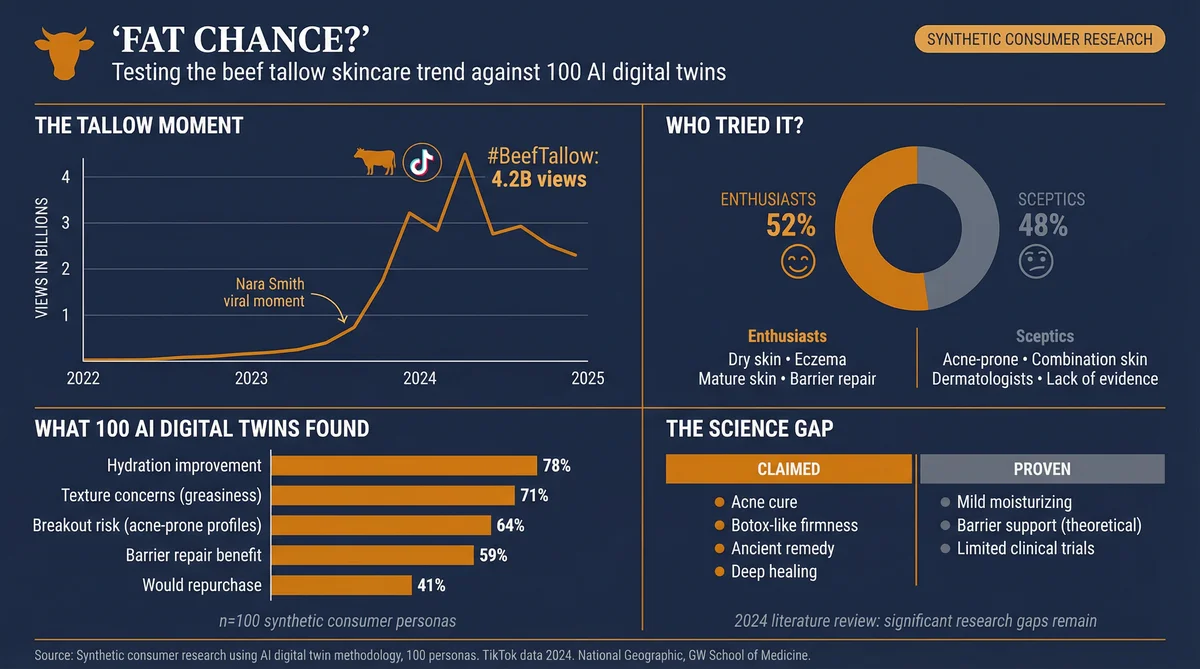
Testing the 'Tallow Takeover' Trend Against 100 Digital Twins
You've seen it everywhere: beef tallow is the cooking fat of 2026. Whole Foods called it. Food media amplified it. Socia...
Read ArticleTag: Trend Testing
Consumer trend reports are perhaps the most over-bought, under-questioned product in market research. WGSN, Mintel, Trendwatching, and a dozen smaller agencies sell five-figure reports claiming to forecast the trends that will define the next 12-24 months. Brands buy them, file them, occasionally cite them in slide decks, and rarely ever check whether the trends actually materialised. The articles below run those trends past synthetic personas to see which ones hold up under scrutiny.
Each trend test in this collection takes a published trend claim, designs a synthetic study to test it against an ICP-matched panel of 100+ digital twins, and reports what the panel actually thinks. The studies are deliberately low-cost and quick to replicate, so any trend report your brand has bought can be stress-tested in an afternoon. Some trends survive the test. Some spectacularly do not.
What you'll find
Stress-test your trend report at fish.dog
You've seen it everywhere: beef tallow is the cooking fat of 2026. Whole Foods called it. Food media amplified it. Socia...
Read Article
A Hilton trend report predicts that in 2026, travelers will "seek out the familiar as they explore new places to gain a ...
Read Article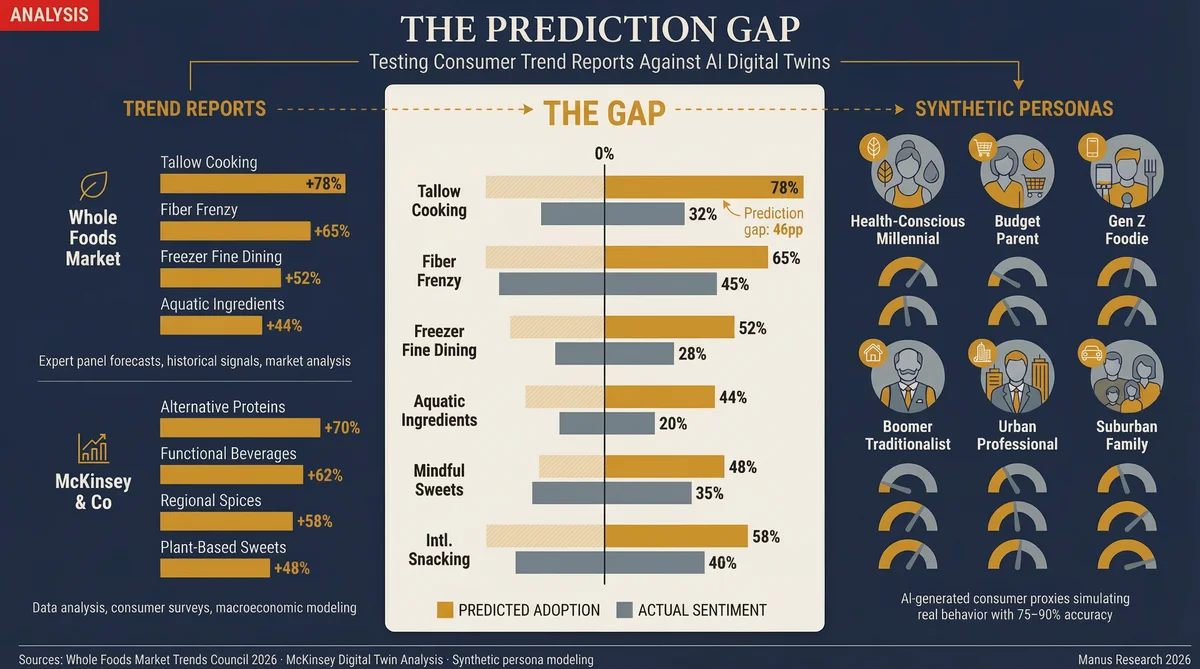
Each fall and winter, many retailers and analysts publish smart forecasts about what we will eat and why, in the coming ...
Read ArticleTrend testing is running a published consumer trend forecast — typically from agencies such as WGSN, Mintel, or Trendwatching — through a synthetic persona panel to see whether the trend's predictions are supported by actual preferences and purchase intent. It is a fast, cheap way to stress-test the five-figure trend reports brands routinely buy.
Mixed. Some trend reports correctly identify directional shifts that play out as forecast. Others are confidently wrong. The challenge is that buyers rarely audit their reports against subsequent reality, so the accuracy distribution is opaque. Trend testing with synthetic research gives a fast, cheap calibration without waiting 18 months for the trend to play out.
Define the trend's specific behavioural prediction ("more consumers will choose X over Y"). Design a synthetic study with persona panels matched to the trend's claimed audience. Ask the prediction directly, plus a couple of validation questions to surface inconsistencies. Compare the panel's response to the trend's claim. The methodology article in this collection covers the protocol.
Yes. The trend tests in this collection are explicitly designed to be replicable by any team in 30-60 minutes against their own ICP. If you've bought a trend report and want to know which of its claims survive scrutiny before betting marketing budget on them, this is exactly the use case.